
Balding Test for Men: Hairline, Crown, and Density Self-Check
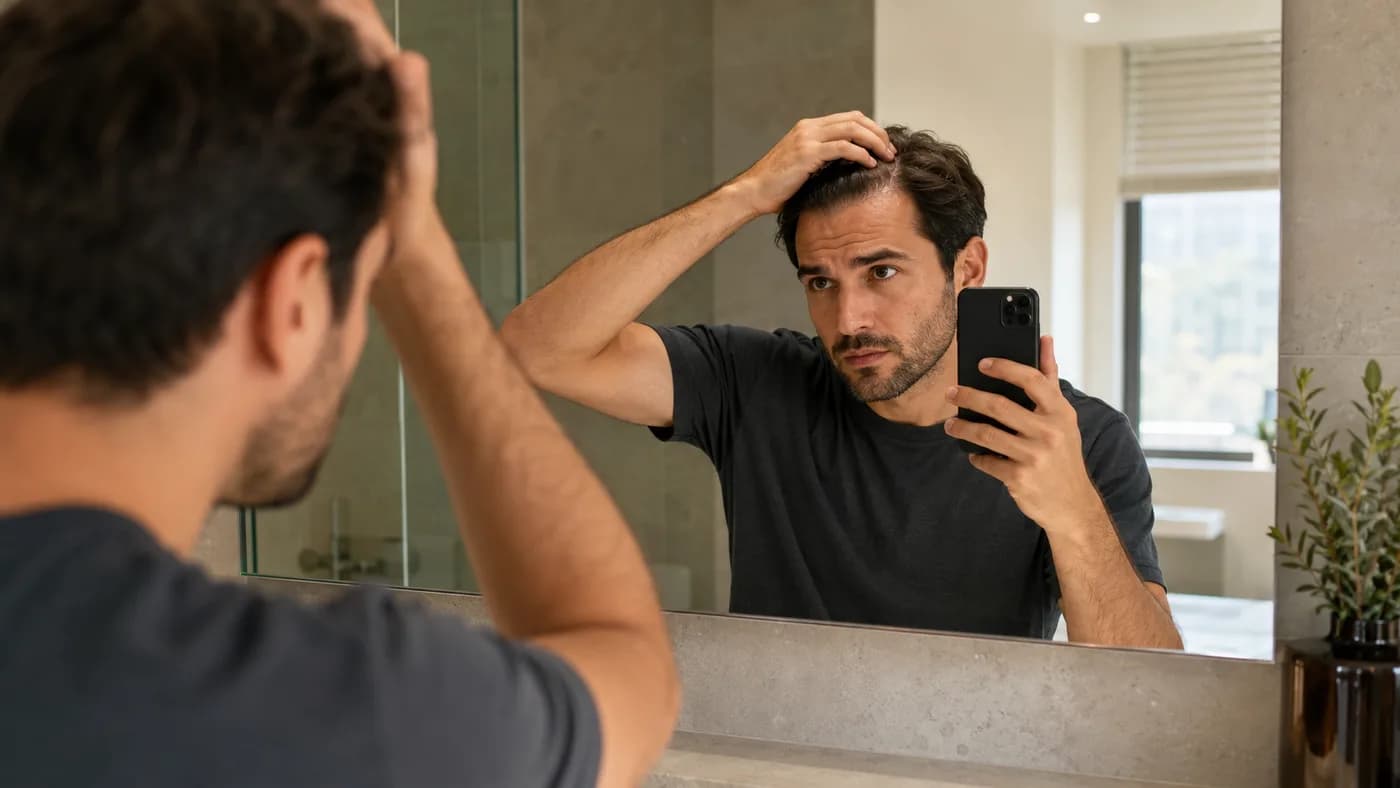
If you are searching for a balding test, you usually want a calmer answer than the internet gives you.
You do not need another panic spiral. You need a way to check whether what you are seeing is a real pattern: hairline recession, temple change, crown thinning, density loss, or just one bad mirror photo.
The short answer is this: a useful balding test for men checks the hairline, crown, overall density, shedding context, and older photos together, then scores the result by pattern over time.
Quick read
Wet hair, bright overhead light, and short-term stress can make your hair look worse than it really is.
Real male pattern hair loss usually repeats across time, angles, and conditions instead of showing up only in one bad moment.
A stable result means monitor, a borderline result means track better, and a clear result may justify a dermatologist visit or shorter style plan.
Quick answer: how to do a balding test
Use this five-part self-check:
- Compare your current hairline with older photos.
- Check the crown in bright but fair lighting.
- Judge density on top versus the sides.
- Treat shedding as a clue, not a diagnosis.
- Ask whether the change is gradual and repeatable.
The Cleveland Clinic says male pattern baldness commonly shows up as temple recession, a receding hairline, or thinning at the crown. Mayo Clinic says the most common hair-loss pattern is gradual thinning on top of the head, and in men it often begins at the forehead hairline or top of the head. The key word in both is gradual. That is why a useful test looks for progression instead of reacting to one stressful angle.
A balding test should lower uncertainty
If your current method is checking your front camera ten times a day, that is not a test. It is an anxiety loop. A real test uses repeatable conditions.
Part 1: check the hairline and temples
For many men, the first signs show up at the front.
Look for:
- deeper corners than you had 6 to 12 months ago,
- a stronger M shape,
- more forehead exposure than before,
- weaker density right behind the front edge,
- or a style that only looks good when positioned carefully.
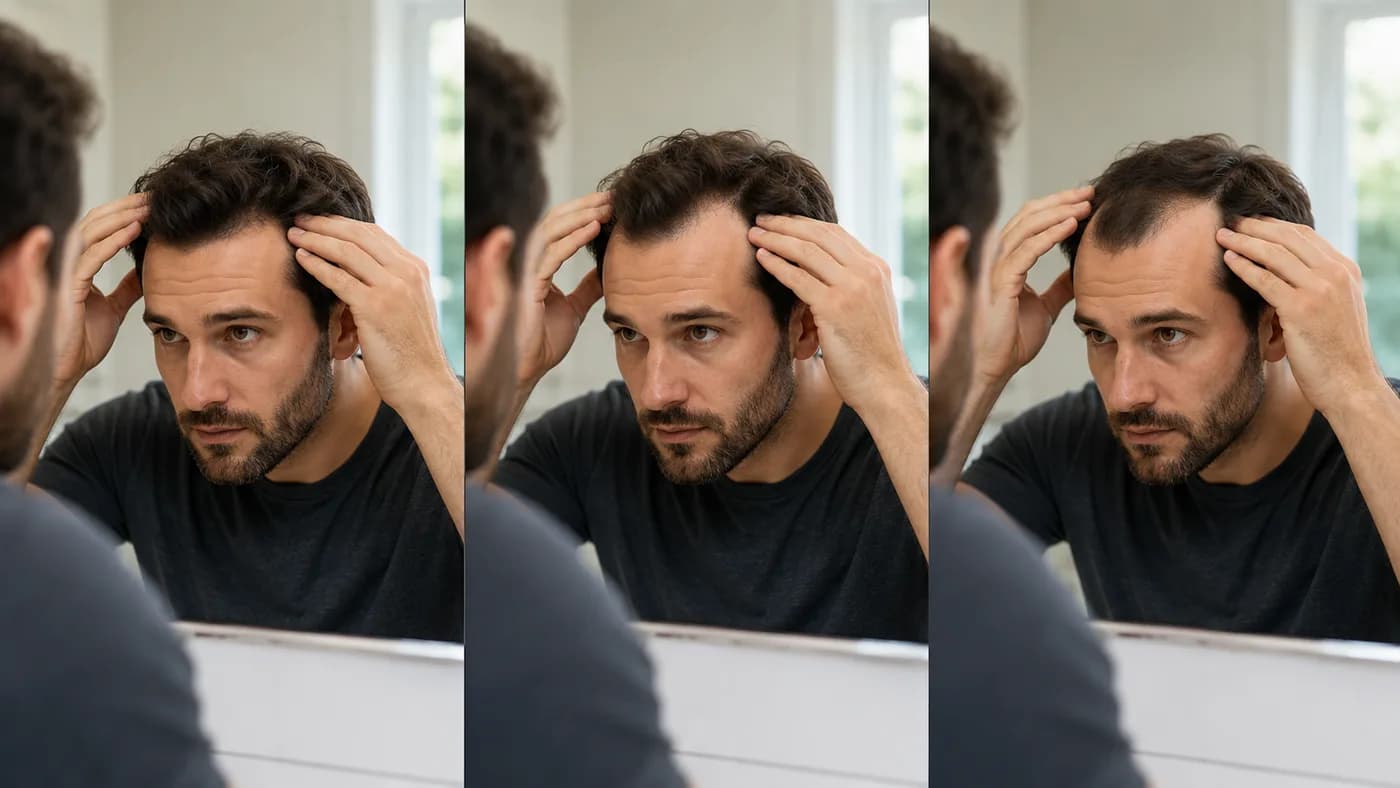
Hairlines can mature a little without turning into obvious male pattern baldness. The difference is whether the change keeps moving.
The Cleveland Clinic notes that the Hamilton-Norwood pattern often starts with slight recession near the temples, then becomes deeper around the front. That does not mean every uneven temple is a problem. It means the temples are one of the best places to monitor honestly.
If this is the area confusing you most, read Hairline Test: Is Your Hairline Mature or Receding? after this article. That guide goes deeper on front-only interpretation.
Part 2: check the crown without fooling yourself
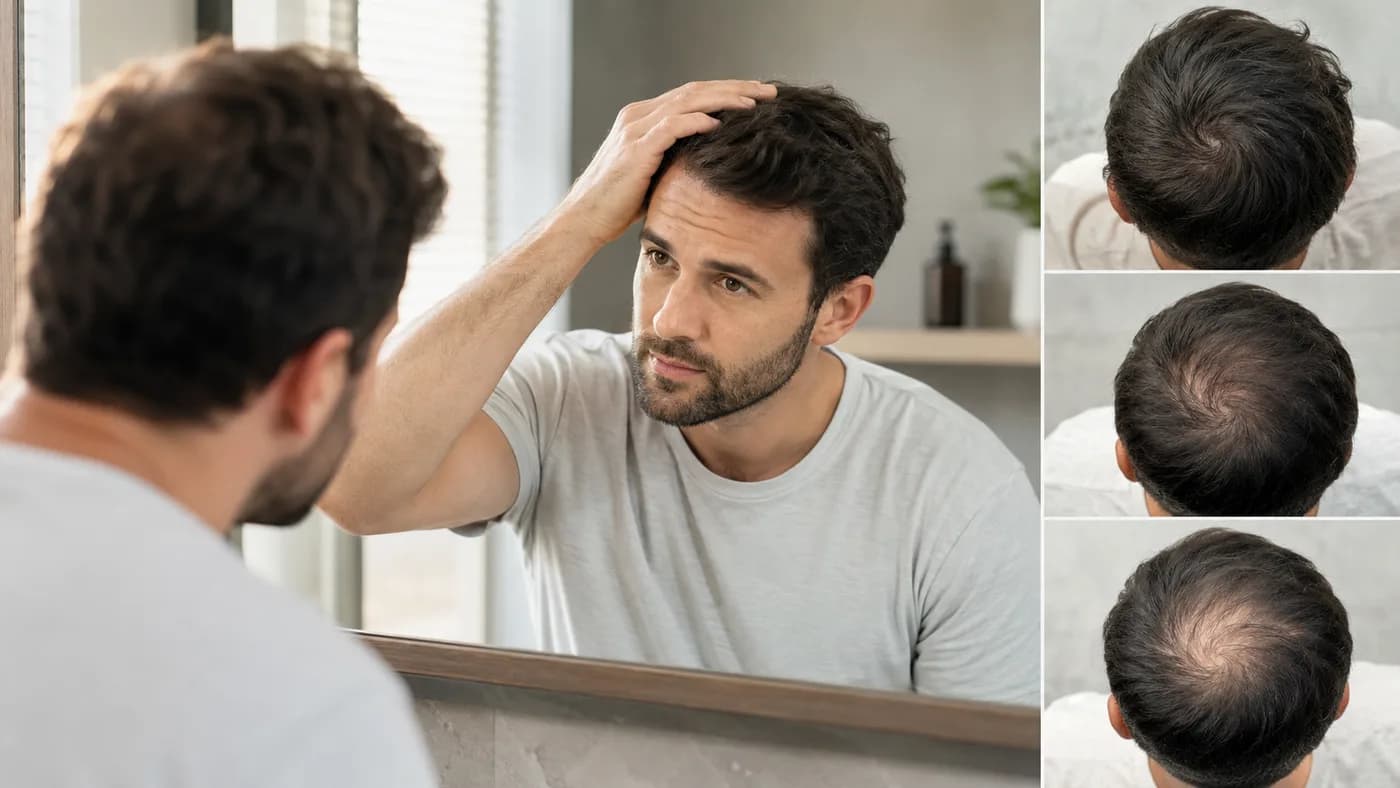
The crown is where many men either miss real thinning or overreact to a normal cowlick.
The crown check should answer one question: is the visible scalp there stable, or is it clearly getting larger over time?
Signs that the crown may deserve attention:
- the thin-looking area is wider than it used to be,
- more scalp shows in normal light, not just harsh bathroom light,
- the surrounding hair looks finer than before,
- barbers or photos notice it before you do,
- the front and crown both seem to be changing together.
Mayo Clinic notes that hair loss can appear in different ways depending on the cause, while Cleveland Clinic specifically calls out crown thinning as a common male-pattern sign. That is why you should not judge the front in isolation.
If crown loss is your main concern, the better follow-up reads are Hair Thinning at Crown, Crown Balding vs Normal, and Crown Balding Stages.
Part 3: compare density on top versus the sides
Many men are not dealing with one obvious bald spot. They are dealing with a top section that feels weaker overall.
That is where density becomes more useful than shape.
Check whether:
- the top looks more see-through than the sides,
- your part or natural separation is wider,
- styling product creates more visible gaps than before,
- the hair on top feels finer in your hands,
- or short light from above exposes a wider area than expected.
Diffuse thinning is harder to spot because the hairline may still look mostly intact. The problem is not a dramatic line change. It is lower support across the top. If that sounds familiar, Am I Balding? and Receding Hairline vs Balding are useful companion reads.
Part 4: use shedding the right way
Shower-drain panic is common, but shedding is only one data point.
Mayo Clinic notes that sudden loosening of hair can happen after physical or emotional stress and can cause temporary overall thinning. The NHS also says some hair loss is temporary and may be related to illness, stress, weight loss, or iron deficiency.
That means this part of the balding test is simple:
- If shedding is high but there is no visible pattern, do not jump straight to male pattern baldness.
- If shedding comes with temple recession, crown change, or lower top density, take it more seriously.
- If the loss feels sudden, patchy, itchy, painful, or inflamed, stop self-diagnosing and get medical input.
This is one area where being cautious matters. Not all hair loss is the standard slow hereditary pattern.
Part 5: use family history as context, not proof
Family pattern matters, but it is not a verdict.
If your father, brothers, uncles, or grandfathers developed similar front or crown loss early, that can make borderline signs more believable. If no one in the family has obvious hair loss, it does not guarantee you are safe. It only changes the context.
Think of family history as a tie-breaker, not the whole test.
Scoring your balding test
Use this simple score:
| Score | What it usually means | Best next move |
|---|---|---|
| 0 to 2 signs | Mostly stable. Maybe a mature hairline, a normal cowlick, or temporary stress. | Monitor with monthly photos. |
| 3 to 4 signs | Borderline. Something may be changing, but the evidence is not clean yet. | Improve your photo tracking, read the pattern-specific guides, and compare shorter style options. |
| 5+ signs | Likely progression. Hairline, crown, density, and photos are telling the same story. | Consider a dermatologist, evidence-based treatment discussion, and a more deliberate haircut plan. |
What to do after the test
Your result should lead to action, not more spiraling.
If your result looks stable
Keep monthly photos, do not over-check daily, and avoid making a permanent haircut decision from fear alone.
If your result is borderline
This is where many men get stuck. The better move is to:
- take fair front, side, and crown photos once a month,
- shorten the haircut enough to reduce false signals,
- compare how a buzzed or shaved look might change the overall balance.
This is where BaldLooks can actually help. BaldLooks Free Analysis gives you a practical read from one photo, and the paid plans become useful when you want to compare a shaved head from multiple angles, outfits, and locations rather than guessing from one selfie.
If your result looks clearly progressive
If preserving hair matters to you, act early. Mayo Clinic says to talk with your doctor about the cause of hair loss and treatment options before pursuing treatment on your own, and the NHS says to see a GP if you are worried about hair loss. That is the most grounded route if you want clarity or treatment discussion.
If your current hair already looks more stressful than helpful, it may also be time to compare a buzz or shaved head with the reality of keeping it.
For haircut direction, Buzz Cut for Hair Loss, Buzz Cut vs Bald, and Should I Shave My Head? are the best next reads.
When a balding test is not enough
There are situations where self-checks stop being useful.
See a clinician if:
- the loss is sudden rather than gradual,
- the scalp is painful, itchy, inflamed, or scaling,
- the hair loss is patchy,
- the shedding feels dramatic and new,
- or the situation is causing real distress.
Mayo Clinic specifically flags patchy loss, sudden loosening, and scaling as different patterns that can point beyond standard hereditary balding. The NHS also says to see a GP if you are worried about hair loss. That is not alarmist. It is just a better use of uncertainty than endless self-diagnosis.
Do not confuse early action with overreacting
Acting early does not mean shaving immediately. It means getting better evidence, considering treatment sooner if you care about keeping hair, and making style decisions before your options feel forced.
Final answer: the best balding test is a pattern test
The most useful balding test for men is not one dramatic photo. It is a pattern test:
- hairline and temples,
- crown,
- density on top,
- shedding context,
- and older photos in similar conditions.
If several of those signs point the same way, the answer gets clearer. If they do not, your next job is better tracking, not more panic.
Once the result is clear, the path usually is too: monitor, talk to a dermatologist, clean up the haircut, or compare buzzed and shaved options before making the real move.