
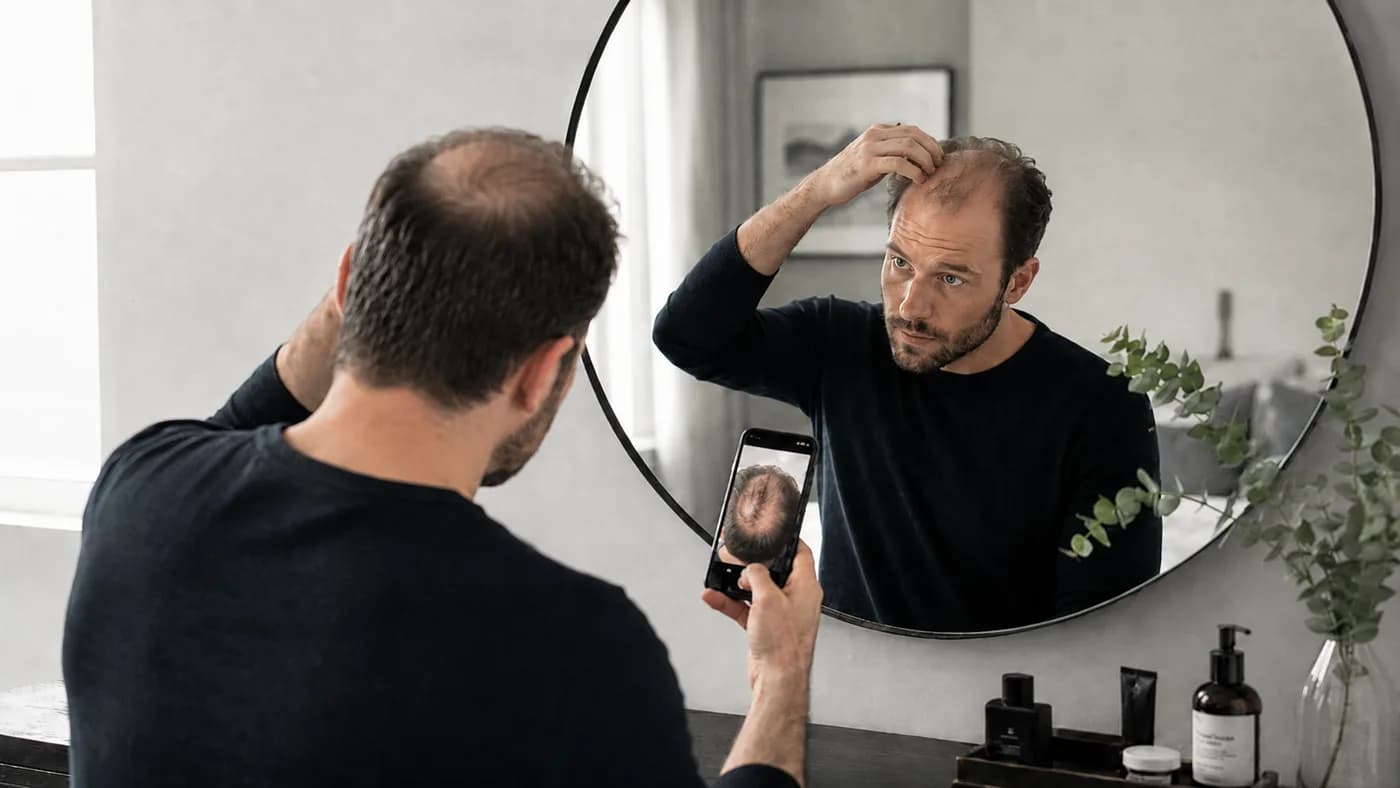
If you are worried about hair thinning at crown level, you are probably stuck in a frustrating grooming loop: sometimes your crown looks normal, and other times one photo makes it seem like you are already going bald.
That confusion is common because the crown is harder to read than the front hairline. It has a swirl pattern, catches light easily, and is usually seen only in mirrors or top-down phone photos.
The short answer is this: a thinning crown becomes more concerning when scalp visibility shows up repeatedly over time and spreads beyond the natural center of the whorl, not when it only appears in one bad lighting moment.
Quick read
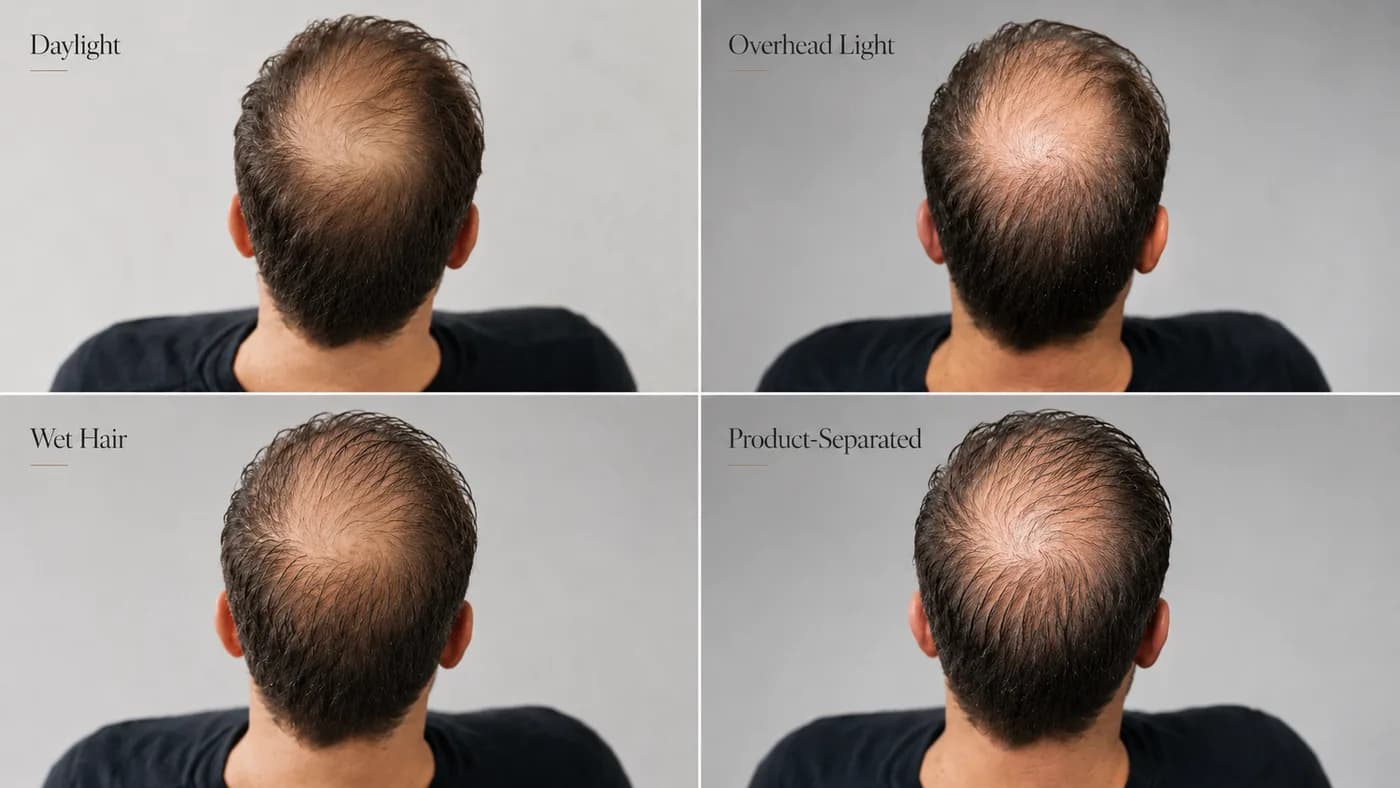
Wet hair, flash, overhead light, and a top-down angle can all make a healthy crown look thinner than it is.
A normal crown usually stays centered and stable, while early thinning often expands around the swirl and reduces nearby density.
Monthly comparison photos tell you far more than daily mirror checks because real thinning usually shows a pattern over time.
Quick answer: when to take crown thinning seriously
You should take a thinning crown more seriously when:
- the visible scalp area looks larger than it used to,
- the area shows up in normal daylight, not only under harsh overhead light,
- the hair around the crown looks weaker, finer, or flatter than before,
- repeat photos taken weeks or months apart show the same change,
- the sides still look dense while the crown and top look more see-through.
The Mayo Clinic notes that hereditary hair loss often develops gradually and in predictable patterns, including thinning on the top of the head. The Cleveland Clinic also lists thinning on the top of the head among common signs of male pattern baldness.
This guide focuses on tracking an early thinning pattern and choosing the next step. If your main question is whether a single visible swirl is normal, start with Normal Crown vs Balding Crown.
Why the crown is so easy to misread
The crown is not a flat surface. It is usually built around a natural whorl, also called a cowlick, where the hair changes direction in a spiral. That swirl alone can expose a little scalp even on a healthy head of hair.
The crown also reacts strongly to conditions that distort how dense hair looks:
- bright bathroom light from above,
- camera flash,
- wet or sweaty hair,
- heavy product that separates strands,
- longer hair that starts splitting around the swirl,
- top-down photos taken too close to the scalp.
That is why the same crown can look normal one day and alarming the next. Usually the truth is slower and less dramatic, and the only reliable way to judge it is repeated comparison.
Normal crown vs thinning crown: what actually changes
The cleanest way to think about balding crown vs normal is this: a normal crown may expose a small center point, but early thinning changes the area around that point too.
| Sign | More likely normal crown | More likely early thinning |
|---|---|---|
| Shape | Scalp visibility stays centered at the whorl | Visible area spreads beyond the center |
| Consistency | Looks similar across months | Looks more obvious over time |
| Density nearby | Surrounding hair still looks full | Hair around the crown looks weaker or flatter |
| Lighting sensitivity | Mostly appears under harsh light | Starts appearing in ordinary light too |
| Haircut effect | Changes a little with length | Often looks more obvious after certain cuts |
This is why comparing a hair whorl vs balding pattern matters more than asking whether you can see any scalp at all.
Crown whorl vs thinning: the safest way to judge it
If you are trying to separate a crown whorl vs thinning pattern, use the lowest-drama method possible.
1. Take monthly photos, not daily photos
Daily checks encourage overanalysis. Monthly photos give you enough space to notice real change without reacting to every haircut, shower, or light source.
Try to keep these details consistent:
- same room,
- similar time of day,
- dry hair,
- no heavy product,
- same camera height and distance,
- one top-down photo and one slightly rear-angle photo.
2. Look for expansion, not just visibility
A normal crown can remain visible for years without changing much. What matters more is whether the visible area is:
- wider than before,
- more diffuse around the edges,
- easier to notice in ordinary conditions,
- paired with lower density across the top.
3. Compare the crown with the rest of the top
If the top overall is getting flatter or more transparent while the sides stay strong, the crown may simply be where you noticed the change first.
If you need the broader self-check, Am I Balding? covers hairline, temples, crown, and diffuse thinning together.
Why hair length can make the crown look better or worse
Hair length changes the crown more than many men expect.
Longer hair can sometimes hide mild thinning from straight-on views, but it can also split around the whorl and create a more obvious see-through area from above. Shorter hair removes some of that separation.
That does not mean shorter is always better. It means the crown is heavily influenced by contrast.
In practical terms, very early thinning may still look fine with normal short hair, moderate thinning often looks cleaner with a shorter cut, and advanced thinning often pushes the decision toward a buzz cut or shaved head.
If your question has already moved from diagnosis to haircut choice, Buzz Cut for Balding Crown is the more specific next step.
Do not use wet-hair evidence as your final answer
Wet hair, product-heavy hair, and close phone angles are useful clues, but they are not reliable enough to tell you on their own whether your crown is truly thinning.
Common reasons the crown looks thin even when it may be normal
The usual reasons are simple: harsh overhead light, wet or sweaty hair, product-separated strands, longer hair splitting around the whorl, and top-down phone photos taken too close.
Signs your crown may be moving from normal to early balding
There is a point where a balding crown becomes more than a lighting issue. Usually that happens when several smaller clues start lining up.
If multiple points on that list are true, the next move is better monitoring, a more honest haircut evaluation, and professional advice if you want medical guidance.
What to do if your crown really is thinning
Once the crown seems to be changing consistently, the practical next steps are simple: monitor it properly for a few months, try a shorter haircut if you want a style-based test, and speak with a qualified dermatologist or healthcare professional if the loss feels persistent, sudden, or otherwise medically concerning. The American Academy of Dermatology emphasizes getting the cause right before deciding on treatment, especially when hair loss is sudden, patchy, or otherwise atypical.
If you are mainly trying to decide how the change affects your look, BaldLooks can help from a styling perspective without pretending to diagnose hair loss. The free analysis gives you a quick read from one photo, and paid plans help when you want more angles before making a visible change.

Final answer: hair thinning at crown level is about repeat patterns
If you can see some scalp at the crown, that alone does not prove early balding. A normal whorl, harsh light, wet hair, and longer hair length can all create the same scare.
The more useful question is whether the crown is changing in a repeatable way.
If it looks stable, centered, and mostly sensitive to lighting, it may be normal. If the visible area is expanding, the nearby density is weakening, and the pattern keeps showing up over time, it is more likely that early thinning is starting.
That is the point where honest tracking beats guessing. And if you are already wondering whether shorter hair or a shaved head would look cleaner, it is worth previewing the style decision separately from the medical question.
For the next step, read Crown Balding if you want the broader progression, or Buzz Cut vs Bald if your real question is how to make the crown look better right now.