
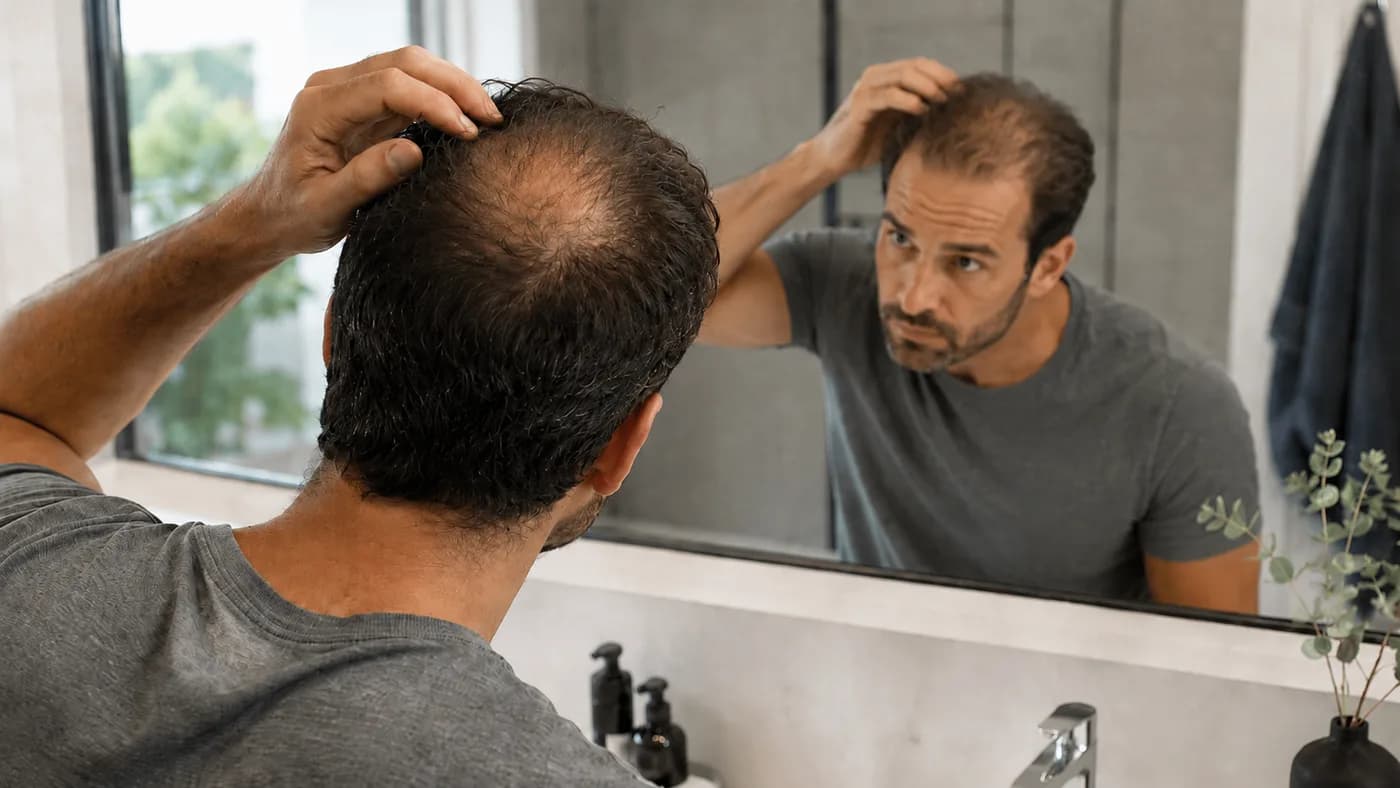
If you are comparing a balding crown vs normal crown, you are probably dealing with the most frustrating part of early hair-loss anxiety: the crown can look perfectly fine one day and alarming the next.
That happens because the crown is naturally deceptive. It has a swirl pattern, it catches overhead light hard, and it often looks worse in phone photos than it does in real life.
The short answer is this: a normal crown can show some scalp in the center, but a balding crown usually looks more see-through around the swirl, shows up repeatedly over time, and becomes easier to notice in ordinary conditions, not only in one bad photo.
Quick read
A crown whorl often exposes a little scalp even when density is still healthy.
Early thinning usually makes the hair around the crown look weaker, flatter, or more transparent over time.
Monthly photos in consistent light are far more useful than daily mirror checks or one flash photo.
Quick answer: normal crown vs balding crown
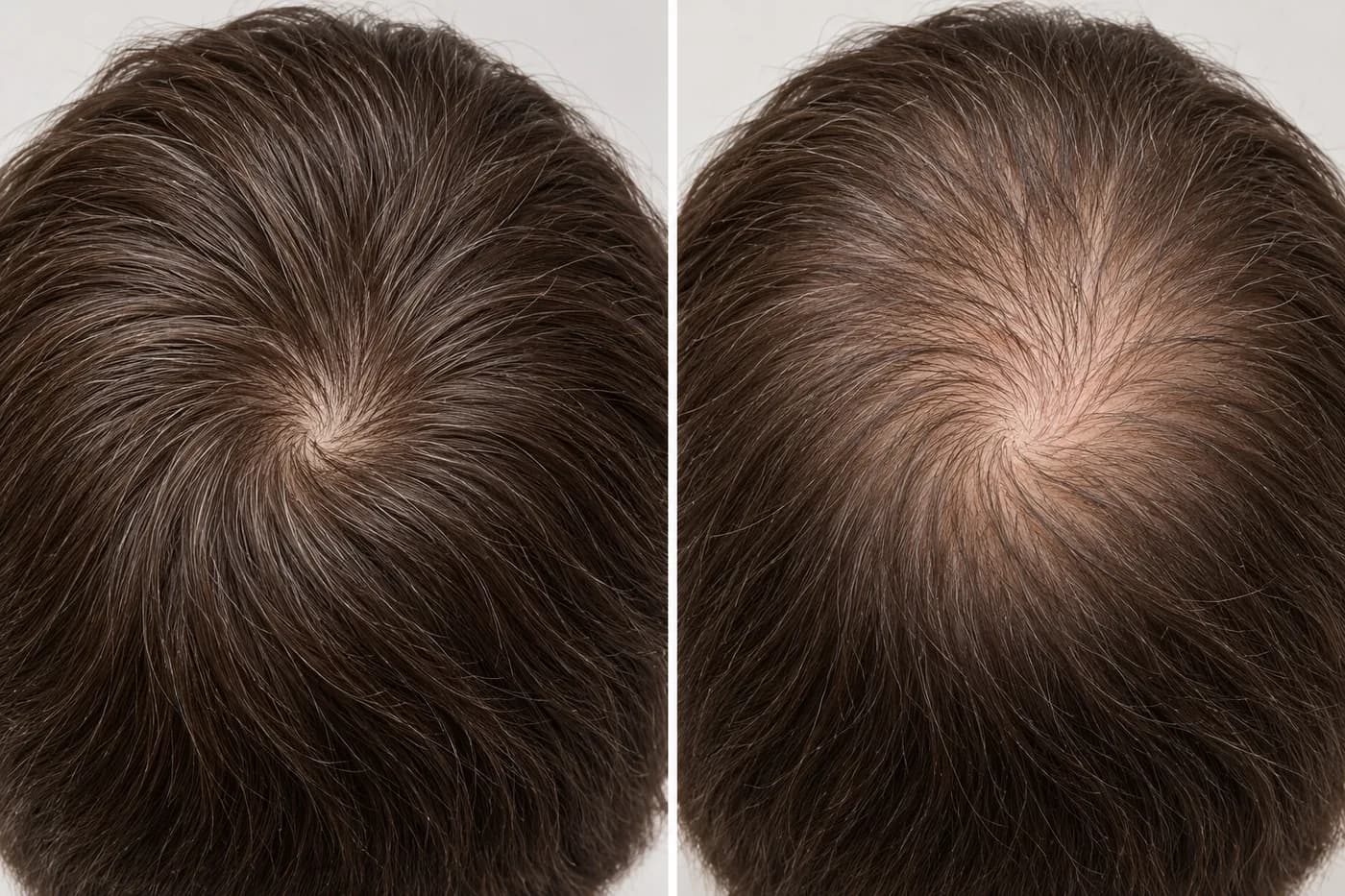
The simplest way to compare a normal hair crown with a thinning one is to ask whether you are seeing a stable shape or a changing pattern.
| Sign | More likely normal crown | More likely balding crown |
|---|---|---|
| Scalp visibility | Mostly centered at the swirl | Spreads beyond the center |
| Density around the crown | Hair nearby still looks even | Nearby hair looks finer, flatter, or more see-through |
| Timing | Looks similar month to month | Looks more obvious over time |
| Lighting | Mainly shows in harsh overhead light or flash | Starts showing in ordinary daylight too |
| Haircut effect | Length changes how much scalp is visible | A shorter haircut cannot confirm hair loss |
That distinction is close to how established medical sources describe pattern hair loss. Cleveland Clinic notes that symptoms of male pattern baldness can include hair thinning or loss on the crown, while Mayo Clinic describes male-pattern loss as often starting at the hairline or top of the head and progressing gradually. Sources: Cleveland Clinic, Mayo Clinic.
Why a normal crown can still look thin
The crown usually has a natural growth pattern, often called a whorl or cowlick. Hair changes direction there, which means strands separate more easily than they do on flatter parts of the scalp. That alone can expose a small center point.
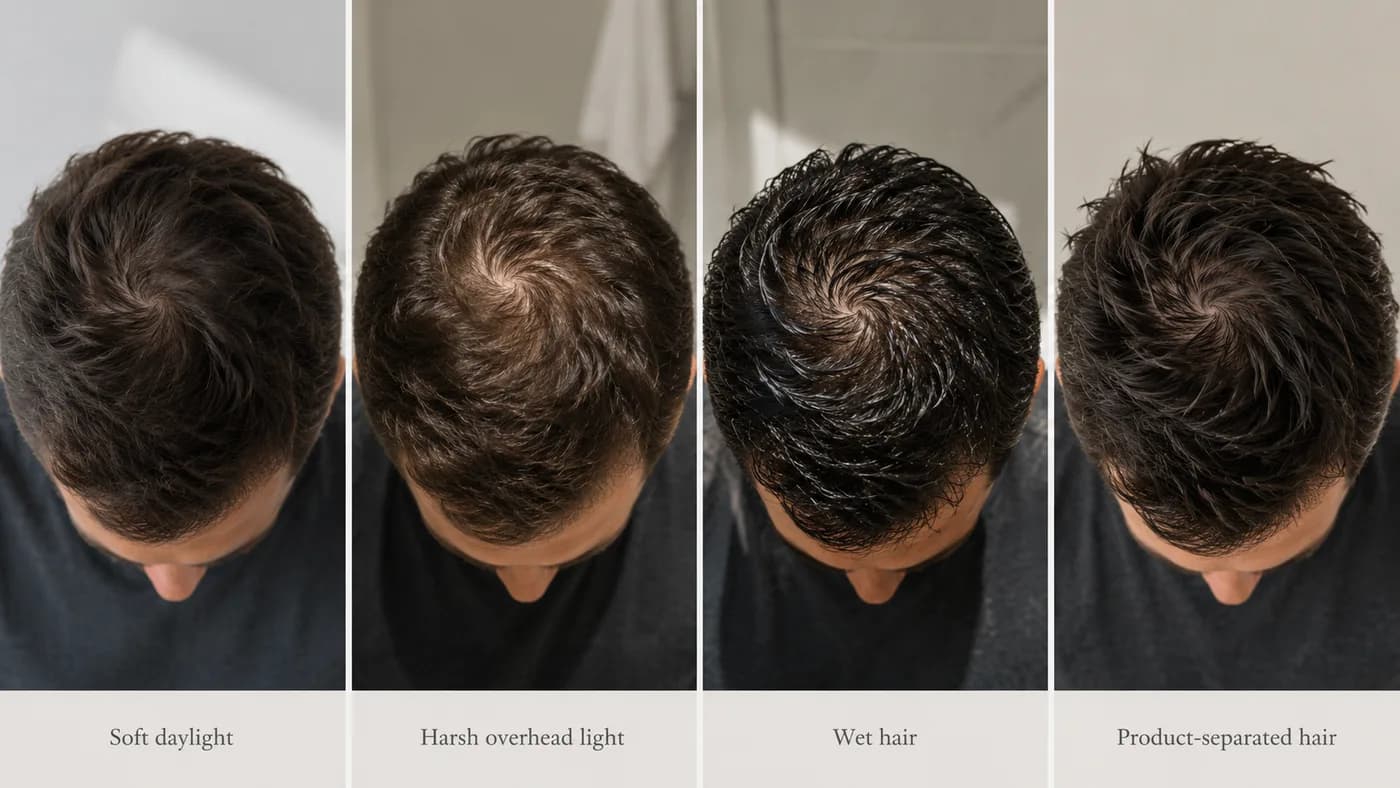
Then several visual factors make it look worse:
- bright overhead bathroom lighting,
- wet or sweaty hair,
- product that clumps strands together,
- longer hair splitting around the swirl,
- a top-down phone angle taken too close,
- flash photography that creates harsh scalp contrast.
This is why hair whorl vs balding is such a common confusion.
One dramatic crown photo is weak evidence
The crown is one of the easiest parts of the scalp to misread. A single top-down photo should start a monitoring process, not finish it.
The five strongest clues that it may be real crown thinning
Once you understand why a normal crown can look thin, the next step is looking for the signals that point more toward a balding crown vs normal pattern.
1. The visible area is getting wider
The most useful clue is expansion. A normal crown can stay visible for years without becoming meaningfully larger. Early thinning usually widens the visible zone around the swirl.
2. The hair around the swirl looks weaker too
In a normal crown, the center may be visible while the surrounding hair still looks dense. With thinning, the hair around the crown often starts looking flatter, finer, or less able to cover itself naturally.
3. It shows up in normal light
If you only notice the crown under brutal overhead light or after a shower, that is weaker evidence. If you notice it in soft daylight, ordinary indoor light, and repeat photos, the signal is stronger.
4. Shorter hair reveals the same pattern
Shorter hair can expose a normal whorl as well as a thinning area. Seeing the same shape after a haircut does not prove density loss. Compare photos at a similar length, angle, and lighting where possible; changing the haircut introduces another variable. A dermatologist can assess changes you cannot explain from photos alone.
5. The rest of the top is changing too
If the top overall looks less dense while the sides stay stronger, that can be a more meaningful sign than the crown alone.
If you want the broader check beyond the crown, Am I Balding? walks through recession, crown changes, and diffuse thinning together.
The safest way to photograph your crown
If your goal is accuracy rather than reassurance, you need a repeatable method.
The American Academy of Dermatology emphasizes that effective treatment starts with finding the cause of hair loss, and that a dermatologist evaluates history, the scalp itself, and sometimes additional testing when needed. That matters here because self-checking should help you notice a pattern, not convince yourself you have a diagnosis. Source: AAD.
Use this photo routine instead:
- Take photos once a month, not every day.
- Use dry hair with no heavy product.
- Stand in the same room with similar light each time.
- Take one straight top-down shot and one slight rear-angle shot.
- Keep camera distance similar so the crown is not exaggerated.
That process reduces panic from bad one-off angles and gives you a fair timeline if the crown is genuinely changing.
Crown whorl vs balding: what usually fools people
Most false alarms come from comparing wet-hair photos with dry-hair photos, judging the crown right after a haircut, using flash, or checking from inches away instead of normal distance. If this sounds familiar, Hair Thinning at Crown: Normal or Early Balding? is the calmer companion guide.
When to monitor, when to change the haircut, and when to ask a professional
The right next step depends on what kind of evidence you have.
| Situation | Useful next step |
|---|---|
| A visible whorl that looks similar in comparable photos | Keep a consistent photo record if you want to monitor it; a visible center alone does not establish hair loss. |
| A change that persists across comparable photos | Discuss it with a dermatologist if you are concerned or want to understand the cause. |
| Sudden, patchy, painful, or irritated scalp changes | Seek medical assessment rather than waiting for a photo timeline or trying a haircut test. |
This is general guidance, not a scored diagnostic checklist. The AAD explains how dermatologists investigate hair loss, including the history and a scalp examination.
A shorter haircut is an appearance choice, not a test for the cause of crown changes. You can seek advice without changing your hairstyle.
If the question has moved from diagnosis to appearance, Buzz Cut for Balding Crown is the next practical guide. If the crown is already part of a broader top-thinning pattern, Crown Balding gives the bigger progression picture.
What a preview can and cannot tell you
A photo-based preview cannot tell you whether you medically have androgenetic alopecia, telogen effluvium, or another cause of thinning. It also cannot replace a dermatologist if the loss is sudden, patchy, painful, or unusual.
What it can tell you is whether a shorter, buzzed, or shaved look may feel cleaner if your crown keeps bothering you. That is where BaldLooks fits best. The free analysis gives you a low-pressure first look, and paid plans help when you want more angles, outfits, and real-life context before making the change.

Final answer: look for patterns around the crown, not panic in the center
If you can see a little scalp at the crown, that is not enough on its own to say you are balding. A normal crown often has a visible center because the hair spirals there, and light or moisture can exaggerate that.
A balding crown becomes more likely when the area around the swirl is getting weaker, the visible zone is widening, the pattern keeps showing up in repeat photos, and the top overall is losing density relative to the sides.
That is why the best way to compare a balding crown vs normal crown is not to zoom in harder. It is to zoom out in time.
Track it monthly. Keep the photo conditions consistent. A haircut can change the appearance, but it cannot confirm a diagnosis. And if the pattern is genuinely progressing or you want medical advice, document it and speak with a qualified professional.