
Crown Balding Stages: From Early Thinning to Bald Spot

If you are searching for crown balding stages, you are usually trying to answer a very practical question: is this still early, or has the crown reached the point where I should change something?
That is the right question.
The crown is one of the hardest places to judge because it sits in a naturally tricky area. Lighting, wet hair, product buildup, and a normal crown swirl can all make the scalp look more visible than it really is. At the same time, male pattern hair loss often does begin or intensify around the crown, so you do not want to ignore a real pattern either.
The short answer is this: crown balding usually progresses from subtle repeat thinning, to a visible small spot, to a larger crown opening, and then to broader loss across the top. The useful move at each stage is different.
Quick read
Crown changes matter when they repeat across time and similar lighting, not when they appear once after a sweaty workout or a harsh overhead light.
There is no fixed timeline. Some men stay in an early stage for years, while others move faster depending on genetics and overall hair-loss pattern.
Early thinning often means monitor and tidy the haircut. Later stages are where buzz cuts, shaved heads, or treatment discussions become more relevant.
What doctors mean when crown balding starts to progress
The official medical term behind common male pattern baldness is androgenetic alopecia. The American Academy of Dermatology notes that male pattern baldness tends to develop slowly, often beginning as a receding hairline or a bald spot on the top of the head. The Mayo Clinic describes gradual thinning on top of the head as the most common presentation. Cleveland Clinic also notes that male pattern baldness may affect the crown, the hairline, or both.
That matters for this article because the crown rarely jumps from "fine" to "fully bald" overnight. It usually becomes clearer in stages:
- the swirl starts looking more see-through,
- scalp visibility repeats in normal photos,
- a small bald spot becomes obvious,
- the crown opens wider,
- the crown blends into broader thinning across the top.
This is an educational guide, not a diagnosis. If the loss is sudden, patchy, irritated, or unusual, the AAD guidance on diagnosis is clear that finding the cause matters before assuming it is routine male pattern loss.
Stage 1: Subtle crown thinning
This is the stage that makes men obsess over mirrors.
Your crown may still look mostly normal from eye level, but under brighter light or in top-down photos, the swirl starts looking a little lighter or more open than it used to. The key detail is change over time, not perfection in one snapshot.
Typical signs of stage 1:
- the crown looks thinner mainly in direct overhead light,
- wet hair or styling products separate the hair more easily,
- the center of the swirl looks brighter than before,
- the surrounding hair still seems fairly strong.
At this stage, the best move is usually not shaving. It is better tracking and a cleaner haircut.
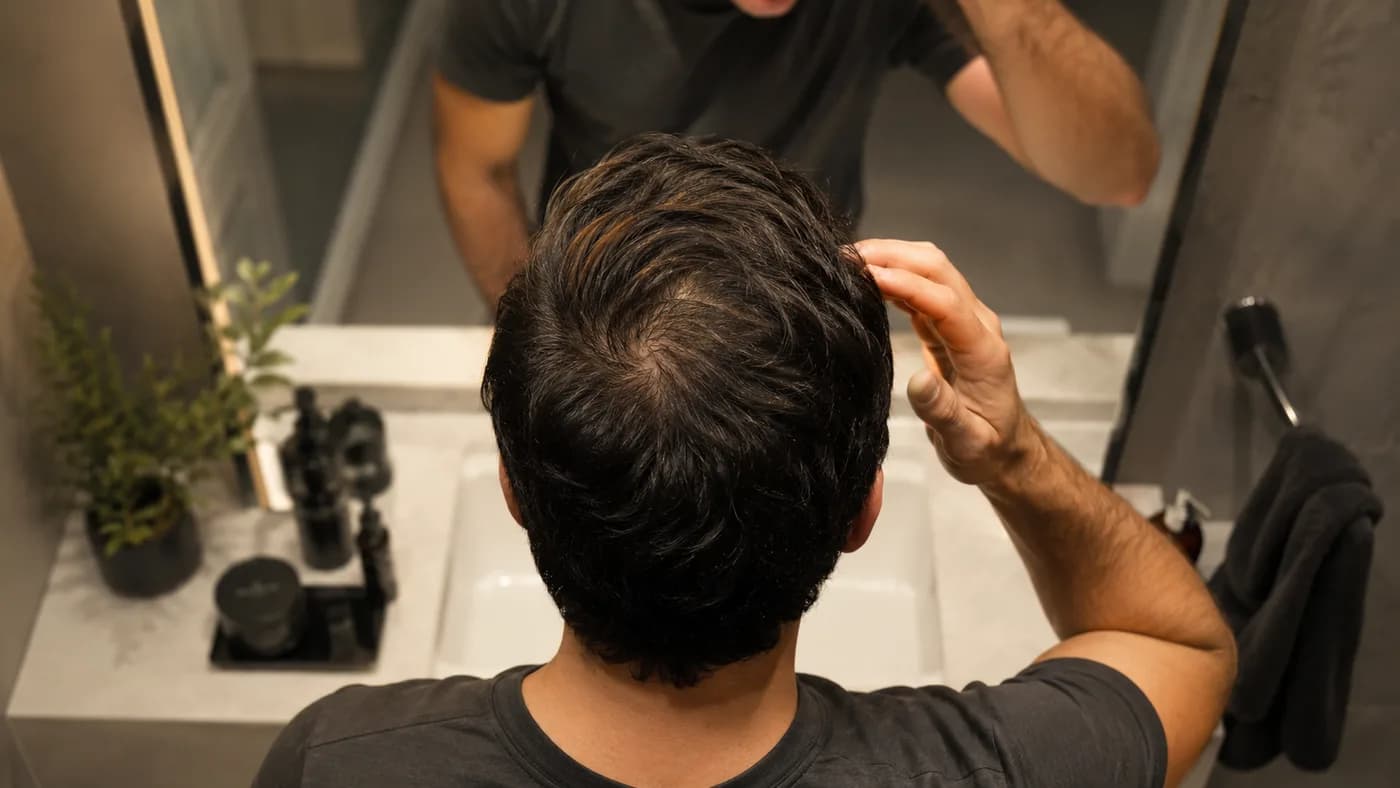
If you are still unsure whether what you see is normal, Hair Thinning at Crown and Balding Crown vs Normal Crown are the best companion reads before you make a style decision.
Stage 2: Repeat scalp visibility
This is the point where the crown starts showing up in more than one context.
The spot may still be small, but you notice it in daylight photos, security-camera angles, or after a haircut even when the hair is dry and clean. You may not have a distinct bald patch yet, but the crown is no longer only an occasional suspicion.
Typical signs of stage 2:
- the crown is visible in multiple recent photos,
- the surrounding hair feels less dense than it used to,
- longer hair is starting to split around the swirl,
- short hair makes the crown easier to judge, but not fully invisible.
At this stage, a shorter crop or conservative buzz cut often becomes worth testing. The reason is practical: shorter hair reduces separation and shows you whether the crown still looks intentional once the styling tricks are gone.
Stage 2 is usually the best time to get honest
If the crown keeps showing up, do not compare yourself to your hair from five years ago. Compare your current look to the cleanest realistic shorter option available now.
Stage 3: Small visible bald spot on the crown
This is the stage most men mean when they say, "I think I have a bald spot."
The crown is now easy to notice from above, and the center area does not look dense even when the hair is dry. You may still have decent coverage around it, but the spot itself keeps announcing the pattern.
Typical signs of stage 3:
- the crown spot is obvious in normal lighting,
- the visible area is wider than the original swirl,
- the top around the spot looks weaker too,
- haircuts are now chosen partly to hide the crown.
This is often the most frustrating stage because the hair is still present, but not convincing. That makes maintenance feel like work without much payoff.
For many men, this is where the decision starts shifting from "Can I hide it?" to "Would a very short buzz or shaved head look cleaner?" If that is your situation, Buzz Cut for Balding Crown goes deeper on guard lengths and when a buzz still works.

Stage 4: Expanding crown loss
At stage 4, the crown is no longer a small isolated problem.
The thin area gets larger, and the hair around it is usually weaker too. The contrast between the denser sides and the thinning top starts becoming more obvious. This is also where some men realize that each shorter haircut looks better than the one before it.
Typical signs of stage 4:
- the crown opening is clearly wider than a small spot,
- the top behind the hairline also looks thinner,
- styling no longer changes the overall impression much,
- the crown stays visible even after going quite short.
This is where a buzz cut becomes a real test rather than a theory. If a #1 or #0 buzz still leaves a distracting crown patch, a fully shaved head often looks more deliberate than preserving a little hair for its own sake.
Stage 5: Crown loss blending into broader top thinning
This is the stage where the crown is no longer the whole story. The top and crown begin reading as one larger thinning zone.
The visual issue is not just the spot itself. It is that the remaining hair on top may look sparse compared with the sides and back, which can make the whole upper scalp seem patchier.
Typical signs of stage 5:
- crown loss connects with general top thinning,
- short lengths still reveal a large see-through zone,
- the haircut looks thinner rather than simply shorter,
- fully shaved starts looking simpler and more intentional.
Not every man reaches this stage at the same speed, and not every man wants the same solution. But this is often where shaving stops feeling extreme and starts feeling practical.

How to tell whether your crown is getting worse
If you want a useful answer, make the comparison process boring and repeatable:
The AAD notes that early treatment often gives the best results for male pattern hair loss, which is why clarity matters. The point is not to rush into medication or shaving. The point is to stop guessing about what stage you are actually in.
What to do at each stage
Here is the simplest practical framework:
| Crown stage | Best next move | Why |
|---|---|---|
| Stage 1 | Monitor, improve photos, clean up the haircut | You need confidence that the pattern is real before making bigger changes |
| Stage 2 | Try shorter hair or a mild buzz | This reduces visual noise and reveals whether the crown still looks acceptable |
| Stage 3 | Compare buzz cut vs shaved head | The crown is now visible enough that honesty usually beats concealment |
| Stage 4 | Decide whether a very short buzz still works | If the spot remains obvious, fully shaved may read cleaner |
| Stage 5 | Strongly consider the shaved option or speak to a professional about treatment goals | Broad top loss often looks better simplified than stretched |
If you want a low-pressure way to compare those options, BaldLooks Free Analysis can give you a first read from one clear photo. If the crown is already pushing you toward a style change, the paid BaldLooks plans are more useful because they let you see the shaved look from more angles, with more context, before you commit.
Final answer: what the crown balding stages really tell you
The stages are not there to scare you. They are there to help you respond appropriately.
Early crown balding usually means monitor, shorten, and stay calm. A visible bald spot means stop pretending the crown is only a lighting issue. Expanding crown loss means decide whether your current haircut still improves the look or whether shorter, buzzed, or shaved now looks more intentional.
If you want the most useful mindset, judge the crown by repeat patterns, not isolated bad moments. Then choose the stage-appropriate move that makes your whole look cleaner and easier to live with.