
Receding Hairline vs Balding: What’s the Difference?
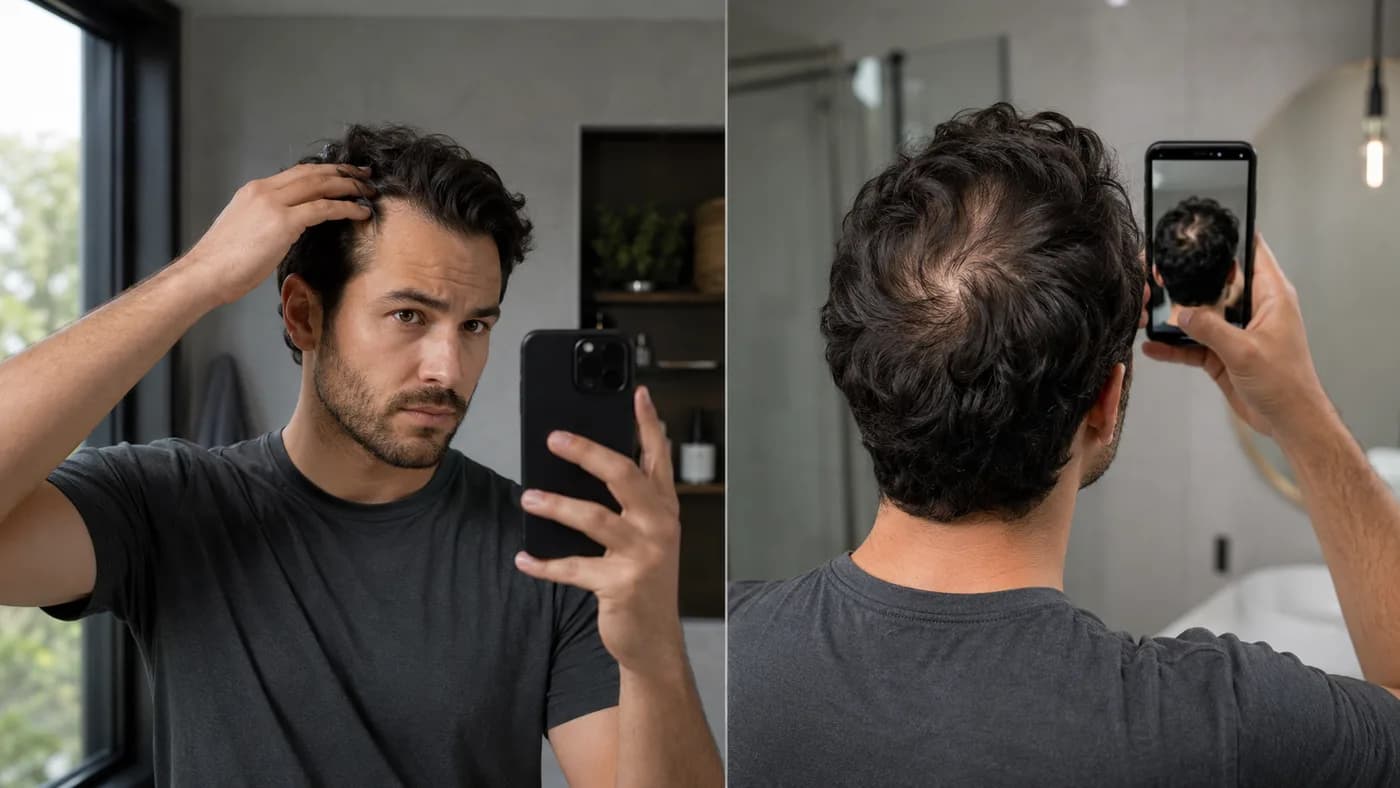
If you are searching for receding hairline vs balding, you are usually trying to solve one anxious question:
Is this just my hairline changing, or is this the start of a bigger pattern?
That is the right question, because a receding hairline and balding are related, but not identical. A receding hairline usually describes where change is happening first: the temples or front edge. Balding describes the larger process: ongoing hair loss that may include the temples, crown, top density, or diffuse thinning over time.
Quick read
The front edge matters, but crown visibility, top density, and progression over time matter just as much.
A stable higher hairline can be one thing. Temples that keep moving back while density gets weaker usually suggest more than simple maturation.
Consistent photos in similar light are far more useful than checking your hairline emotionally every day.
Quick answer: a receding hairline can be balding, but it is not the full definition
The American Academy of Dermatology says male pattern hair loss often begins as a receding hairline or a bald spot on the top of the head and usually develops slowly. The Cleveland Clinic similarly lists recession at the hairline, temple thinning, and crown loss as common signs. MedlinePlus Genetics describes the typical male pattern as beginning above both temples, forming an M shape, with thinning that can also appear at the crown.
That gives you the practical distinction:
- Receding hairline is usually a front-of-scalp description.
- Balding is usually the broader pattern description.
You are more likely dealing with a limited hairline change when:
- the temples moved back mildly and then mostly stabilized,
- density behind the front edge still looks strong,
- and the crown looks normal.
You are more likely dealing with broader balding when:
- the temples keep opening,
- the front edge looks finer or more transparent,
- the crown is changing too,
- or repeated photos show a clear trend.
Do not force this into a yes-or-no label too early
Many men try to decide from one bad mirror day. The better question is whether you are seeing an isolated hairline shift or a repeatable pattern of loss.
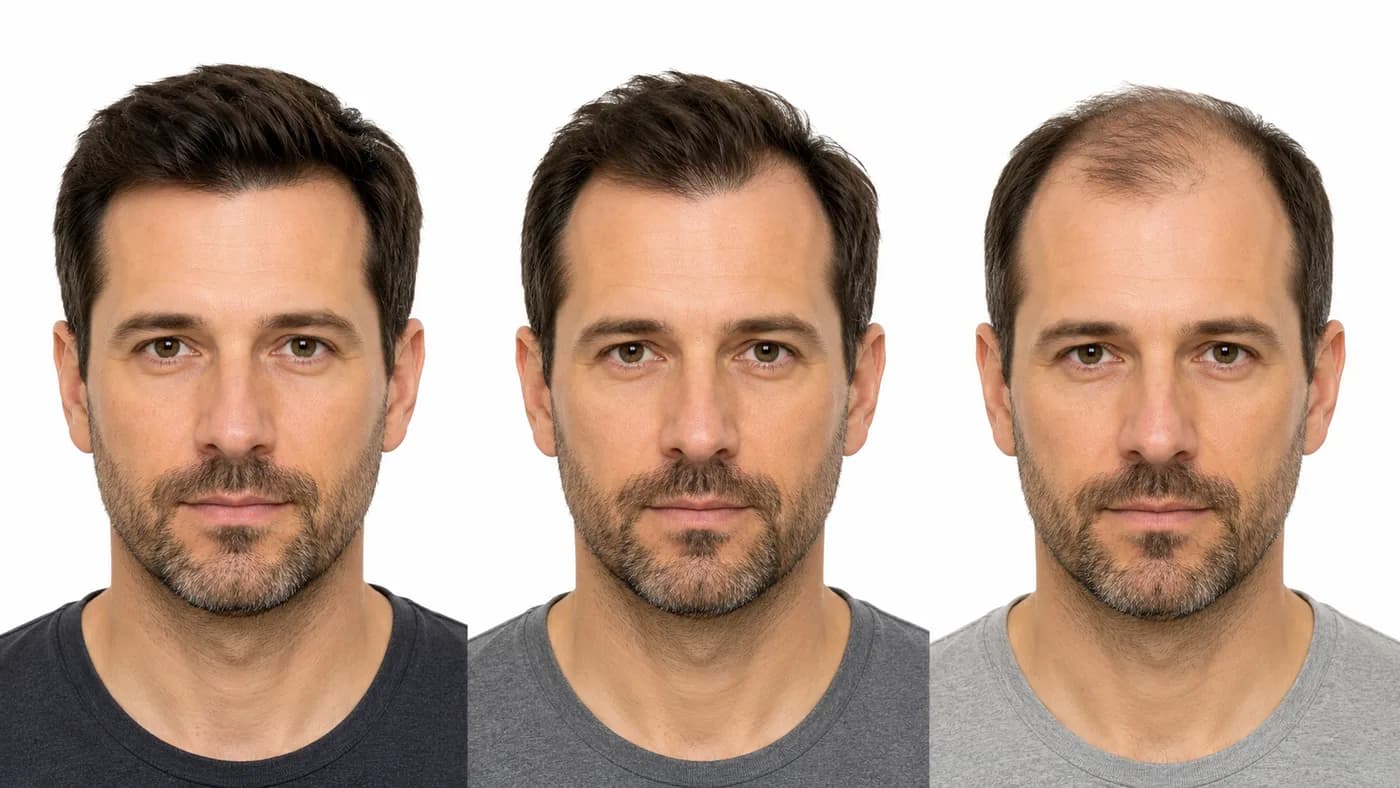
What balding usually adds beyond the hairline
When most men say they are "balding," they usually mean the pattern is no longer confined to a slightly higher front edge.
1. The temples keep deepening
A stable adult hairline can sit a little higher without becoming dramatic. Balding usually keeps pushing the corners farther back. The M shape becomes more obvious, or one temple starts looking clearly worse than the other.
2. The density behind the front edge gets weaker
This is one of the best clues. Two men can have a similar hairline outline, but if one has strong density behind it and the other has finer, more see-through hair, those are not the same situation.
3. The crown starts changing too
The Cleveland Clinic notes that male pattern baldness commonly involves crown thinning as well as temple loss. Once the crown is becoming visible in repeat photos, the "it is only my hairline" explanation gets weaker.
Receding hairline vs balding: the practical comparison
| Signal | More consistent with receding hairline only | More consistent with broader balding |
|---|---|---|
| Location | Mostly temples or front edge | Temples plus crown, top, or diffuse thinning |
| Change over time | Mild shift that then stabilizes | Ongoing movement across months or years |
| Density | Front density still looks strong | Hair behind the line looks finer or more transparent |
| Crown | Looks normal in repeat photos | Crown starts showing more scalp or a round thin area |
| Styling | Normal short cuts still work | Hair becomes harder to style honestly |
| Emotion | Concern mostly comes from comparison with younger self | Concern comes from real pattern change others can also see |
That is why this article is different from Mature Hairline vs Receding Hairline. That earlier question is about whether the front edge changed normally. This question is wider: whether the front change is part of a more meaningful balding pattern.
The five signs that usually tell the truth
1. Photo trend beats memory
Memory is unreliable. Monthly photos in similar light are much better evidence. Take one straight-on hairline photo, one photo of each temple, one crown photo from above, and one three-quarter angle.
2. Crown involvement changes the answer fast
MedlinePlus notes that male pattern hair loss in men often includes thinning at the top of the head, also called the crown or vertex. If you are seeing temple recession plus a changing crown, you are usually not just talking about a slightly mature hairline anymore.
This is why Am I Balding?, Hair Thinning at Crown, and Balding Crown vs Normal are useful companion reads.
3. Lighting can distort the front, but not forever
The Mayo Clinic notes that hair loss can appear gradually or suddenly depending on the cause, and sudden loosening or patchy loss deserves medical attention rather than self-diagnosis. For ordinary male-pattern concerns, the main lesson is simpler: bad lighting can exaggerate scalp visibility, but true thinning usually shows up across good lighting too. If your hairline only looks alarming when wet, under harsh overhead light, with greasy product, or from one phone angle, that is weaker evidence than a consistent trend across normal conditions.
4. Speed matters more than labels
The AAD says male pattern hair loss tends to worsen slowly. That means you usually are not trying to decide from one week to the next. You are trying to notice whether six months and twelve months tell the same story. If they do, that matters more than whether someone online calls your stage Norwood 2, mature, or early recession.

When to monitor and when to act
Most men do not need to panic. They need a clean threshold for the next step.
Acting does not always mean shaving your head. It can mean tracking better photos, booking a dermatologist, researching evidence-based treatment, moving to a shorter haircut, or testing whether a buzzed or shaved look would suit you.
If you are already wondering whether shorter would look cleaner, Best Haircuts for Receding Hairline and Crown Thinning, Norwood 3 Hairline and Hairstyles, and Receding Hairline: When Is It Time to Shave? are the next logical reads.
When you should not assume it is normal male-pattern loss
The Mayo Clinic notes that sudden loosening, patchy bald spots, painful areas, or scaling can point to causes beyond ordinary male pattern loss. So if your hair loss is:
- sudden,
- patchy,
- itchy or painful,
- inflamed,
- or paired with significant scalp changes,
that is a better reason to seek medical evaluation than to keep debating whether your temples look different.
This article is about the common slow-pattern question, not every possible cause of hair loss.
Final answer: a receding hairline is one pattern marker, while balding is the larger trend
If you only remember one distinction, make it this: a receding hairline tells you where change may be starting, while balding tells you whether the overall pattern is spreading.
Judge the difference with consistent photos, honest assessment of density, and attention to whether the crown and top are staying stable. If you are still early, that gives you time to monitor calmly, talk to a professional if you want treatment guidance, or preview how shorter and shaved directions would actually look on your face.