
Hairline Test: Is Your Hairline Mature or Receding?

If you are searching for a hairline test, you probably want a practical answer: is your hairline maturing, or is it receding?
The short answer is this: a useful hairline test is not one mirror check. It is a checklist that looks at shape, symmetry, density, progression, and whether the crown is changing too.
Quick read
Temple depth, M shape, and forehead exposure are useful clues, but shape alone is not enough to call it balding.
A hairline that changed slightly and then stayed stable is very different from one that keeps moving back in repeatable photos.
The hair behind the front edge and the crown often reveal more than the hairline outline by itself.
Quick answer: how to do a hairline test
Use this self-check:
- Compare your hairline with older photos in similar lighting.
- Check whether both temples are moving back or one side looks naturally higher.
- Look at the density just behind the front edge, not only the outline.
- Check the crown so you do not judge the front in isolation.
- Ask whether the pattern is stable, slowly progressing, or clearly worse.
The Mayo Clinic says hereditary hair loss usually happens gradually and in predictable patterns, including a receding hairline in men. The American Academy of Dermatology says men tend to get the best treatment results when they start soon after noticing hair loss. That is why the goal of a hairline test is not to panic. It is to recognize a real pattern early enough to respond intelligently.
Part 1: check the hairline shape, but do not stop there
Look for:
- more open temples than before,
- a stronger M shape,
- front corners that sit farther back than the middle,
- or an edge that looks less defined than it used to.
Shape starts the test, but it does not finish it. A slightly higher adult hairline can still be normal. A similar outline with weaker density and active change can point to recession.
The Cleveland Clinic explains that male pattern baldness commonly progresses from little or no recession to slight temple loss, then deeper recession around the temples with a more obvious M or U shape. The point is simple: pattern matters over time, not only in one snapshot.
Do not fail the test because of one bad photo
Wet hair, overhead light, close phone cameras, and extreme angles can make a normal hairline look worse than it is. Use repeatable photos before you label yourself.

Part 2: test symmetry at the temples
A mature or naturally higher hairline is often still fairly balanced from left to right. A receding hairline often starts creating deeper corners, a more visible M shape, or one side that seems to be weakening faster.
Ask yourself:
- Are both temples moving back in a similar way?
- Has one side become noticeably deeper than it was a year ago?
- Does the asymmetry look new, or has it always been there?
Unevenness by itself does not prove balding. What matters is whether the asymmetry is getting stronger over time.
If your main confusion is still mature versus receding, Mature Hairline vs Receding Hairline goes deeper on the visual difference.
Part 3: check density behind the hairline
Plenty of men stare at the line itself and ignore the hair directly behind it. That is often a mistake. Two hairlines can look similar from the front, but one will still have strong, even density while the other will look finer, softer, or more see-through under light.
Signs that density may be weakening:
- scalp shows through more at the front edge,
- the corners look thin rather than only high,
- your fringe behaves differently,
- product separates the front faster than before,
- or bright light reveals weaker support behind the hairline.
If the outline looks a bit mature but the density is still solid, the answer may simply be "monitor." If the line is changing and the density behind it is weakening, that is harder to dismiss.
The Mayo Clinic notes that the most common hair-loss pattern is gradual thinning on top of the head, and in men hair often starts receding at the forehead hairline. That is exactly why outline plus density is a better test than outline alone.
Part 4: check the crown so you do not misread the front
The crown often tells you whether the front is an isolated concern or part of a broader pattern. If the crown is also getting more visible, the recession explanation becomes more convincing.
If you are unsure how to read that area, Hair Thinning at Crown, Crown Balding vs Normal, and Am I Balding? are the best follow-up reads.
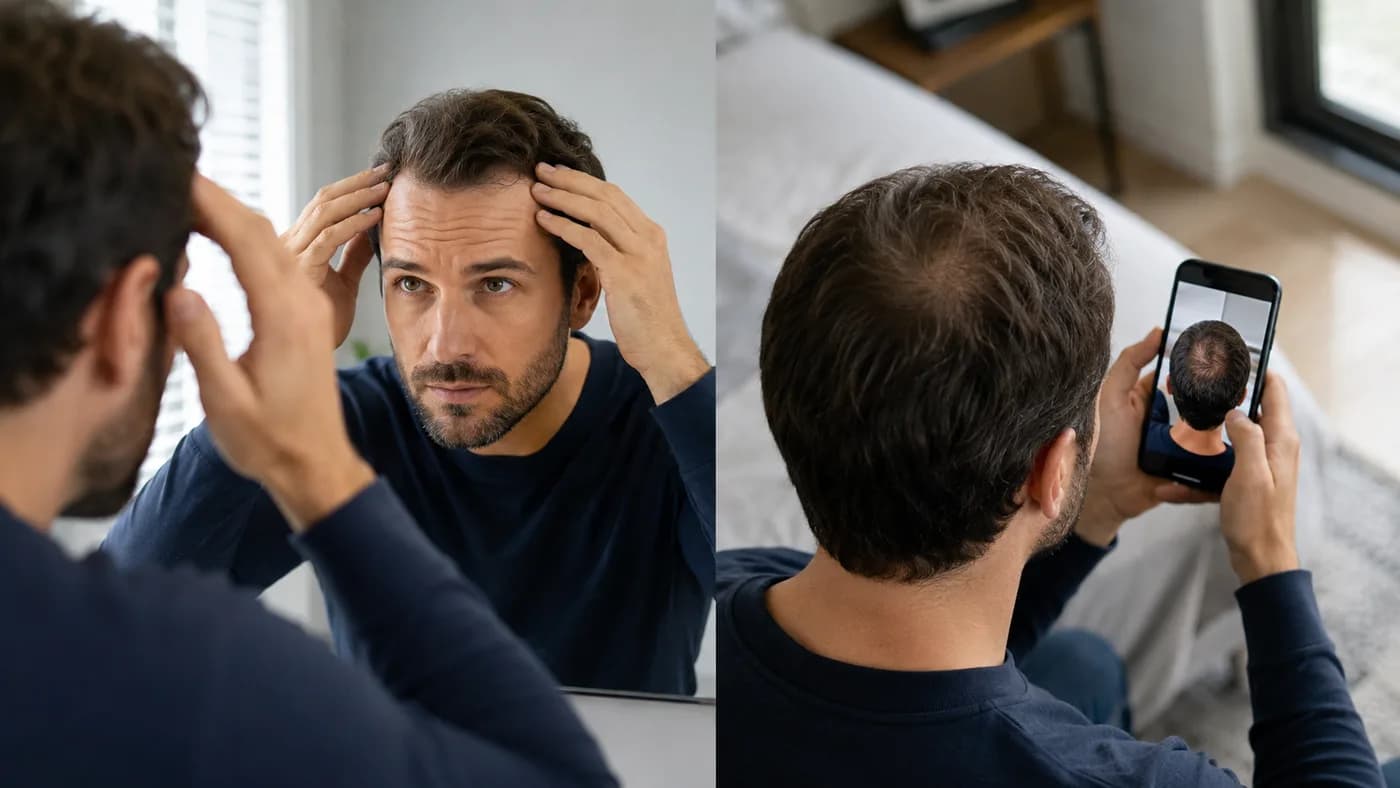
Part 5: compare older photos instead of trusting memory
The best at-home hairline test is usually a photo comparison routine:
- find a front-facing photo from 6 to 12 months ago,
- choose one with similar haircut length if possible,
- compare it in similar lighting,
- then look for repeatable change at the temples, corners, and front density.
A better question is: Does my hairline look materially worse than it did a year ago under comparable conditions?
If the answer is no, that supports monitoring. If the answer is yes, that supports acting sooner. The AAD notes that FDA-approved treatments for male pattern hair loss tend to work better when started soon after you notice the loss, which makes documentation more useful than denial.
Scoring your hairline test
Use this simple interpretation:
| Result | What it usually means | Best next move |
|---|---|---|
| Mostly stable | Mildly higher line, solid density, no crown change, little photo progression | Monitor every 1 to 2 months |
| Borderline | Some temple movement, maybe slight density loss, unclear progression | Improve photo tracking and compare haircut options |
| Likely receding | Deeper temples, weaker front density, clear photo progression, or crown change | Consider dermatologist input and compare shorter styles |
If you fall into the borderline group, a preview can help more than more mirror-checking. BaldLooks Free Analysis gives you a first read from one photo, and the paid plans are more useful when you want to compare buzzed or shaved options from multiple angles.
The test should reduce stress, not create it
If you keep repeating the same check every day, you are not gathering better evidence. You are feeding anxiety. Use a structured test, save the photos, and revisit the answer after enough time has passed.
When a hairline test is not enough
The Mayo Clinic says hair loss can also come from medical conditions, stress, and traction from hairstyles, and it advises seeing a doctor if persistent hair loss is distressing. It also notes that sudden, patchy, or non-typical loss patterns can reflect causes other than standard hereditary balding.
Be more cautious if:
- the loss feels sudden,
- the shedding is dramatic and new,
- the scalp is itchy, painful, or inflamed,
- the pattern is patchy rather than gradual,
- or your hairline concerns are paired with broader health changes.
In those cases, the correct next step is a dermatologist.
The most honest next step
If your hairline test points to stability, keep monitoring and avoid making a dramatic decision from fear alone.
If it points to likely recession, you still do not need to jump straight to shaving. Compare real options: keep your current cut, go shorter, try a buzz, or preview a shaved head before doing it for real.
That is what makes a photo-based decision tool useful. It turns the question from "Am I doomed?" into "What actually looks best on me now?"