
Am I Balding? How to Tell From Hairline, Crown, and Temples
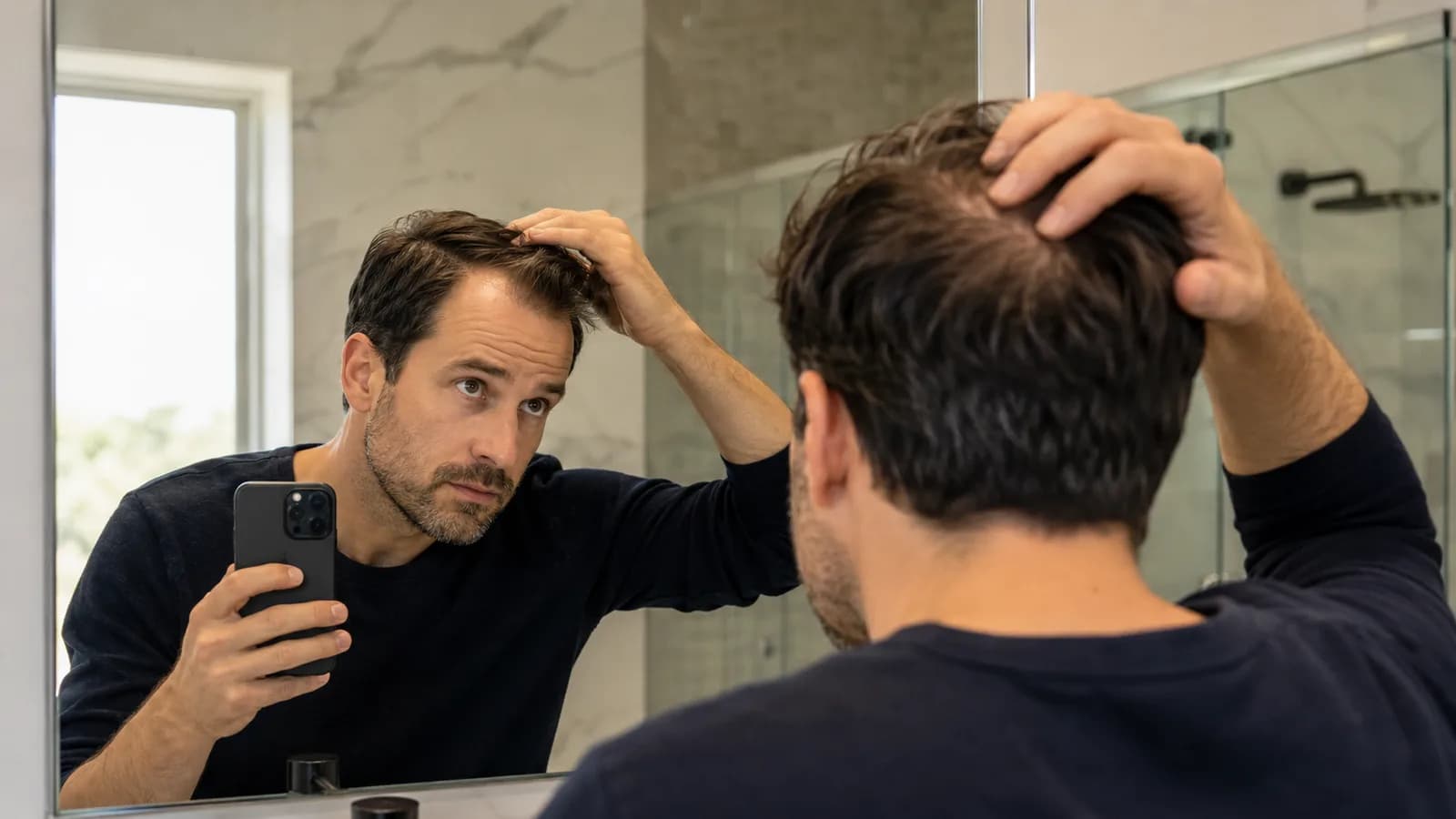
If you keep asking "am I balding?", you are usually not looking for a perfect medical answer from the internet. You are looking for practical signs that help you tell the difference between normal worry, a maturing hairline, temporary bad lighting, and real hair loss that may be progressing.
That distinction matters because a lot of men start checking too late, and a lot of men also panic too early.
The best way to judge it is not one mirror check. It is a pattern over time.
The short answer is this: you may be balding if your hairline, temples, crown, or overall density are changing in a repeatable way across time, lighting conditions, and photos.
The key phrase is may be. A single bad hair day is not enough. Wet hair is not enough. Harsh overhead light is not enough. One cowlick photo is not enough.
Quick read
Real thinning usually shows up repeatedly across time, not only in one mirror, haircut, or lighting setup.
Hairline recession, temple changes, crown thinning, and diffuse thinning all create different visual clues.
Wet hair, strong product, overhead light, and low camera angles can make even healthy hair look thinner than it is.
The quick answer
You may be balding if you notice several of these changes together:
- your hairline appears to be moving back,
- the temples are opening more than before,
- the crown looks thinner in photos or bright light,
- the top feels less dense than the sides,
- your styling no longer behaves the same way,
- tracking photos taken months apart show clear change,
- close relatives have a history of similar hair loss patterns.
The Mayo Clinic says hereditary hair loss typically happens gradually and in predictable patterns, often with recession at the hairline in men or thinning on top. The Cleveland Clinic similarly notes that male pattern baldness often shows up as temple recession, a hairline that moves farther back, or thinning at the crown.
That does not mean every receding temple or visible crown means you are definitely balding. It does mean those are the places worth monitoring.
Start with the hairline, not your anxiety
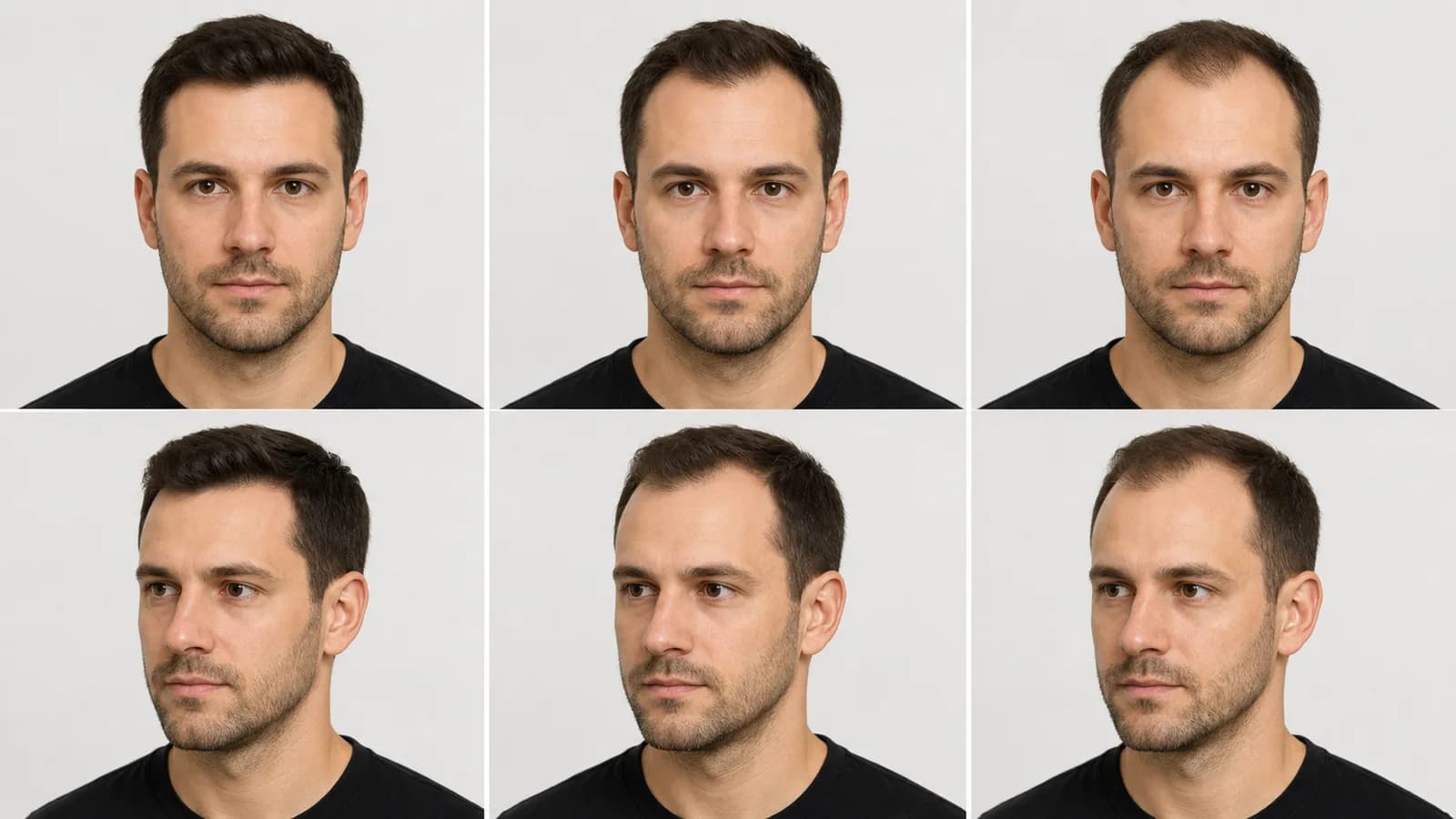
For many men, the first place they notice change is the front hairline.
The front can be confusing because hairlines do not stay identical forever. Some men naturally develop a more mature hairline without fast ongoing loss. Others notice clear recession that keeps moving backward over time.
What matters is not whether your hairline looks exactly like it did at 17. What matters is whether it is still changing.
Signs the hairline may be thinning
Watch for:
- a deeper "M" shape than before,
- front corners that pull back more than the center,
- less density immediately behind the hairline,
- more scalp visibility in the front than you used to see,
- the need to style around the front to make it look even.
If the hairline looks higher but stable, that can be one thing. If it keeps pulling back month by month, that can be another.
This is why comparison beats memory. Most men are bad at recalling exactly what their hairline looked like a year ago. Photos are better.
Temple recession is one of the earliest clues
Temple recession often creates the earliest "something is changing" feeling.
The temples are the front corners of the hairline. When they start moving back, the forehead may look wider and the hairline may start forming a mild or stronger M shape.
Temple recession may suggest early male pattern baldness when:
- it is new rather than lifelong,
- both corners are slowly moving back over time,
- the hair in those corners looks finer or weaker,
- the rest of the front no longer blends smoothly into the sides.
Temple recession can also be easy to exaggerate in your own head. A slightly higher temple does not automatically mean fast balding. What matters is the trend.
If your temples concern you most, compare photos from:
- 6 months ago,
- 12 months ago,
- after the same haircut length,
- in similar natural lighting.
That will tell you more than checking the mirror ten times today.
Crown thinning is often easier to miss
The crown is the area toward the back top of your head, and it is one of the most common places for early thinning to hide from you.
You do not see it directly in most mirrors. That is why some men think their hairline is the whole story until a photo, barber, or overhead camera angle shows more scalp than expected.
Possible signs of crown thinning include:
- a small area at the crown that looks lighter than the surrounding hair,
- a cowlick that seems more scalp-visible than it used to be,
- friends or barbers noticing the back before you do,
- a circular or spreading thin spot in repeated photos,
- extra visibility under direct light even when the rest of the top looks normal.
The Cleveland Clinic notes that hair loss at the crown is a common part of male pattern baldness and may later connect with frontal recession. That is one reason crown checks matter even if you mostly focus on the front.
Cowlick or crown balding?
This is a common source of confusion.
A crown cowlick is a natural growth pattern. It can show scalp in the center, especially when the hair is wet, short, flattened, or split by light. That alone does not prove thinning.
Possible signs it may be more than a cowlick:
- the visible area is getting larger,
- the surrounding hair looks finer than before,
- the scalp shows in more conditions, not just one,
- your older photos show stronger density there.
If you suspect crown thinning, take top-down photos once a month rather than trying to judge it by feel.
Diffuse thinning is the hardest to spot early
Diffuse thinning means the top of the hair is getting less dense overall rather than retreating sharply in one zone.
That can be harder to notice because the hairline may still look mostly intact. Instead, the whole top starts looking flatter, lighter, or more scalp-visible in certain conditions.
Possible signs of diffuse thinning:
- your part or natural separation looks wider,
- styling no longer gives the same coverage,
- the top looks less dense than the sides,
- bright light reveals scalp across a broad area,
- your hair feels finer or less substantial in your hands.
Diffuse thinning can be one reason men say, "I know something looks off, but I cannot tell where." That feeling itself is not proof, but if repeated photos show the top becoming more see-through, it is worth taking seriously.
If you are also deciding whether shorter hair would help, the practical comparison in buzz cut vs bald is useful after you confirm the pattern.
Shedding can matter, but it is not enough by itself
A lot of men start with the shower drain.
Seeing hairs when washing or styling can feel alarming, but shedding alone does not automatically mean you are balding. Hair naturally sheds every day, and temporary shedding can happen for multiple reasons.
What makes shedding more relevant is when it comes with visible pattern change:
- more temple recession,
- lower density on top,
- a crown that is becoming easier to see,
- hairs that seem finer than the ones you used to lose.
The Mayo Clinic notes that sudden loosening or hair coming out more than usual can happen for reasons beyond hereditary balding, and sudden or patchy hair loss is worth discussing with a doctor. That is important because not all hair loss follows the typical slow male-pattern route.
So use shedding as a supporting clue, not your only clue.
Family history does not decide everything, but it matters
If close relatives have similar hair loss patterns, that can raise the odds that what you are seeing is real hereditary thinning rather than a one-off change.
Pay attention to:
- father, brothers, uncles, or grandfathers with temple recession,
- crown thinning appearing at a similar age,
- a known pattern of male pattern baldness in the family.
Family history is not destiny, and lack of family history does not guarantee perfect hair. But it helps you interpret borderline signs more realistically.
Why your hair may look thinner than it really is
This is where a lot of unnecessary panic starts.
Hair can look dramatically thinner depending on how you are seeing it.
Lighting
Harsh overhead light creates scalp visibility fast, especially at the crown and front. Soft daylight is a better reference than a bright bathroom spotlight.
Wet hair
Wet hair clumps together and exposes the scalp underneath. That can make healthy density look thin for a moment, especially at the temples and crown.
Product
Greasy products, gels, and anything that clumps the strands can create artificial gaps. Matte or dry styling often hides them better.
Camera angle
Phone photos from above can exaggerate crown thinning. Very low angles can make the hairline look weaker. Front cameras can also distort proportions.
Hair length
Sometimes longer hair looks fuller. Sometimes it separates and exposes more scalp. Sometimes a shorter cut makes density look stronger by reducing contrast. Context matters.
Do not diagnose yourself from one bad angle
If you only look thin in wet hair under bathroom lighting with your phone above your head, that is weak evidence. Real thinning usually survives better conditions and repeated checks.
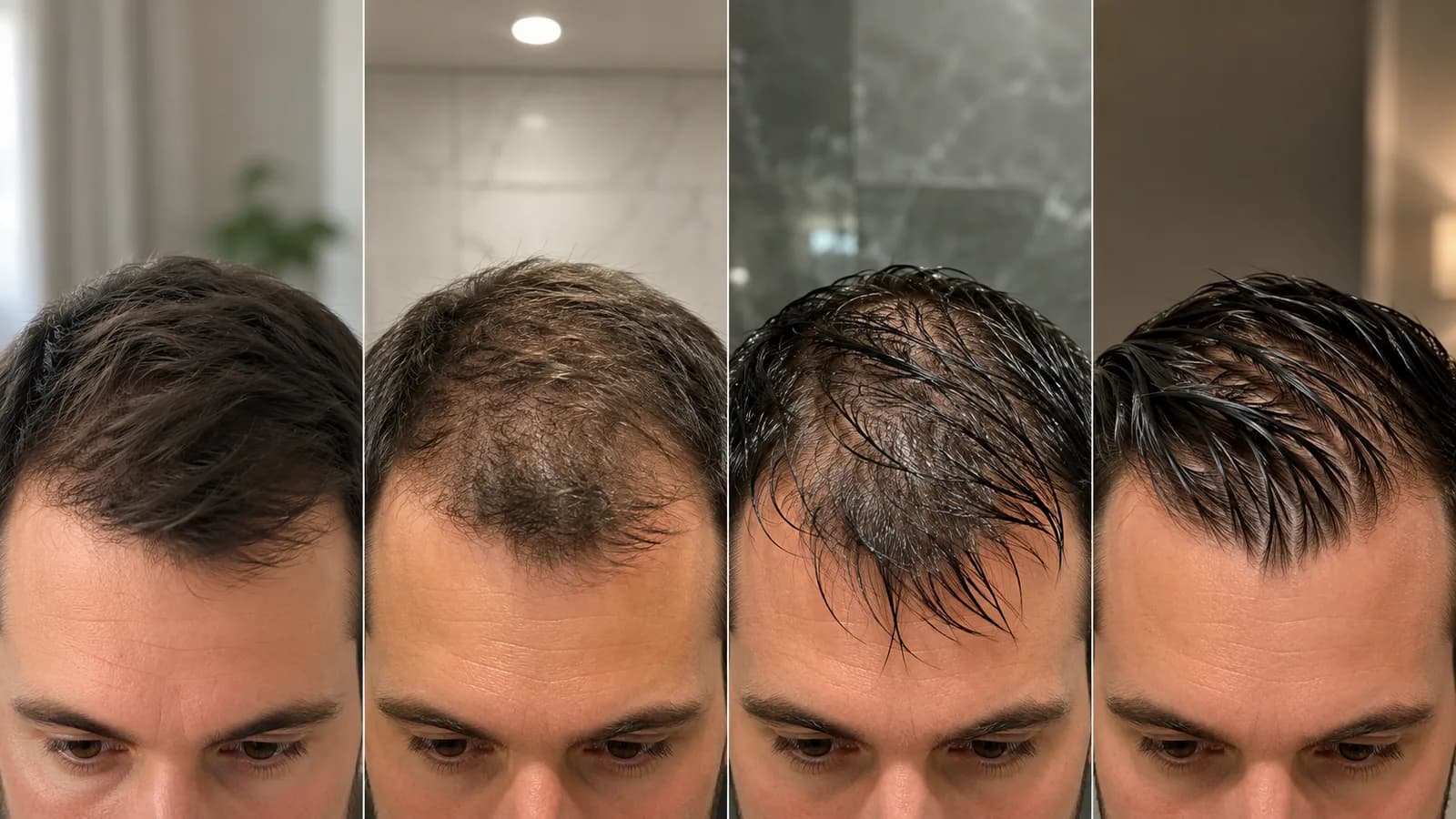
The best way to check: track photos over time
If you want the clearest answer to "how to tell if you're balding," start tracking instead of guessing.
Take the same photos once a month:
- Front hairline.
- Left temple.
- Right temple.
- Crown from above.
- One three-quarter angle.
Keep the setup as consistent as possible:
- same room,
- same natural lighting if possible,
- dry hair,
- minimal product,
- similar haircut length.
This gives you something your memory cannot: evidence.
When the signs add up
You may be dealing with real balding if several of these are happening at once:
- temple recession is increasing,
- the crown looks more open in repeated photos,
- the top is losing density compared with the sides,
- your styling options are getting weaker,
- the overall pattern matches family history,
- the changes persist across months, not only one day.
That does not mean you need to shave your head immediately. It means you are probably past the stage of relying on guesswork.
At that point, your next decision is usually one of three things:
- Keep monitoring.
- Speak with a qualified professional if you want medical guidance.
- Start exploring style options so the change feels more controlled.
If the emotional question underneath this is really "if I am balding, would I actually suit a shaved head?" you can upload one photo for a free BaldLooks analysis and get a practical first read before making any haircut decision.
When to talk to a professional
This article is about self-assessment, not diagnosis.
If your hair loss seems sudden, patchy, painful, inflamed, or unusually fast, it is a good idea to talk to a qualified dermatologist or healthcare professional. The Mayo Clinic recommends medical evaluation for sudden or patchy loss and for hair loss that feels persistent or distressing.
Even if the change is gradual, professional guidance can help if you want clarity on what may be going on and what options exist.
Conclusion
If you are asking "am I balding?", the most useful answer is not yes or no from one stressful moment. It is whether the signs form a consistent pattern over time.
Look at the hairline. Look at the temples. Check the crown. Pay attention to density changes across the whole top. Notice whether the pattern survives different lighting, dry hair, and repeated monthly photos.
That is how you turn hair-loss anxiety into something more concrete.
If the pattern is real, you will be in a better position to decide what to do next. If it is not, you will stop letting one bad angle control your thinking.