
Mature Hairline vs Receding Hairline: How to Tell

If you are searching for mature hairline vs receding hairline, you are usually trying to answer a very specific question:
Is this a normal adult change, or is this the start of real hair loss?
That question matters because the right response is different. A mature hairline often needs nothing except perspective. A receding hairline may deserve monitoring, treatment research, or a style decision later on.
The short answer is this: a mature hairline usually moves back slightly and then stabilizes, while a receding hairline keeps changing in shape, depth, density, or both.
Quick read
A mature hairline often settles into a slightly higher adult shape without continuing to creep backward every few months.
If the temples keep opening, the front gets thinner, or the pattern is clearly worse across photos, that is harder to call simple maturation.
The outline of the hairline can look similar in both cases, but weaker density behind the front edge often tells the more useful story.
Quick comparison: mature hairline vs receding hairline
| Signal | Mature hairline | Receding hairline |
|---|---|---|
| Age pattern | Often appears after the teenage hairline settles into an adult shape | Can begin early or later, but keeps progressing over time |
| Shape | Slightly higher, softer, often still balanced | Deeper temple loss, stronger M shape, or more obvious front recession |
| Symmetry | Usually fairly even from left to right | Often becomes more uneven or visibly deeper at one or both temples |
| Speed of change | Slow and then mostly stable | Ongoing change across months or years |
| Density | Front density usually still looks solid | Hair behind the hairline may look finer, weaker, or more see-through |
| Other signs | No major crown issues, less styling stress | May also come with crown thinning, shedding concerns, or diffuse loss |
That table is the framework, but the real answer usually comes from trend plus density, not one mirror check.
Do not judge this from one bad lighting angle
Wet hair, overhead light, harsh flash, and low-angle phone photos can make a healthy hairline look worse than it is. Use repeatable photos in similar conditions before deciding you are definitely receding.
What is a mature hairline?
A mature hairline is an adult hairline that sits a little higher than a teenage or juvenile one. It is not unusual, and by itself it does not automatically mean you are balding.
The confusing part is that the word mature often gets used loosely online. In practice, the more useful meaning is this:
- the hairline has shifted a bit from the very low, rounded juvenile line,
- the temples may be slightly more open than before,
- the overall frame of the face still looks balanced,
- and the pattern does not keep noticeably worsening.
The American Academy of Dermatology notes that hereditary hair loss in men often first appears as a receding hairline or bald spot on top. The distinction is not "higher hairline equals balding." It is whether you are seeing the predictable pattern of ongoing hair loss.
In plain terms: a mature hairline is often a new normal, not necessarily an active problem.
What is a receding hairline?
A receding hairline is a hair-loss pattern where the hairline moves farther back over time, usually starting around the temples and front corners.
The Cleveland Clinic describes male pattern baldness as commonly involving thinning hair and a hairline that moves farther back. MedlinePlus Genetics similarly describes a pattern that begins above both temples and forms a more characteristic M shape over time.
What makes a receding hairline different is not only where it sits today. It is that it often comes with one or more of these signs:
- the temples are clearly deeper than before,
- the front edge looks less dense,
- the change keeps progressing in photos,
- the crown may also be thinning,
- hairstyles that used to work start looking fragile.
That progression is the key. A mature hairline may look different than your high-school hairline. A receding hairline does not stay put.
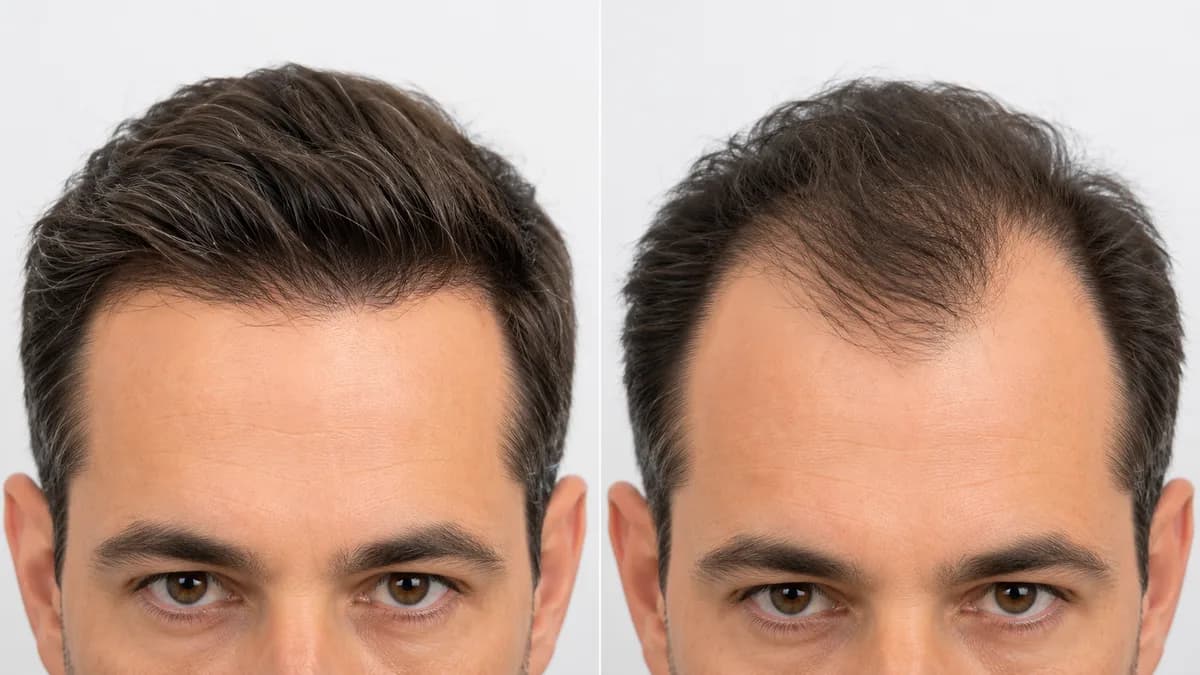
The four signs that usually tell the difference
If you want a practical read, focus on these six signals.
1. Age matters, but not as much as people think
Many men notice some hairline change in early adulthood. That alone does not tell you whether it is mature or receding. What matters more is whether the line changed a bit and then stayed stable, or kept changing through your 20s and 30s.
2. Symmetry is one of the best clues
A mature hairline is often fairly balanced from one side to the other. A receding hairline often looks more dramatic at the temples:
- one corner may pull back faster,
- the M shape may become more obvious,
- or the front corners may become harder to style evenly.
Symmetry alone is not enough, but it is a useful clue.
3. Speed of change is usually the deciding factor
This is the biggest difference.
If your hairline looks a little higher than it did at 17 but mostly the same as it did 12 months ago, that often supports the mature-hairline explanation. If you can line up photos from:
- 6 months ago,
- 12 months ago,
- and 24 months ago,
and see the temples or front corners steadily moving back, that is much harder to call stable maturity.
The Mayo Clinic notes that hereditary hair loss typically happens gradually and in predictable patterns. Real progression is usually not dramatic in a single week, but it is often obvious across enough time.
4. Density behind the hairline tells the truth
A lot of men focus only on where the line starts. A better question is: what does the hair immediately behind that line look like? With a mature hairline, the front density often still looks strong. With recession, the front may start looking:
- finer,
- more transparent under light,
- weaker at the corners,
- or harder to style without coverage tricks.
That is why two hairlines with a similar outline can mean different things.
Temple recession versus normal maturation
This is where most confusion lives.
Some temple movement is common as a boyish hairline becomes an adult one. Recession is more likely when the temples are not only higher, but also visibly emptier or more dramatically cut back.
Signs it may be simple maturation:
- both temples moved back mildly and then settled,
- the front still looks dense,
- your haircuts still work without strategic styling,
- the crown looks normal,
- the overall look has been stable.
Signs it may be actual recession:
- the temples keep deepening,
- the M shape is becoming more defined,
- the corners look weaker than the mid-front,
- scalp visibility is increasing at the front,
- you also notice family-pattern loss or crown change.
If this sounds familiar, the stage-focused explanation in Norwood Scale Explained gives more context.
Why Norwood 2 creates so much confusion
Norwood 2 is often where the internet becomes unhelpful. Some men at that stage are simply looking at a mature hairline that stays there. Others are looking at the first clearly trackable stage of pattern hair loss.
So is Norwood 2 balding or just mature? The honest answer is: it can be either, depending on whether it stabilizes or progresses.
The best read is not a label by itself. It is:
- Norwood-like shape,
- plus density,
- plus progression,
- plus whether the crown or top is also changing.
If your temples are your only concern and the rest of the scalp looks strong, you may just need monitoring.
Check the crown and family pattern too
Do not judge only from the front. If the crown is also getting more visible, or close relatives followed the same temple-first pattern and later developed obvious recession, the mature-hairline explanation gets weaker.
If you are still unsure whether you are seeing a pattern, the tracking approach in Am I Balding? is the best next step.

When to monitor and when to do something
Not every uncertain hairline needs treatment or a shaved-head decision.
Monitor if:
- the shape changed slightly but then stayed stable,
- the density behind the front edge still looks good,
- the temples are only mildly open,
- the crown looks unchanged,
- you are mainly anxious, not seeing clear progression.
Consider acting if:
- the hairline is moving steadily,
- the corners are clearly weaker,
- you also see crown or top thinning,
- styling is becoming more frustrating,
- you want to discuss treatment with a qualified professional while the change is still early.
The AAD notes that treatment tends to work better when started soon after noticing male pattern hair loss. That is not an instruction to medicate every maturing hairline. It is a reminder that if the pattern is truly progressing, indefinite waiting is not automatically the smart move either.
Also, if hair loss is sudden, patchy, or paired with scalp symptoms, the Mayo Clinic advises getting medical evaluation because not all hair loss follows the usual hereditary pattern.
What to do if you are still undecided
If you only have a mature hairline and the rest of your hair still looks strong, shaving is usually not the obvious next move. If the hairline is clearly receding and beginning to control your grooming choices, shorter styles start becoming more relevant.
The best next reads are Best Haircuts for a Receding Hairline, Buzz Cut for a Receding Hairline, and Receding Hairline: When Is It Time to Shave Your Head?.
If you want to test the bald option privately first, BaldLooks lets you start with a free bald-fit analysis from one photo, then go deeper with the paid previews if you want more realistic shaved-head comparisons.
The bottom line
A mature hairline usually changes a little and then settles. A receding hairline keeps telling the same story over time: deeper temples, weaker density, more visible progression, or other signs like crown thinning.
So if you are stuck on mature hairline vs receding hairline, stop asking your mirror for a verdict today. Use photos, compare timing, look at density, and check whether the pattern is stable or moving.
If you want the most practical next step:
- take consistent front and temple photos once a month,
- compare them after 6 to 12 months,
- check the crown too,
- and if the pattern is progressing, decide whether you want treatment research, a haircut change, or a private bald preview first.