
Receding hairline: when is it time to shave?
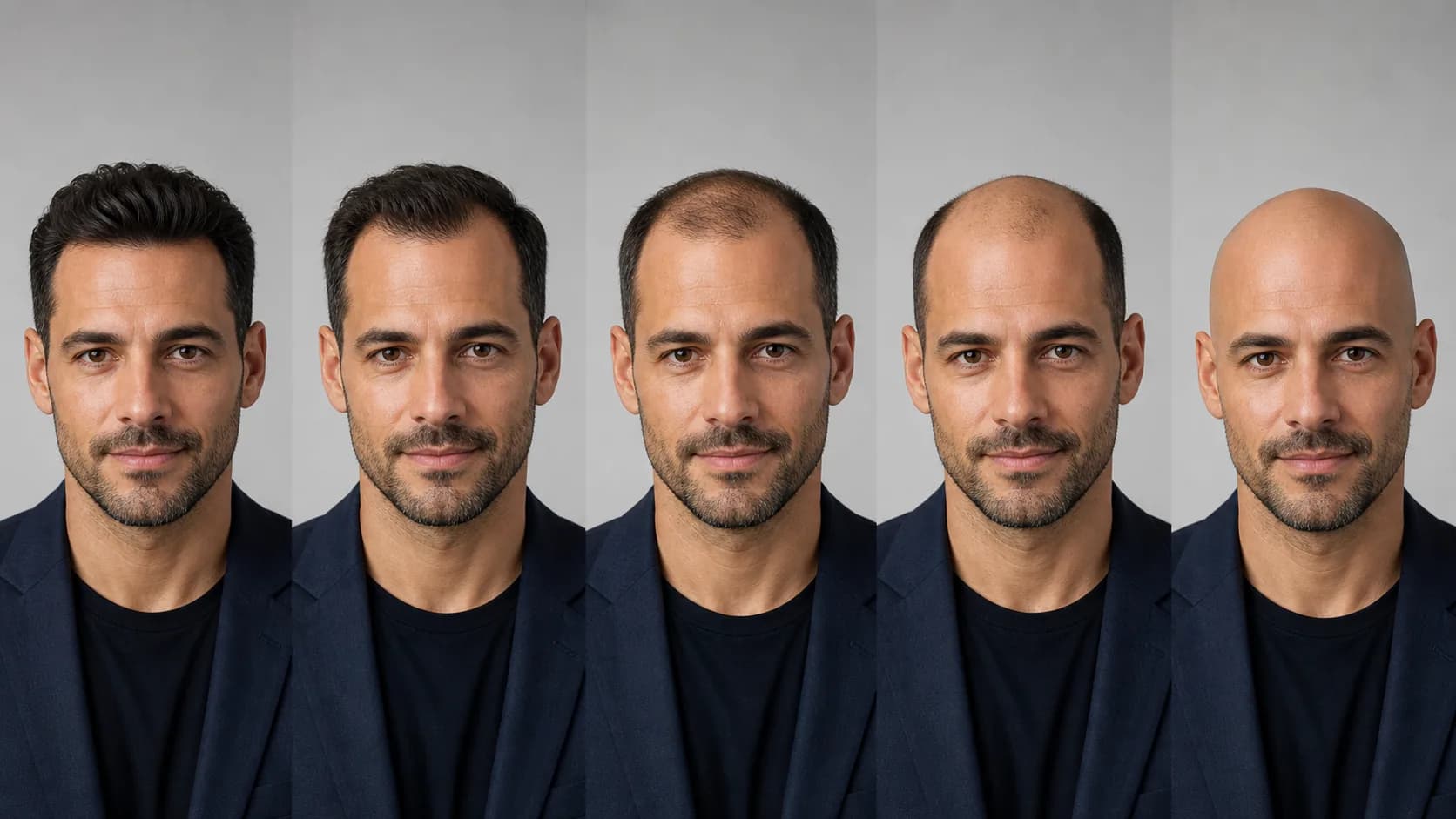
A receding hairline does not automatically mean it is time to shave your head.
Some men look great with a mature hairline, short crop, or textured buzz. Others spend years trying to hide hair loss that would look cleaner, stronger, and calmer as a shaved head.
The real question is not, "Is my hairline receding?" It is, "Is my current hair still helping my face?"
This guide gives you a practical way to decide when to keep styling, when to treat hair loss, when to buzz shorter, and when shaving your head is probably the better move.
Quick read
If people notice the hairline before your face, the style may be working against you.
Avoiding wind, rain, photos, and bright rooms is a real signal, not vanity.
A buzz cut, better photos, or a bald preview can make the decision less emotional.
What counts as a receding hairline?
A receding hairline usually means the hair at the temples or front of the scalp is moving back. It may create an M shape, a deeper widow's peak, or a wider forehead than you used to see in photos.
The Cleveland Clinic describes male pattern baldness as often involving temple recession, crown thinning, and a hairline that moves farther back. It also uses the Hamilton-Norwood scale to describe common stages, from little recession to deep temple loss, crown loss, and later a narrow band of hair around the sides.
The American Academy of Dermatology notes that male pattern hair loss can start as a receding hairline or a bald spot on top and may progress slowly for years.
In plain terms: a receding hairline is a pattern. What matters is how visible that pattern has become and how much effort it takes to work around it.
Mature hairline vs balding hairline
Not every higher hairline is a problem. Many men develop a mature hairline in adulthood and keep a strong, stable look for years.
A mature hairline usually:
- moves back slightly from the teenage hairline,
- stays fairly even from month to month,
- still has density behind the front,
- works with short, simple haircuts,
- does not create constant styling stress.
A balding hairline is different. It tends to keep changing, especially around the temples, front corners, or crown. The hair may become thinner, softer, or harder to style. The top may sit flat while the sides stay dense.
The difference is visual too. If the front still frames your face, you may not need to shave. If the hairline has become the main feature, shaving or buzzing shorter may restore balance.
Sign 1: your hairstyle only works from one angle
This is one of the clearest signs.
Your hair looks fine in the mirror, but not in photos. It works when brushed forward, but not from the side. It looks okay indoors, then collapses under sunlight or overhead lighting.
That usually means the hairstyle is no longer robust. It depends on a controlled angle.
Common examples:
- long fringe pulled forward to hide the temples,
- heavy sides with a thin top,
- product used to freeze hair across the front,
- hair fibers that look different under bright light,
- a part line that gets wider in every photo.
There is nothing wrong with styling your hair. The issue is when the style becomes fragile. If one gust of wind can ruin your confidence, the hairline may be making too many decisions.
Use photos, not only mirrors
Mirrors show the version of your hair you already know how to arrange. Photos reveal the angles other people actually see: side, three-quarter, crown, and bright light.
Sign 2: the hairline pulls attention away from your face
A good haircut should support your face. It should make your eyes, brows, jaw, smile, and expression easier to notice.
A receding hairline becomes a problem when it does the opposite.
Ask yourself:
- Do I notice my temples before my eyes?
- Does my forehead look larger because the front is thin, not because of natural proportions?
- Does the top look see-through compared with the sides?
- Do I choose every haircut around hiding one area?
- Do I feel better in hats than without them?
If several answers are yes, the hairline may be controlling the look.
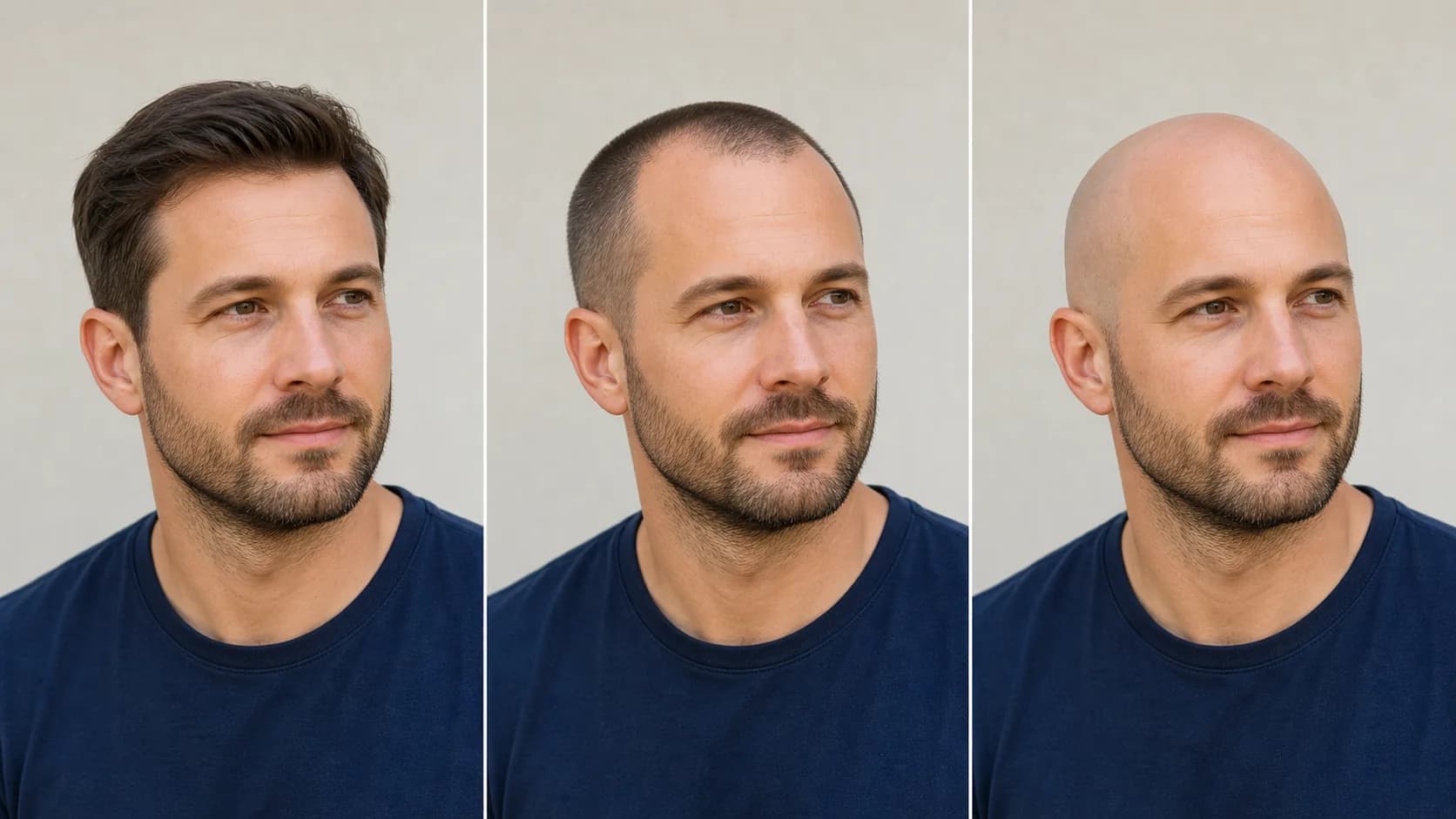
That does not mean you must go razor-smooth tomorrow. A shorter crop, no-guard buzz, or number 1 buzz can be a useful middle step. Shorter hair reduces contrast between dense and thin areas.
Sign 3: you are avoiding normal situations
Hair loss becomes more costly when it changes behavior.
You may avoid:
- swimming,
- windy days,
- bright restaurants,
- gym showers,
- dating photos,
- video calls,
- haircuts,
- standing under overhead lights.
This is not superficial. Hair is tied to identity and self-image. A 2021 systematic review and meta-analysis in JAMA Dermatology found androgenetic alopecia was associated with impaired health-related quality of life and emotional impact. A later systematic review focused on men in Psychology & Health Medicine also found a moderate quality-of-life impact, while noting that the evidence base has limitations.
If your hairline is making you smaller in daily life, that matters.
Shaving can feel scary because it makes hair loss visible for a moment. But for many men, it also ends the constant negotiation. There is no style to protect, no cover-up to maintain, and no surprise angle to fear.
Sign 4: treatment is not your real goal
There are legitimate treatment options for male pattern hair loss.
The AAD explains that FDA-approved options such as topical minoxidil and prescription finasteride can slow further hair loss for some men, and that results tend to be better when treatment starts early. Results take time and must be maintained with continued use. Hair transplant and PRP may be options for some people after a dermatologist evaluates the pattern and extent of loss.
That is useful if your goal is to preserve or regrow hair.
But be honest about your real goal. Are you excited to treat hair loss, accept the cost and consistency, and wait months for possible improvement? Or are you mainly trying to postpone the moment you stop hiding it?
Both choices are valid. The mistake is choosing treatment only because shaving feels emotionally loaded.
See a dermatologist if your hair loss is sudden, patchy, itchy, painful, or accompanied by scaling or inflammation. Those signs can point to causes other than typical male pattern hair loss.
Sign 5: the shorter you go, the better you look
Before shaving, pay attention to how your face responds to shorter hair.
Some men look worse with medium-length thinning hair but much better with a tight buzz. The shorter cut reduces contrast, sharpens the face, and makes the hairline look intentional.
Try this sequence:
- Move from your current style to a shorter crop.
- Try a number 2 buzz.
- Try a number 1 buzz.
- Try no guard or a close electric shave.
- Decide whether razor-smooth is better than shadow.
You do not have to complete every step in one day. If each shorter stage looks cleaner, that is a strong sign the full shave may suit you.
Sign 6: facial hair or style can balance the change
A shaved head removes visual weight from the top of your face. You can replace that balance with other details.
Facial hair is the easiest tool. Stubble, a short boxed beard, or a clean mustache-and-stubble combination can define the jaw and make the shaved head feel deliberate.
If you cannot grow a beard, you still have options:
- stronger eyebrow grooming,
- glasses with frames that suit your face,
- fitted collars and structured layers,
- better scalp care,
- richer colors near your face,
- improved posture in photos.
The bald look rarely succeeds or fails because of the scalp alone. It succeeds when the whole look makes sense.
This is where previewing helps. BaldLooks can show whether the shaved head works better with stubble, a clean shave, different outfits, or different angles before you commit.
When not to shave yet
It may not be time to shave if:
- your hairline is stable and still suits your face,
- you are curious about medical treatment and willing to be consistent,
- a short crop solves most of the visual problem,
- you are reacting to one bad photo,
- you have scalp irritation that should heal first,
- you are shaving only because someone pressured you.
You should also pause if hair loss appeared suddenly or unevenly. Typical male pattern hair loss is gradual. Sudden shedding, round patches, burning, scaling, or pain deserves medical evaluation.
The shaved head should be a clear choice, not a panic move.
How to test the shaved head before committing
Use a staged decision instead of one dramatic leap.
First, take clear photos: front, side, three-quarter, and crown if possible. Use natural light. Then compare your current style with a tight cap, pulled-back hair, or a short buzz.
Next, preview the look. BaldLooks Free Analysis can give you a first read from one photo. If you want more certainty, paid plans can show a shaved head from different angles, outfits, and locations, which is especially useful if you are worried about dating photos, work style, or head shape.
A practical decision scale
Here is the simplest way to use it:
- Keep styling if the hairline is stable, the front still has density, and your haircut works in real life.
- Treat if preserving hair matters to you and you are ready for long-term consistency.
- Buzz if the hairline is visible but you want a lower-risk transition.
- Shave if the hairline has become the main feature and managing it costs more confidence than letting it go.
If you are mainly worried about whether you will look good bald, read the guide to signs a shaved head might suit you. If the emotional side feels bigger than the haircut itself, the bald head confidence guide can help with the first week.
Frequently Asked Questions
Final answer: shave when the hair costs more confidence than it gives
A receding hairline is not a deadline. It is information.
If your hair still frames your face, feels easy to maintain, and does not control your behavior, keep it. If you want to treat hair loss and you are ready for the commitment, speak with a dermatologist early.
But if your hairstyle has become a fragile cover-up, your photos revolve around avoiding certain angles, and shorter hair keeps looking cleaner, it may be time to shave.
The best decision is the one that makes you look more like yourself, not less. Test it, preview it, and choose from evidence instead of fear.