
Best Haircuts for Receding Hairline and Crown Thinning
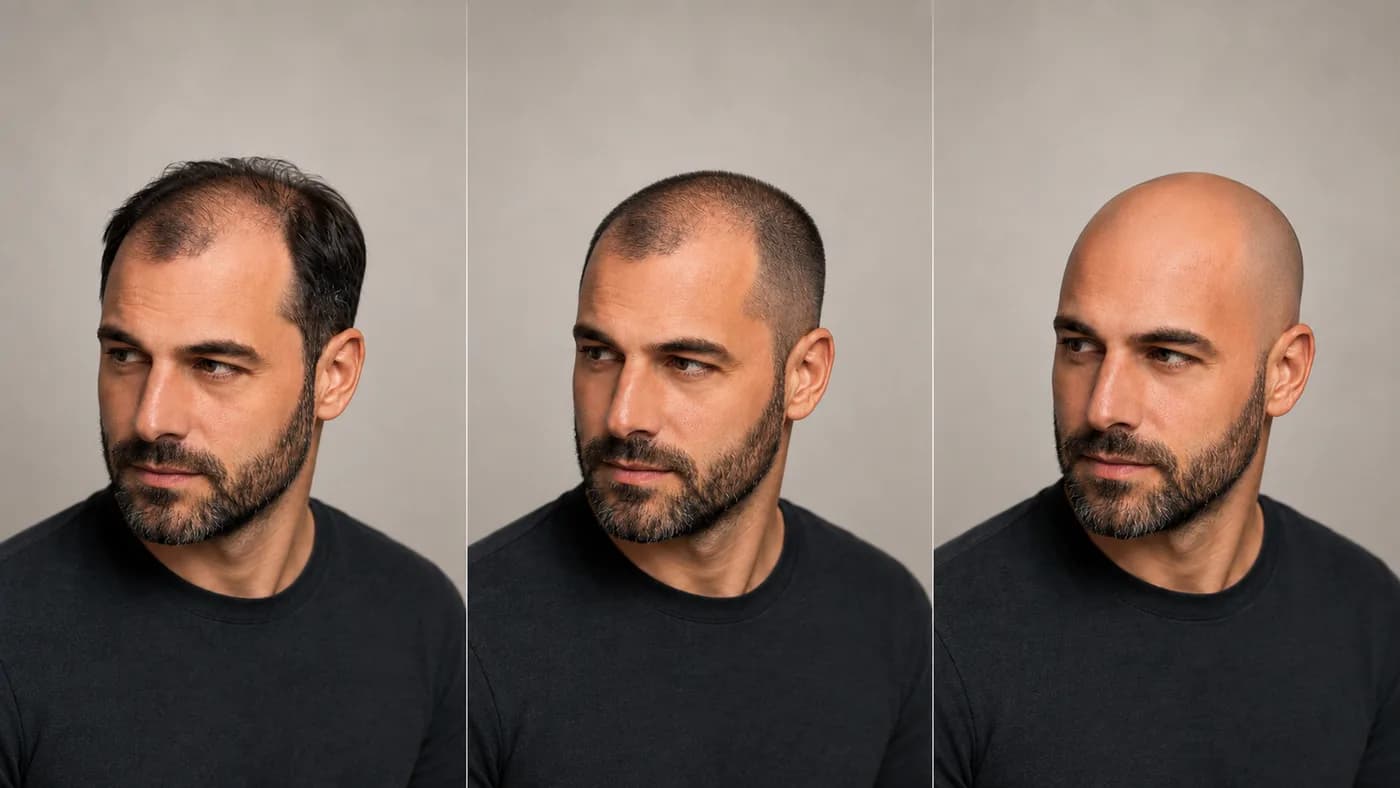
If you are dealing with a receding hairline and crown thinning at the same time, the haircut problem gets harder fast.
Recession alone is one thing. Crown thinning alone is another. But when the temples move back and the crown starts opening, the haircut has to work from the front, the side, and the back. That is why styles that still looked acceptable a year ago can suddenly feel unstable, high-maintenance, or older-looking now.
The good news is that this combination still has clear answers. The bad news is that those answers are usually shorter and more honest than many men want at first.
Quick read
You are not only managing the front corners. You are also managing scalp visibility at the crown and the contrast between the top and the sides.
Once both areas are involved, styles that depend on coverage and volume usually collapse faster than simple, short cuts.
Even if you are not ready to shave, comparing buzzed and shaved versions on your own face usually makes the next step much clearer.
Why this pattern is harder to style
The American Academy of Dermatology notes that male pattern hair loss often begins as a receding hairline or a bald spot on the top of the head and tends to develop slowly. The Cleveland Clinic describes a similar progression: recession around the temples, thinning or loss on the crown, and later thinning between those areas.
That matters because a haircut that can still handle only temple recession may stop working once the crown joins the problem.
With this combined pattern, men usually run into three practical issues:
- the front looks thinner because the temples sit farther back,
- the crown looks weaker under overhead light or from behind,
- and the dense sides start making the top look even thinner by comparison.
This is why longer styles often begin to fail. They are trying to cover multiple weak zones with hair that no longer has enough density to carry the illusion.
This is usually a contrast problem, not just a haircut problem
When both the hairline and crown are changing, the goal is not to "hide baldness." The goal is to reduce the contrast between strong areas and weak areas so the haircut looks deliberate again.
Quick answer: which haircuts usually work best?
If you want the short version first, the strongest haircuts for this pattern are usually:
- buzz cut,
- crew cut,
- Caesar cut,
- short textured crop,
- short high fade with a short top,
- close clipper cut,
- fully shaved head.
These work because they keep expectations realistic. They do not ask weak top coverage to behave like thick hair. They reduce the difference between the temples, the crown, and the sides.
The weaker options are usually:
- long combovers,
- slicked-back volume,
- medium styles that separate around the crown,
- pompadours,
- disconnected undercuts with long tops,
- and anything that only looks right from one mirror angle.
If you already know recession is your main issue, Best Haircuts for a Receding Hairline is the narrower guide. If the crown is your main concern, Hair Thinning at Crown and Crown Balding go deeper. This article is for the men dealing with both at once.
The best haircuts for a receding hairline and crown thinning
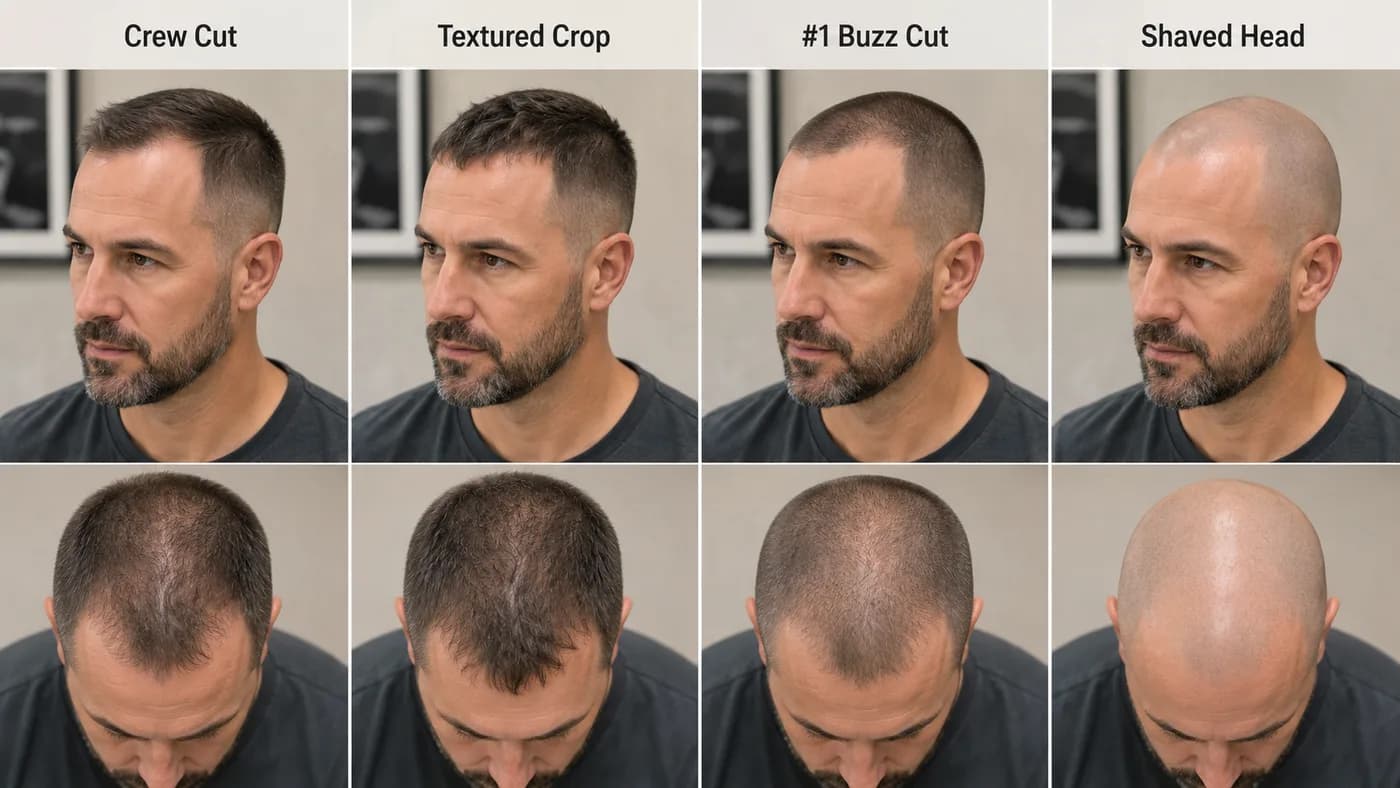
1. Buzz cut
For most men, the buzz cut is the best first move.
It lowers contrast across the whole scalp quickly. It does not hide the hairline or magically fill the crown, but it often makes the pattern look much cleaner because the front, top, and crown stop fighting each other.
A #2 or #1 is usually the most practical starting range:
#2works if the top still has decent density,#1is stronger when the crown is more obvious,#0gets closer to the shaved look and is useful if you already suspect the buzz may not go far enough.
If you want the detailed guard-length breakdown, Buzz Cut for Hair Loss and Buzz Cut for Balding Men are the best follow-up reads.
2. Crew cut
A crew cut still works if your top density is not too weak yet.
It keeps enough shape to feel like a haircut, not a concession. But it has to stay short in real terms. Once the front gets too long, the recession becomes more obvious. Once the top gets too long, the crown starts separating and exposing scalp.
The crew cut is best when:
- recession is visible but not deeply advanced,
- the crown is thinning but not yet opening into a strong spot,
- and you still want a conventional haircut shape.
It is weaker when your sides are dense and the top has already gone soft, because the shape starts emphasizing the mismatch.
3. Caesar cut or short crop
A Caesar cut or short textured crop can help when you still have enough front density to create a compact forward shape.
This works better than many men expect because it stops the haircut from relying on height. Height usually exposes recession. A short forward crop keeps the style lower, tighter, and easier to control.
The catch is the crown. If the crown is already noticeably thin, a crop can still leave the back looking weaker than the front. That is why this option works best in the earlier part of the combined pattern, not the later part.
4. Short high fade with a short top
A high fade can help when the sides are much denser than the top.
That side density often makes combined loss look worse because it frames the top too aggressively. Taking the sides tighter can reduce that contrast. But this only works if the top is also kept genuinely short. A long disconnected top over a fading crown usually makes the problem more obvious, not less.
This is a refinement cut, not a rescue cut. It is strongest when you still have enough density on top to support some shape.
When a buzz cut still works and when it stops working
This is the decision most men actually need.
A buzz cut usually still works when:
- the crown looks thin but not hollow,
- the top still has enough density to look fairly even at short length,
- the recession is obvious but not paired with major diffuse thinning,
- and the haircut immediately looks calmer once you remove extra length.
A buzz cut usually starts failing when:
- the crown still grabs attention even at
#1or#0, - the top looks patchy from normal distance,
- the sides stay much denser than the top,
- or every shorter version keeps looking better until you are basically one step away from bald anyway.
That is the point where Buzz Cut vs Bald becomes the more honest comparison.
When shaving your head starts to make more sense
Many men treat shaving like the extreme option. In this specific pattern, it is often just the cleanest option.
Shaving usually starts making more sense when the haircut is no longer solving the visual conflict. If the front is receding, the crown is thinning, and the bridge between them is getting weaker, keeping some hair can start highlighting all three areas at once.
That is why the Cleveland Clinic Hamilton-Norwood description matters practically. Once you move into the stages where crown loss and frontal recession begin connecting, haircut flexibility drops quickly.
Signs shaving may be the cleaner move:
- you keep choosing shorter cuts and each one looks better than the last,
- the crown still shows through after buzzing,
- styling only works in controlled lighting,
- the haircut looks older or more tired by the end of the day,
- and you are spending energy protecting a shape that no longer reads as intentional.
This is exactly where BaldLooks can help without overcomplicating the decision. Start with the free analysis from one photo. If the shaved direction looks promising, the paid plans let you compare that look from more angles, with different outfits and even different beard options, so you are not basing the choice on one nervous guess.
A simple stage-based recommendation table
| Pattern | Usually best first move | Usually weaker option | What to watch for |
|---|---|---|---|
| Early recession + mild crown thinning | Crew cut or #2 buzz cut | Medium-length styling | If the crown separates under light, go shorter |
| Deeper recession + visible crown | #1 buzz cut | Crop with extra top length | If the crown still stands out, compare shaved |
| Recession + crown + diffuse top thinning | #0 buzz or shaved head | High-volume haircut | If the top looks patchy, hair is not helping much |
| Strong side density + weak top/crown | Short high fade with very short top or shaved head | Long disconnected top | Side contrast can make the top look even thinner |
Mistakes that usually make this pattern look worse
The most common mistake is trying to solve a two-zone thinning pattern with a one-zone strategy.
Examples:
- styling only for the front while ignoring the crown,
- choosing a crown-friendly short cut but leaving too much length at the hairline,
- keeping the sides heavy because they still feel "strong,"
- using wet or shiny products that separate thin hair,
- taking haircut advice from men who only have temple recession.
This is also why generic barber advice can miss the point. A barber can execute a cut well, but he still sees you for one appointment. You are the one living with the front view, the crown view, phone photos, work lighting, and the emotional side of the decision.
Final answer: keep hair only if it improves both the front and the crown
The best haircuts for a receding hairline and crown thinning are not the ones that preserve the most hair. They are the ones that make the whole pattern look more deliberate.
For many men, that means a short buzz cut first. For some, a crew cut or crop still works for a while. And for a lot of men once the crown and hairline are both clearly involved, the shaved head starts looking less like a defeat and more like the cleanest design choice available.
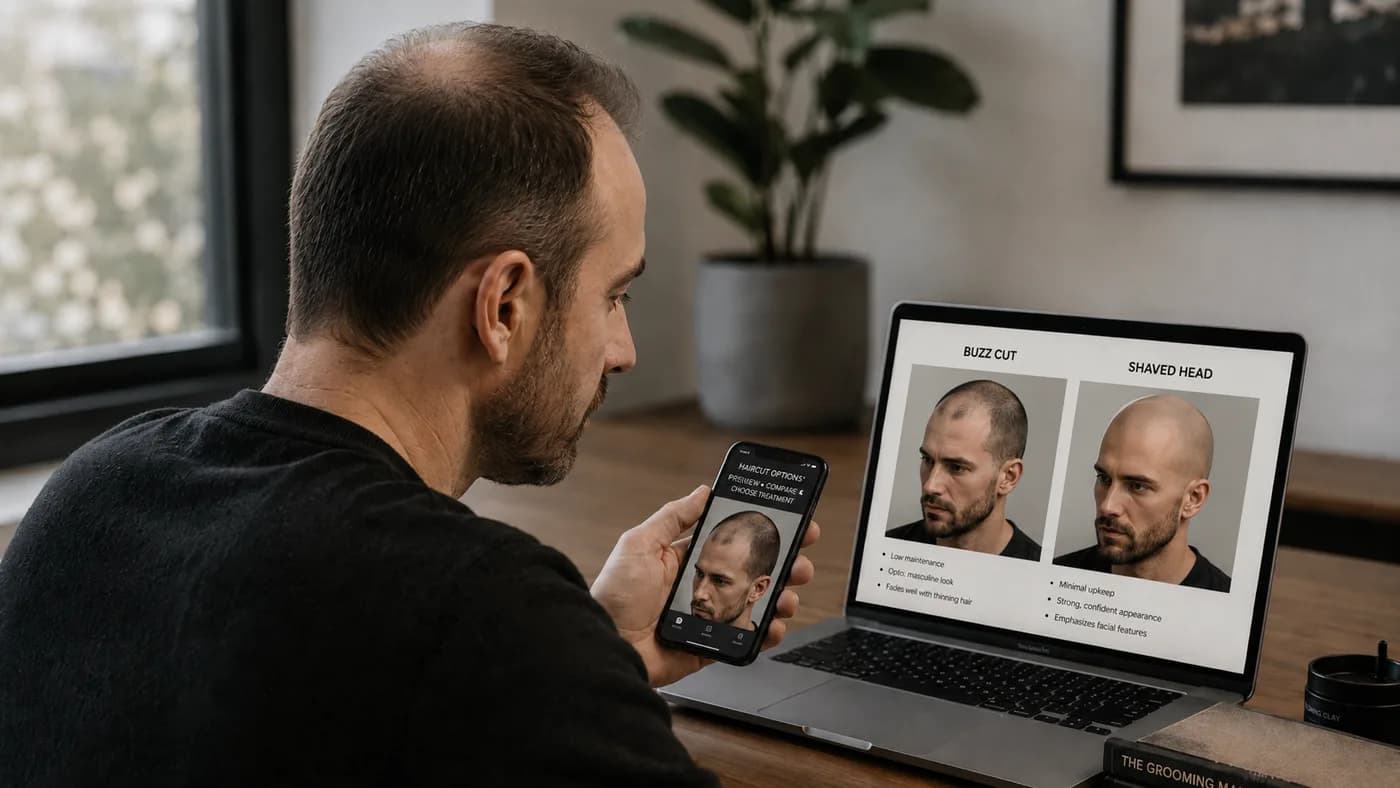
If you are unsure, do not argue with yourself in the mirror for another month. Compare the buzzed and shaved options on your own face, then choose the version that removes the most visual conflict.