
Personal Branding for Bald Men: Build a Signature Look
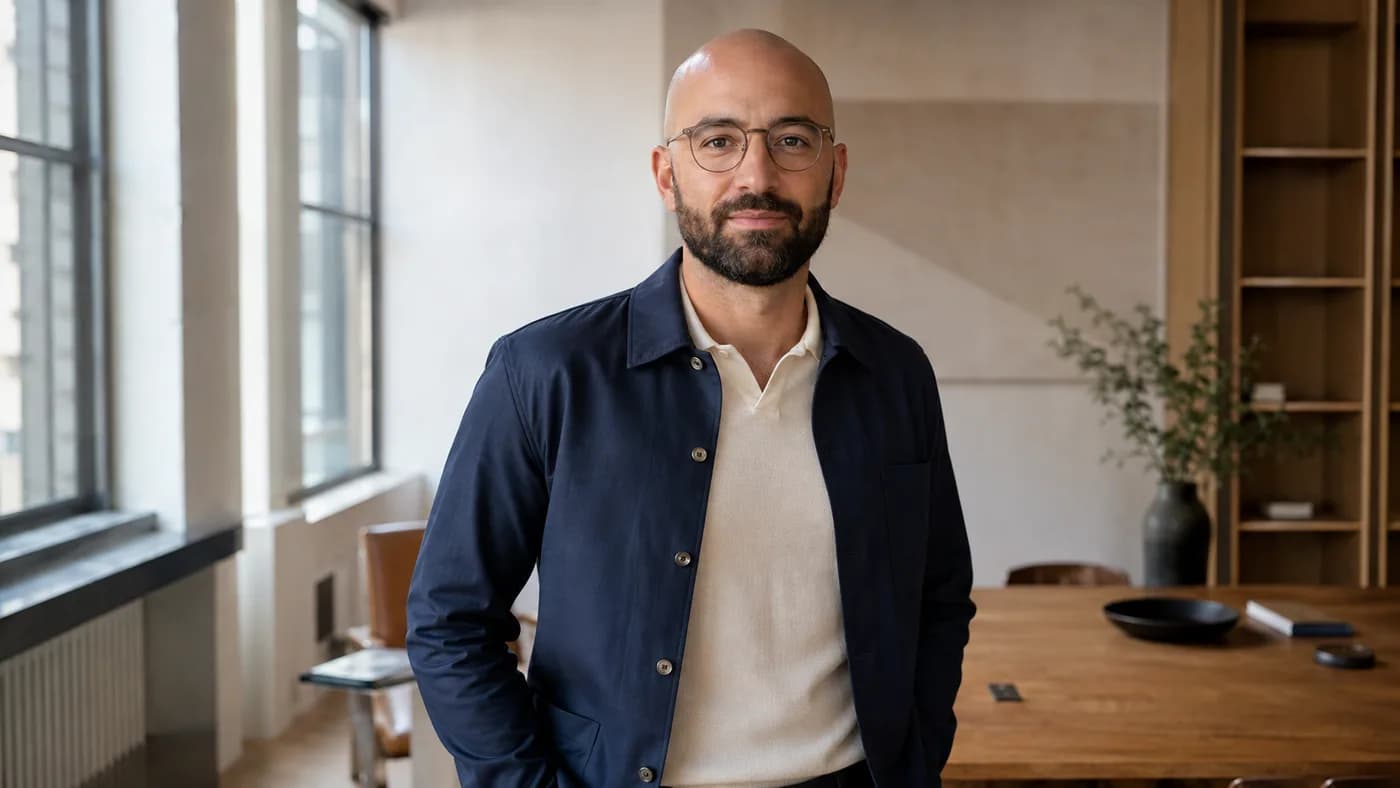
Personal branding for bald men is not about making baldness your whole brand. It is about making your professional image easy to recognize, believable, and simple to repeat. For a founder, consultant, creator, salesperson, or public-facing leader, the goal is not a permanent costume. It is a dependable visual system: a grooming finish, a few clothing shapes, a color direction, and portrait choices that all sound the same note.
That matters because people often meet your face before they meet your work—in a profile photo, on a video call, on a conference stage, or in a shared post. LinkedIn advises using a current photo that looks like you and matches the professional story in the rest of your profile (LinkedIn profile-photo guidance). Your bald look is simply one clear part of that story.
Quick read
Repeat a few compatible choices so you look like yourself in different rooms, seasons, and levels of formality.
A signature is stronger when it reflects your real beard, glasses, work, and personality instead of a borrowed persona.
A good mirror look must also work in a small avatar, a video-call frame, a client meeting, and daylight.
Quick answer: build a recognizable bald professional image
Choose one professional direction you can maintain—clear and minimal, warm and approachable, textured and creative, or tailored and authoritative. Then make five decisions: your normal scalp and facial-hair finish; one or two frame styles if you wear glasses; three compatible colors near the face; two repeatable collar or neckline shapes; and a photo approach with similar lighting and settings.
Keep the details stable enough to be recognizable, but let the actual outfit change with the meeting, climate, and role. Brand consistency is not visual sameness. As Canva puts it, personal branding works best when it highlights real strengths rather than inventing a new identity (Canva’s personal-branding guide).
Start with the professional impression you can honestly support
Before picking a jacket or beard length, write down the work you want people to associate with you. “Professional” is too broad to guide a wardrobe. Try a short phrase that combines your value and your working style:
- Calm operator who makes complex work clear
- Warm specialist who helps clients decide
- Practical creative who makes ideas tangible
- Direct founder who moves projects forward
This is not a promise that an outfit will make you more authoritative or trustworthy. It is a filter for choices. A consultant who sells clarity may want clean lines, a quiet palette, and a calm portrait. A creative director might still prefer a simple base, but add a recognizable frame shape, textured layer, or richer color. A sales leader may need a more approachable expression and meeting-ready polish without dressing like a different person.
A signature should reduce decision fatigue, not your personality
You do not need one outfit, one beard, or one permanent mood. Pick a dependable base, then make occasion-appropriate variations. The recognizable part is the relationship between the choices—not a rigid dress code.
The five anchors of a bald signature look
1. Choose your scalp and facial-hair baseline
Your baseline is the version people see most often: razor-smooth, foil-shaved, or short even head stubble; clean-shaven, stubble, or a beard at a consistent range. It should be the finish your skin tolerates and your schedule supports—not the most dramatic look you can create once for a photo.
If you wear a beard, decide what “normal” means in practical terms: light stubble, a short boxed beard, or a fuller, controlled shape. Keep the neckline and cheek lines intentional. If you are clean-shaven, the same coherence can come from tidy brows, calm scalp care, a structured collar, or glasses that fit well. Bald With Beard vs No Beard can help you choose a direction without treating facial hair as mandatory.
For a polished professional image, avoid making a close shave or a new beard shape your photo-day experiment. The Bald Head Care Routine covers a calm, repeatable foundation; Razor Bumps on a Shaved Head covers why irritation is worth addressing before an important shoot or event.
2. Use glasses as a deliberate anchor—only if they are yours
Eyewear can be memorable because it repeats close to the face, but frames do not need to become a prop. If you already wear glasses, keep one everyday pair that is comfortable, level, and clean; add a second pair only if it serves a real use, such as outdoor work or presentations.
Think in terms of visual weight. Heavy dark frames plus a very full beard can be effective, but they need a quieter collar and outfit. Light metal frames with neat stubble often leave more room for color or texture in the clothes. With no beard, frames may become a larger part of the face, so fit and proportion matter more. Use Bald With Glasses for a deeper fit guide instead of buying a frame just because it reads “creative.”
3. Build a small color palette near the face
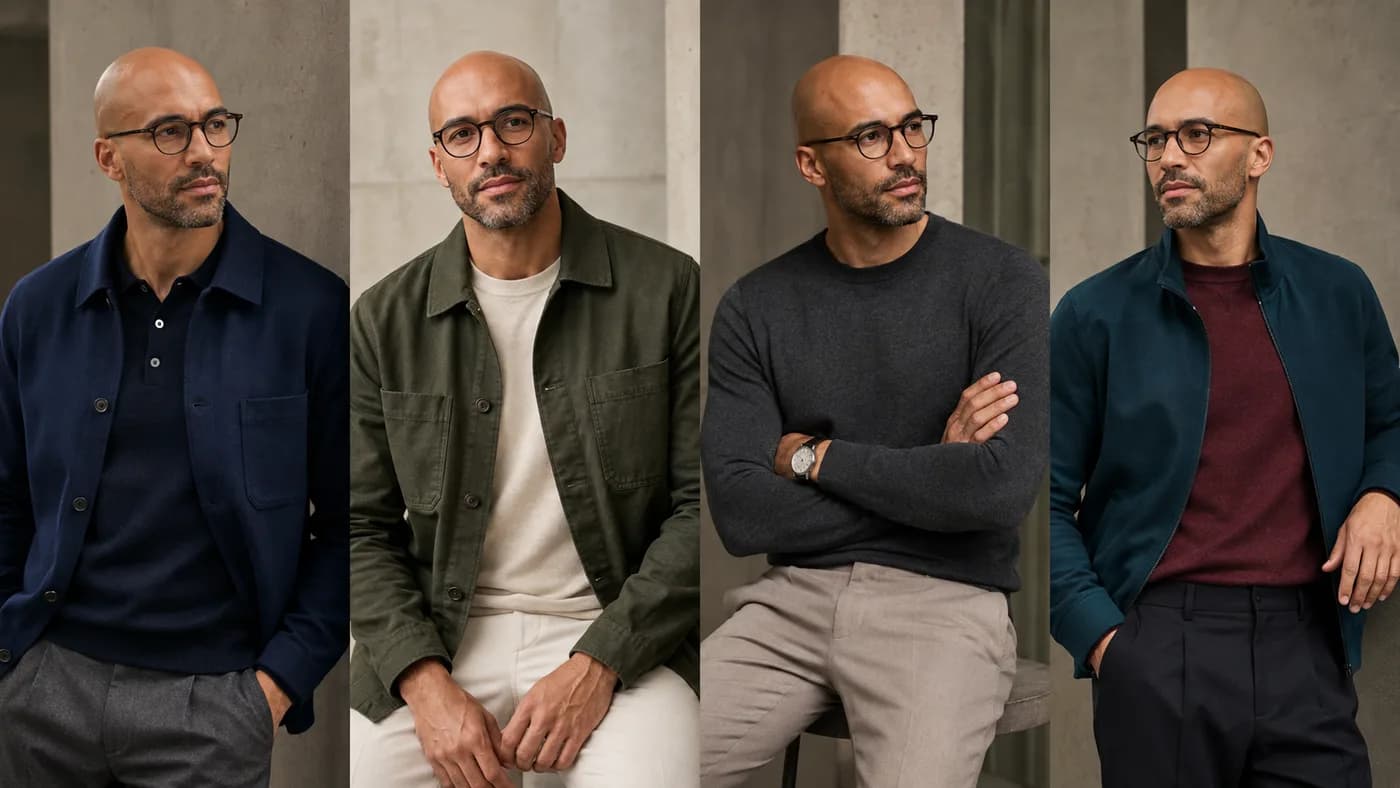
Choose three core colors that work together and make getting dressed easier: usually one dark neutral, one lighter neutral, and one accent. For example:
| Direction | Core colors | What it communicates visually | Easy pieces |
|---|---|---|---|
| Clear and polished | Navy, soft white, medium blue | Calm contrast and clean structure | Oxford, knit polo, overshirt, trousers |
| Warm and grounded | Olive, ecru, deep brown | Texture and ease without visual noise | Heavy tee, chore layer, knit, suede footwear |
| Modern and minimal | Charcoal, stone, muted black | Quiet, graphic simplicity | Crew knit, tee, straight trousers, simple sneakers |
| Confident and expressive | Deep teal, burgundy, navy | Controlled character near the face | Polo, overshirt, scarf, subtle pocket square |
These are starting points, not skin-tone rules. Beard color, glasses, background, and daylight all change the result. Take quick test photos in two candidate colors by a window. The better choice is the one that keeps your eyes and face clear instead of making the shirt or scalp reflection dominate. Clothing Colors for Bald Men explains this contrast test in more detail.
4. Repeat shapes, not the exact same clothes
The most useful personal uniform repeats silhouette: perhaps a knit polo or clean crew neck under an overshirt; an Oxford with tapered trousers; or an unstructured blazer over a simple tee. When the collar, shoulder fit, and proportion feel familiar, you can vary fabric, color, and formality without looking disconnected from yourself.
For bald men, the neckline and shoulder line do visible framing work. A collapsing collar, stretched tee, or oversized layer can make even expensive pieces look accidental. That does not mean every top needs a collar. It means the neck opening should hold its shape and the shoulders should land where your shoulders actually are. How to Dress When Bald and the Bald Men’s Capsule Wardrobe are useful next reads when you need the practical pieces.
5. Make portraits and environments feel related
Your LinkedIn avatar, website photo, speaker bio, and social profile do not need one duplicated headshot. They should share a logic. Use a similar crop, soft light, color family, and level of formality. A founder may use a close, calm headshot for LinkedIn and a wider working image for a website; a creator can use a more expressive scene while keeping the same grooming and palette.
LinkedIn recommends a current, high-resolution likeness, and says attire, expression, and setting help convey the “vibe” of your professional identity (LinkedIn’s sales-profile photo guide). Keep that true in every environment. If your online image says tailored and polished but your usual work is practical and informal, aim for a believable middle ground.
Pick a direction, then pressure-test it in real life
You can build a compelling look around several different directions. Choose the one that already has evidence in your wardrobe and work, then adjust one or two things rather than rebuilding everything.
| If your work asks for… | Try this direction | Grooming and clothing anchors | Keep it from becoming a costume |
|---|---|---|---|
| Reassurance, precision, client confidence | Calm and polished | Even shave or neat stubble, navy/blue/white palette, knit polos or Oxfords, simple frames | Use real work clothes, not a formal uniform you never wear |
| Energy, visibility, teaching | Warm and approachable | Natural expression, medium-value colors, softer knitwear, clean beard lines if worn | Do not over-style every detail; leave room for normal life |
| Ideas, design, public creativity | Textured and distinctive | One memorable frame or outer layer, deep color, tactile fabrics, consistent photo treatment | Keep one focal point; avoid stacking statement pieces |
| Leadership, negotiation, formal rooms | Tailored and grounded | Defined collar, structured jacket or overshirt, restrained palette, controlled scalp finish | Let the role set the formality, not baldness |
The useful test is repeatability. Could you recreate the version in five minutes before a video call? Could you pack it for a work trip? Would a colleague recognize you at an event? If the answer is no, simplify the system.
Create a one-page bald brand-look brief
Make the choices concrete in a short brief. Bring it to a photographer, a barber, a stylist, or simply keep it in your notes when you shop. Adobe’s guidance on a recognizable color style makes the same practical point: repeated color decisions can make images feel cohesive across different photos (Adobe Learn).
Use BaldLooks to test the system before committing
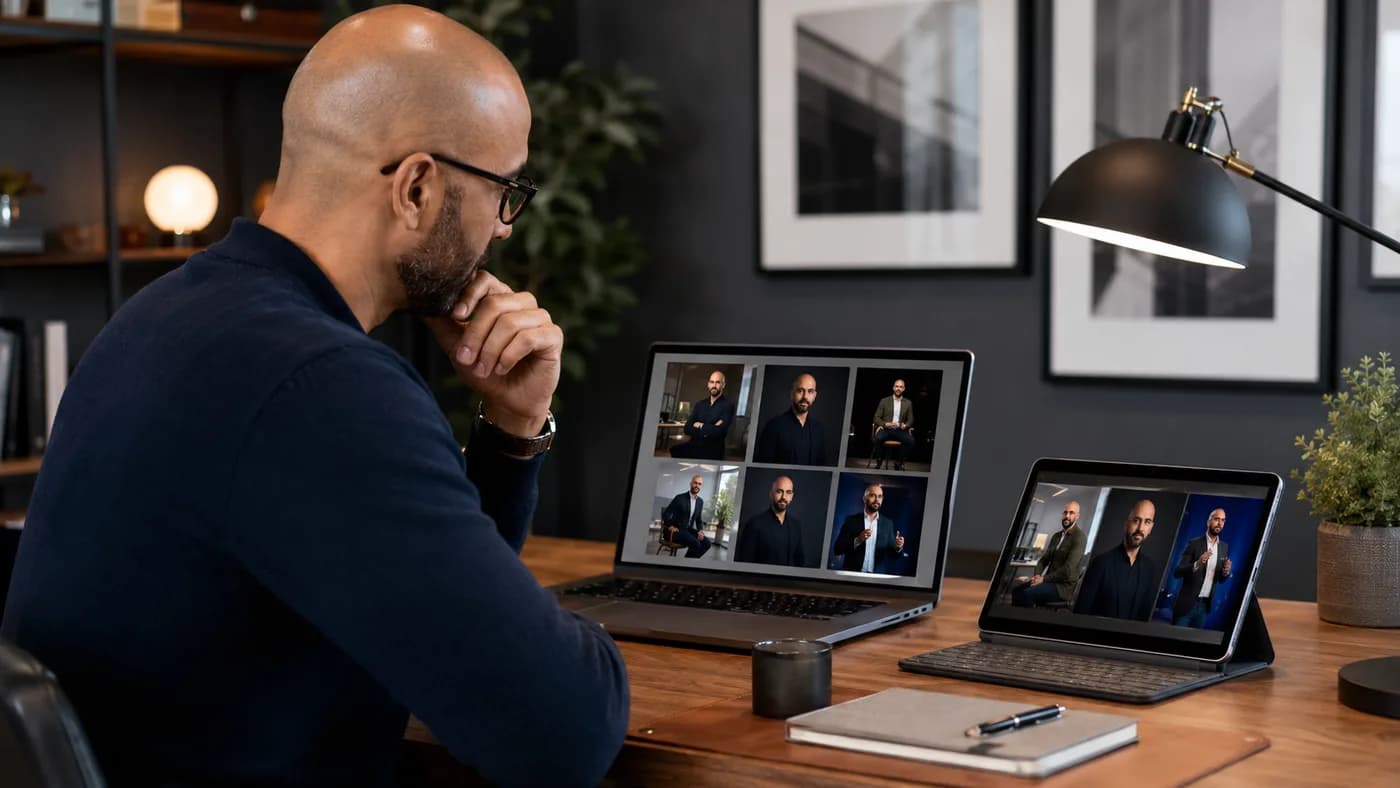
It is difficult to judge a signature look from one bathroom mirror angle. BaldLooks Free Analysis can give you a bald-look report from one photo. With a paid BaldLooks plan, you can compare several directions—clean-shaven or bearded, different frames, professional outfits, and office or stage settings—across angles before you choose the combination you want to repeat.
The practical takeaway
A personal brand is not a dramatic reinvention. It is a pattern people can recognize: you look current, your grooming is intentional, your clothes make sense for your work, and your photos feel connected to the person they will meet. For bald men, that starts with a repeatable head and facial-hair finish, then expands through color, collars, glasses, and settings.
Pick a clear direction. Keep only the choices you can maintain. Then let your work—not a manufactured image—do the rest. For the portrait side of the system, continue with LinkedIn Headshots for Bald Men; for live meetings, use Video Call Lighting for Bald Men.