Best Colors for Bald Men: A Contrast and Skin-Tone Guide
The best colors for bald men are the ones that make your face look clear and intentional in real light—not the ones a generic palette says you are allowed to wear. Once hair is gone, the color nearest your face has a little more influence. But skin tone is only one input. Your beard, brows, glasses, tan, scalp finish, and the contrast you want all change the result.
The useful goal is not to find one magic shade. It is to build a small color system you can repeat: reliable darks, useful lights, a few richer colors, and a way to test them before you rebuild your wardrobe.
Quick read
First compare light, medium, and dark clothes near your face. The light-dark relationship is usually easier to see than a warm-versus-cool undertone.
A beard, brows, glasses, and even a tan can create contrast after you shave. Do not choose colors as if your head were the only feature.
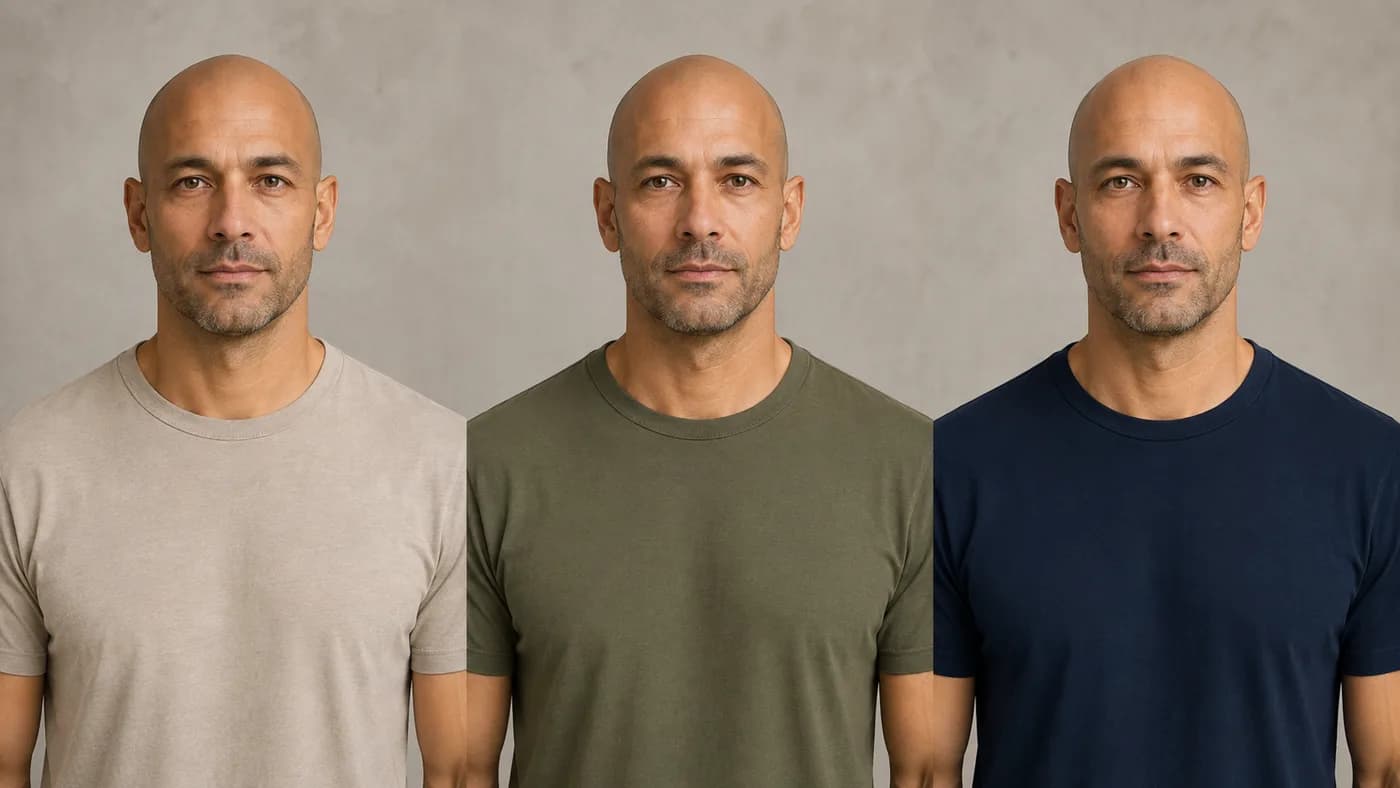
Daylight photos in three simple tops reveal more than a rigid seasonal label. Keep the colors that make you look awake and use them often.
Quick answer: a practical bald-man color palette
If you want a dependable first rotation, try navy, charcoal, off-white or cream, olive, medium blue, deep green, chocolate, and one muted red or burgundy. They are flexible enough to test with jeans, trousers, jackets, and different beard colors.
Then change the depth before you change your entire wardrobe. If black feels too severe, try charcoal. If pure white feels stark, try ecru or cream. If pale blue feels faint, try a dustier or deeper blue. The family may be right; the value or saturation may be wrong.
Color is a tool, not a verdict
A shaved head does not require dark clothes, a beard, or a particular skin-tone category. Use color to create the effect you want—quiet, sharp, relaxed, rugged, or polished—then judge it in actual photos.
Why the color nearest your face matters
Hair usually frames the upper face. With a shaved head, the eye moves more directly between scalp, features, neckline, and shoulders. A dark beard, glasses, a tan, and lighting can all change the result, so choose from the full frame—not scalp tone alone.
Learn the four color levers: value, contrast, undertone, and saturation
You do not need to memorize color theory. Four plain-language levers are enough.
| Lever | What it means | What to test near your face |
|---|---|---|
| Value | How light or dark a color is | Cream versus navy, stone versus charcoal |
| Contrast | The visual gap between you and the clothes, or between outfit pieces | A dark jacket over a light tee versus tonal layers |
| Undertone | Whether a color reads warmer, cooler, or neutral | Olive versus cool forest green; cream versus optic white |
| Saturation | How vivid or muted a color is | Clear cobalt versus dusty blue; bright red versus burgundy |
Start with value because it is the clearest. A shirt can be the right blue but too pale; the right green but too dark. Then test temperature and vividness inside the color family that already feels good.
Personal color systems often use your skin, eyes, and hair to estimate contrast. For a bald look, facial hair can still affect that read: color-analysis guidance specifically notes that more visible facial hair can add contrast around the face (colorDNA on human contrast). Treat that as a styling observation, not a prescription. Your own daylight test is the decision-maker.
Find your facial contrast without guessing your undertone
Your facial contrast is the combination of light and dark already visible in your face. A shaved scalp may soften the upper border, but it does not erase your brows, eyes, beard, skin depth, or glasses.
Lower facial contrast: keep the outfit tonal and calm
If your brows and facial hair are light, gray, close to your skin, or absent, softer combinations can feel natural: cream with stone, light olive with taupe, or soft blue with medium gray. Deep tones can still work; keep the jumps between top, jacket, and face more gradual when you want a softer result.
Medium facial contrast: the most flexible starting point
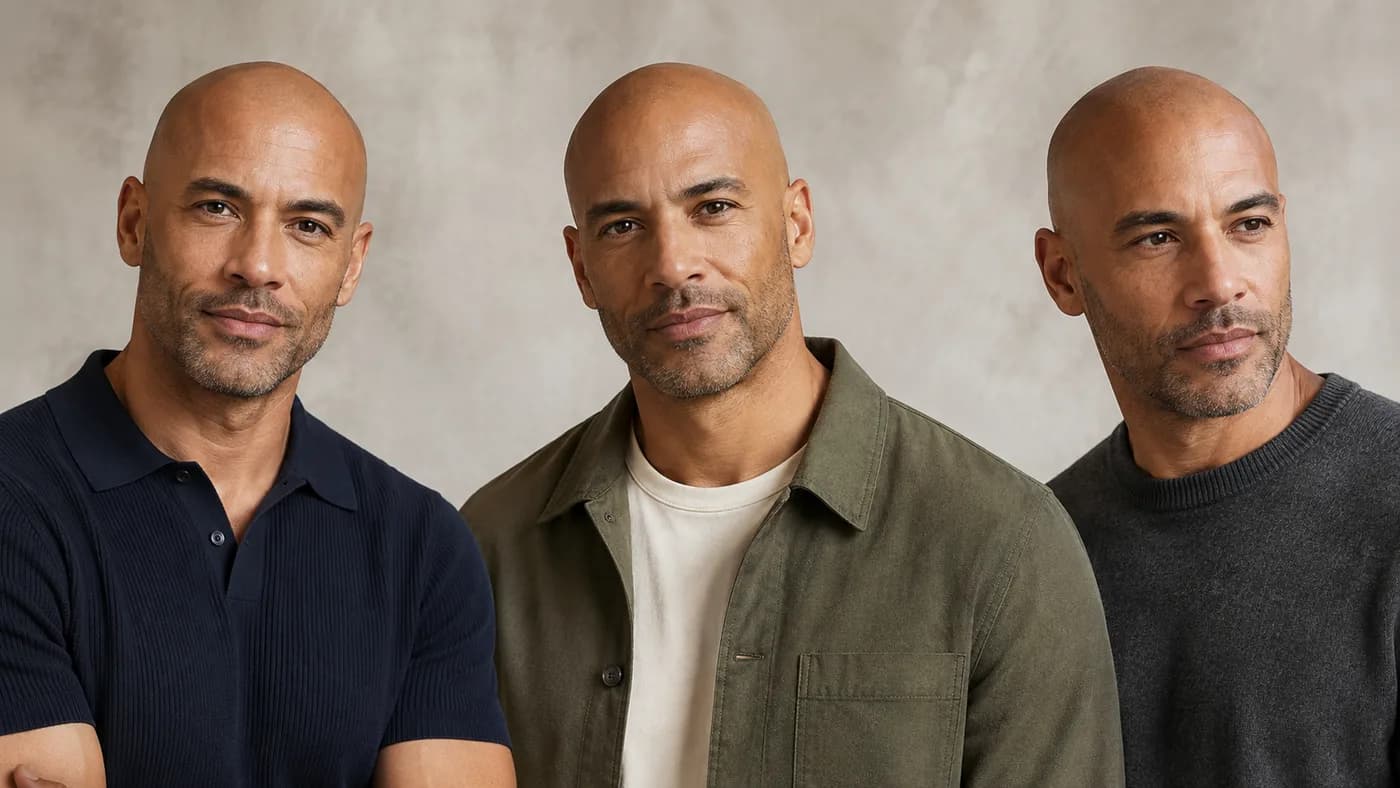
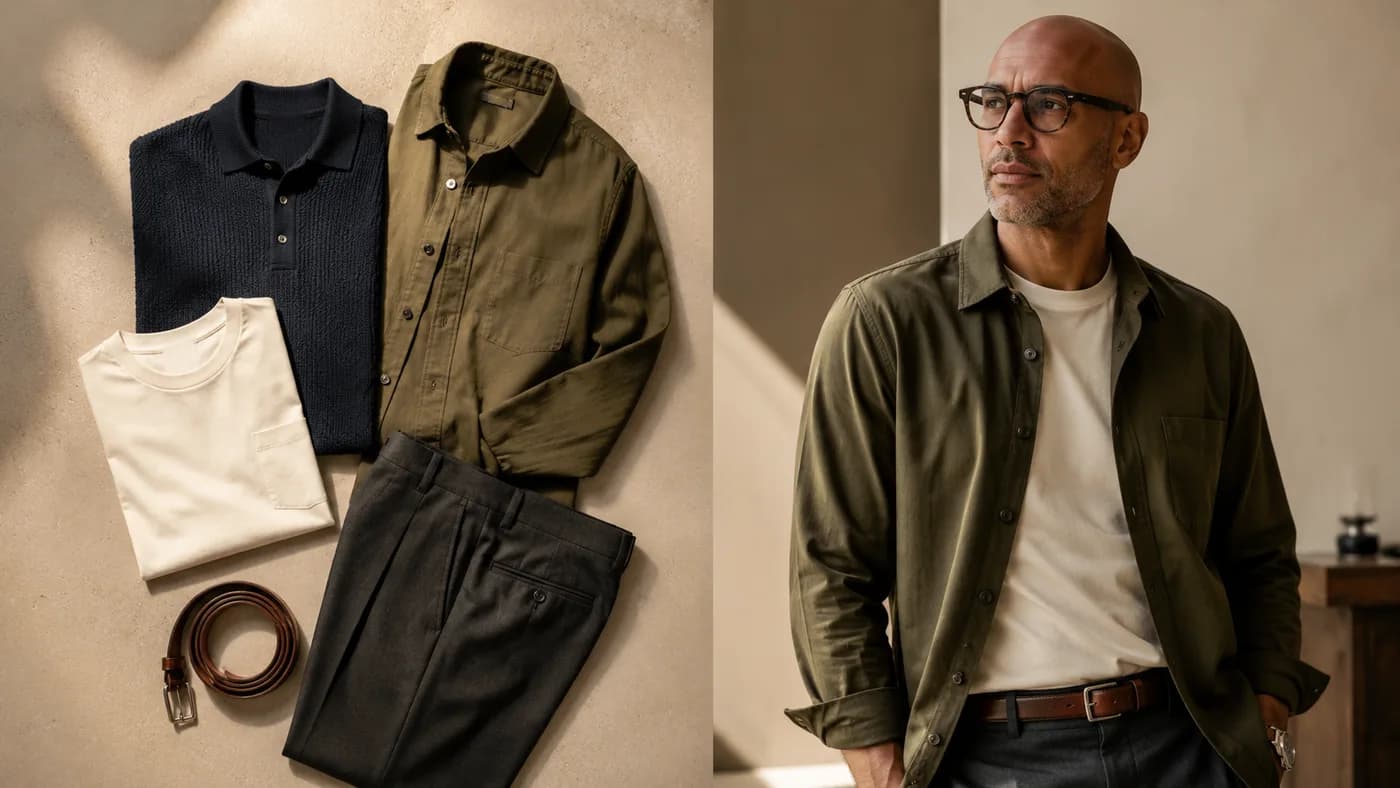
Many bald men land here: the face has some definition from brows, eyes, stubble, glasses, or a medium-to-dark beard, but not a dramatic split. Use a navy polo with stone trousers, olive overshirt with cream tee, or charcoal knit with mid-blue denim. If unsure, start here.
Higher facial contrast: use clear anchors, then keep the rest simple
If you have a dark beard against lighter skin, strong dark frames, pronounced brows, or naturally deep features, a black or navy top or dark jacket over a light tee can echo those anchors. Do not use contrast everywhere; let one or two elements lead.
Use skin tone and undertone as experiments, not rules
You can wear nearly any color family. The useful question is which version helps your skin look even and your features stay visible.
- If warm, earthy colors make your face look rested, test olive, tobacco, chocolate, rust, warm navy, cream, and muted mustard.
- If cooler or clearer colors look fresher, test charcoal, blue-gray, deep navy, pine, cool burgundy, crisp white, and cobalt in small doses.
- If both work, you may prefer neutral colors—or simply be reacting more to value and saturation than temperature.
Hold two tops, one warmer and one cooler, under your chin in indirect daylight. Photograph both and keep the one that makes redness, under-eye shadows, and uneven beard color less distracting. Retest after summer, a beard change, or new glasses.
Build a small color palette around the clothes you actually wear
A useful wardrobe has colors that combine easily, not isolated statement shades. Start with three layers.
| Layer | Reliable color families | How to use them |
|---|---|---|
| Foundation neutrals | Navy, charcoal, cream, stone, chocolate, olive | Tees, polos, knitwear, trousers, jackets |
| Face-friendly color | Medium blue, deep green, burgundy, rust, muted teal | Shirts, overshirts, knit polos, scarves |
| Small contrast accents | White, black, denim blue, tan leather, silver or gold hardware | Sneakers, watch, glasses, undershirt, belt |
For a five-top test, try cream, charcoal, navy, olive, and one burgundy or medium-blue piece. That is enough range to learn your preferred contrast without buying a new wardrobe.
Let beard color, glasses, and scalp finish change the final call
A dark beard can support a lighter shirt or a deeper top. Gray facial hair often pairs well with charcoal, navy, olive, cream, and clear blues, but test the exact shade. Dark frames add contrast; lighter frames reduce it. For more on frame proportion, see Bald With Glasses. If a shiny scalp or harsh lighting is disrupting the balance, see Bald Head Shine.
The two-minute daylight test before you buy
Use this simple test when a color looks promising in a store or online:
For outdoor plans, function may make the color decision for you. Darker, tightly woven clothes can offer more UV protection than light, loose-weave fabrics, according to the American Academy of Dermatology’s clothing guidance. That does not make dark clothes a substitute for shade, a suitable hat, and SPF on exposed skin—especially on a shaved scalp. Read Hats for Bald Men for the practical outdoor layer.
See the colors on your full bald look before changing your wardrobe
The mirror gives you one angle and one room. A better test is the full frame: collar, beard or clean shave, glasses, outfit color, and setting. BaldLooks Free Analysis gives you a bald-look report from one photo. When you want to compare several directions, BaldLooks plans let you see a shaved-head look from different angles, in different outfits, and in different locations before you buy into a new wardrobe idea.
Final takeaway: choose the effect, then verify it
The best clothing colors for bald men are not a fixed list. Start with value contrast. Refine with undertone and saturation. Include your beard, glasses, scalp tone, and lighting. Then take a daylight photo before you decide.
Build around a few reliable neutrals and colors that work close to your face. That gives you a wardrobe that looks considered without making baldness the whole story.