
Norwood Scale Explained: Which Stage Are You?
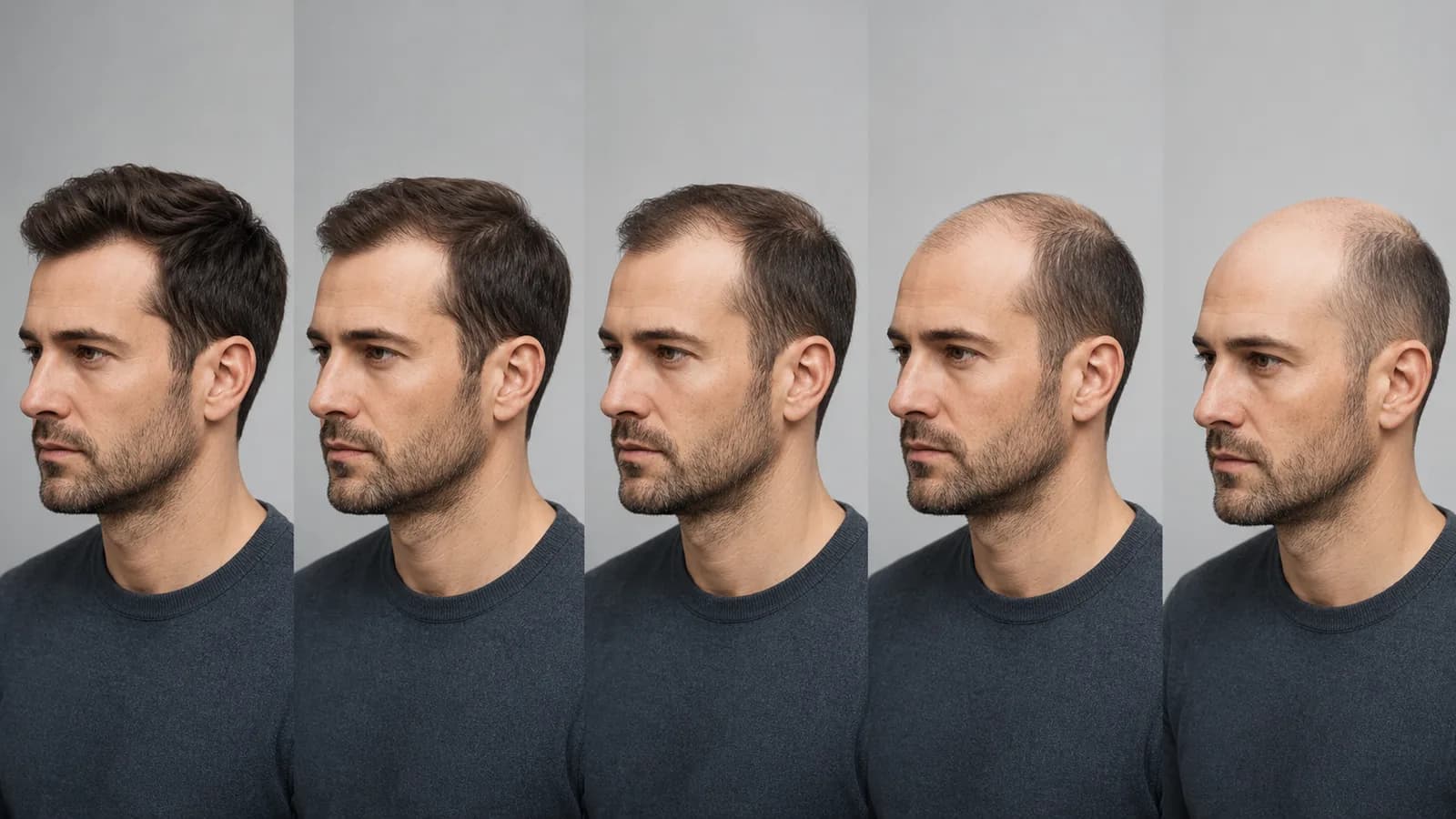
If you are searching "Norwood scale", you usually want one of two things: a fast way to figure out which stage you may be in, or a clearer idea of what that stage means for your next haircut decision.
That is exactly what the Norwood scale is good for. The Hamilton-Norwood scale is the common staging system used to describe how male pattern baldness tends to progress. The Cleveland Clinic summarizes it as a seven-stage pattern that usually begins with temple recession and can later involve the crown and top. A review in PMC notes that Norwood revised Hamilton's earlier classification in 1975 and that the Hamilton-Norwood system remains the most widely used way to classify male patterned hair loss.
The short answer is this: Norwood 1 to 2 is usually early or mild change, Norwood 3 is often the first real decision stage, and Norwood 4 to 7 generally means the pattern is clearly established.
Quick read
It helps classify a hair-loss pattern you can see. It does not medically diagnose why the pattern is happening.
This is usually where recession stops feeling subtle and shorter cuts start outperforming styled coverage.
Your stage depends less on one angle and more on the combination of temple recession, top density, and crown visibility.
What the Norwood scale actually measures
The Norwood scale focuses on the pattern of hair loss, especially at the temples, the frontal hairline, and the crown. The American Academy of Dermatology describes male pattern hair loss as something that tends to develop gradually, often beginning with a receding hairline or thinning at the crown, which is exactly why this scale is so widely used.
It is best viewed as a classification tool, not a prediction tool. It does not tell you the exact cause, speed, or best response to your hair loss.
Do not confuse stage with destiny
Two men can both look like Norwood 3 and still have very different outcomes. One may stay there for years. Another may keep progressing. The stage tells you what the pattern looks like now, not exactly what will happen next.
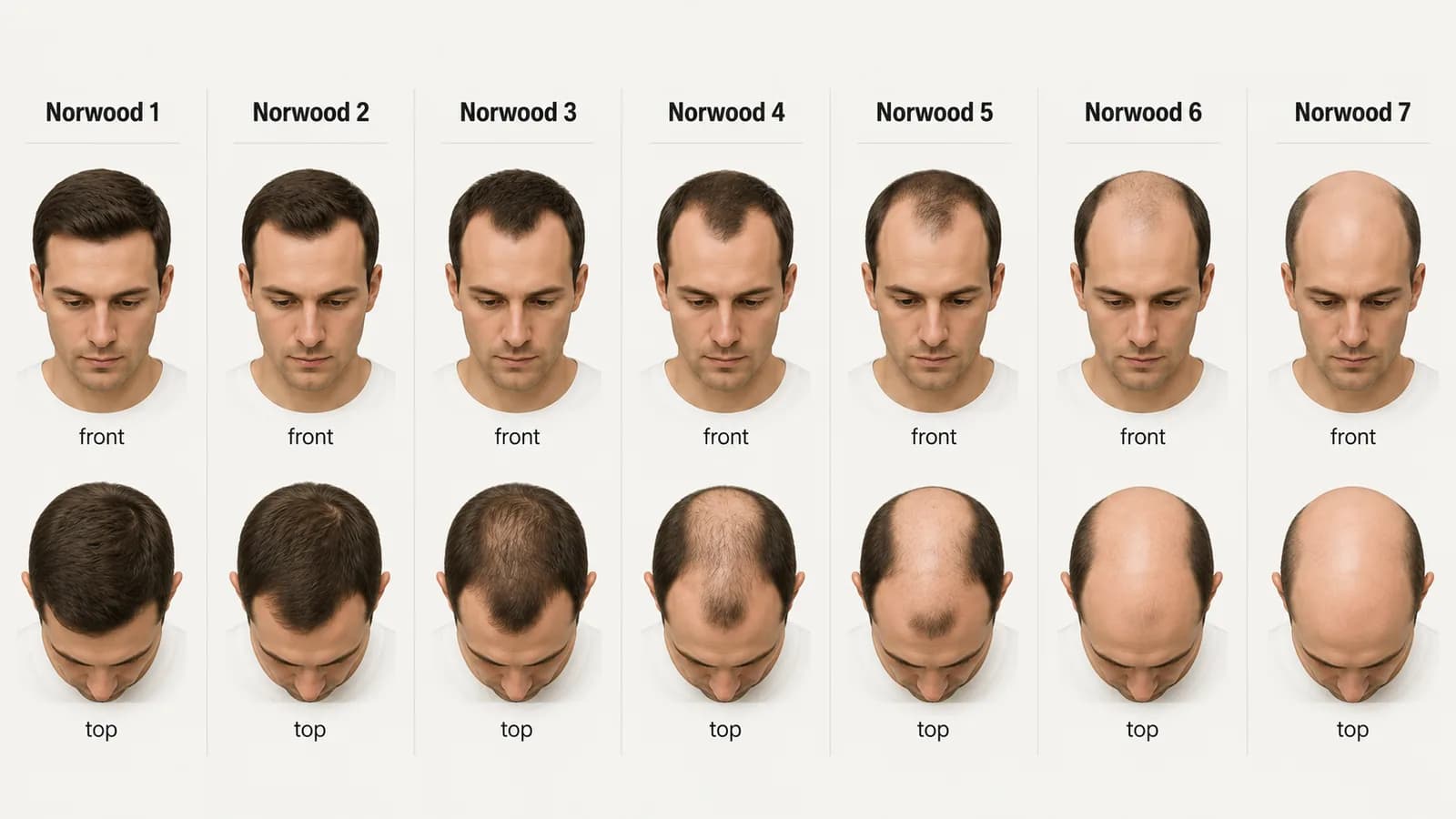
Norwood 1 to 7 explained in simple language
The easiest way to understand the scale is to stop thinking clinically and start thinking visually.
| Stage | What it usually looks like | What most men notice |
|---|---|---|
| Norwood 1 | Little to no visible recession | Hairline looks basically intact |
| Norwood 2 | Mild recession at the temples | Front corners start to open slightly |
| Norwood 3 | Clearer temple recession, often an M shape | "My hairline is definitely changing" |
| Norwood 4 | Deeper frontal recession and early crown loss | Front and crown are both becoming noticeable |
| Norwood 5 | Bridge between front and crown gets thinner | Hair loss looks broader, not just localized |
| Norwood 6 | Very limited hair across the top middle | Front and crown loss mostly merge |
| Norwood 7 | Only a band of hair remains on the sides and back | Top is largely bare |
Norwood 1
Norwood 1 usually means little or no visible recession. It is the baseline end of the scale, not a promise that your hairline must look exactly like it did in your teens.
Norwood 2
Norwood 2 usually means slight temple recession. Mild recession does not automatically mean aggressive balding, which is why time and photo comparison matter more than one stressful check.
Norwood 3
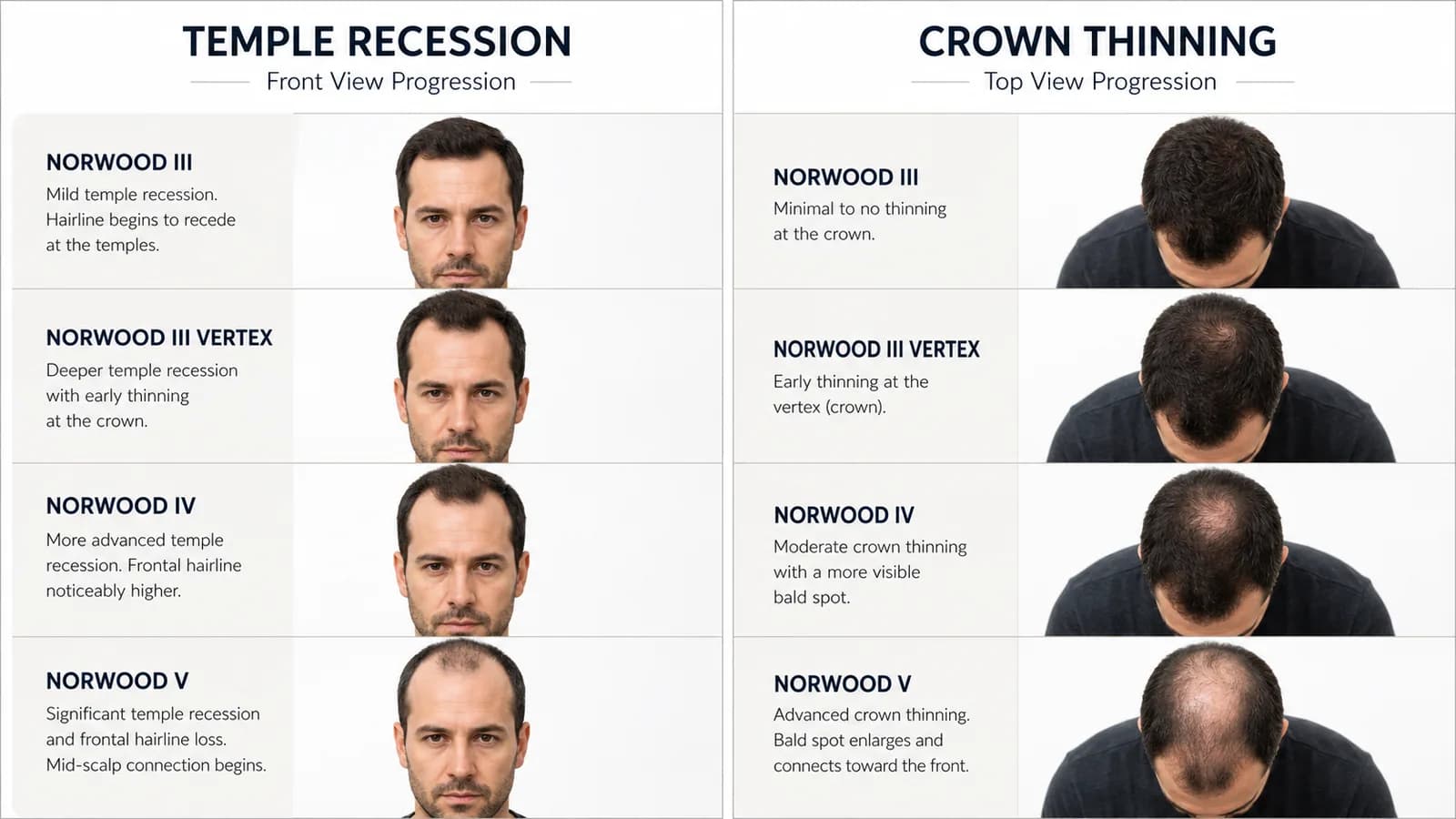
Norwood 3 is often the first stage where the recession becomes clearly noticeable. This is usually the point where shorter haircut decisions become more practical. If that sounds familiar, the guide on Norwood 3 haircuts and when to shave goes deeper.
Norwood 4
Norwood 4 usually adds obvious crown thinning to deeper frontal recession. That is when the pattern often starts feeling broader than a simple hairline issue.
Norwood 5 to 7
From Norwood 5 onward, the weak zones across the top usually become larger and more connected. By Norwood 6 and 7, there is limited hair across the top and the styling decision often becomes more about clean grooming than coverage.
How to tell which Norwood stage you may be in
Most men misread their stage because they rely on one mirror angle. A better method is to check four views:
- front hairline in natural light,
- left and right temple angles,
- crown from above,
- one three-quarter photo.
Then ask whether the temples are only slightly back or clearly deeper, whether the middle front is still strong, and whether the crown is stable or now part of the same story. Mild temple change is often closer to Norwood 2. Clearer recession that already affects haircut choices is often closer to Norwood 3. Crown involvement usually pushes the pattern into Norwood 4 or beyond.
This is also why readers often jump between guides like am I balding, crown balding, and best haircuts for a receding hairline. They are all trying to answer different parts of the same classification problem.
The most common mistake: confusing Norwood 2 with Norwood 3
This is the line most men care about. In practical terms:
- Norwood 2 often still looks like a hairline that has changed, but still reads as fairly normal.
- Norwood 3 usually looks like a hairline that has become a noticeable feature of your appearance.
If you style around the front every day, wind exposes the corners fast, shorter cuts keep looking better, and photos show more recession than expected, you are often no longer in the "barely changed" category.
Use the scale to reduce arguments with yourself
The Norwood scale is most useful when it turns vague anxiety into a more practical observation: mild temple change, clear recession, crown involvement, or broad top loss. That makes the next decision easier.
What the Norwood scale means for your haircut choices
The scale matters because each stage changes which styles still work naturally.
If you are debating the practical side of that shift, when to shave a receding hairline and buzz cut vs bald are usually the next useful reads.
When the scale becomes a shave decision
The Norwood scale does not tell you that you should shave at a certain number. It simply becomes more useful once the remaining hair is adding less than the stress of managing it. For many men, that conversation starts around late Norwood 3 and becomes more serious once the crown joins in at Norwood 4 or 5.
If you are at that point, a preview usually helps more than more internet debate. Once you understand your stage, the next useful question is whether a shaved head creates a cleaner, more intentional look on your actual face.
Limits of the Norwood scale
The scale is useful, but it can be less helpful with diffuse thinning, misleading lighting, or patterns that do not follow the classic front-and-crown route. If your top is getting see-through while the hairline still looks mostly intact, broader self-check guides like am I balding are often more useful than obsessing over one exact Norwood number.
Final answer: which stage are you probably in?
Use this shortcut:
- Mostly intact hairline with little temple movement: likely around Norwood 1.
- Mild corner recession but still subtle overall: often Norwood 2.
- Clearly visible temple recession that shapes the whole haircut: often Norwood 3.
- Deeper recession plus visible crown thinning: often Norwood 4.
- Front and crown thinning beginning to connect: often Norwood 5.
- Very limited hair across the top: often Norwood 6.
- Hair mainly left on the sides and back: often Norwood 7.
If you want the most accurate self-read, do not judge from one stressed mirror session. Use photos, check both the front and crown, and compare over time.
Then make the next decision from there: keep the haircut if the hair still improves the overall look, go shorter if shorter keeps looking cleaner, and preview bald if you are close to the point where shaving may be the stronger option. The Norwood scale is not about locking yourself into an identity. It is about getting honest about the pattern so your next move is based on evidence instead of avoidance.