
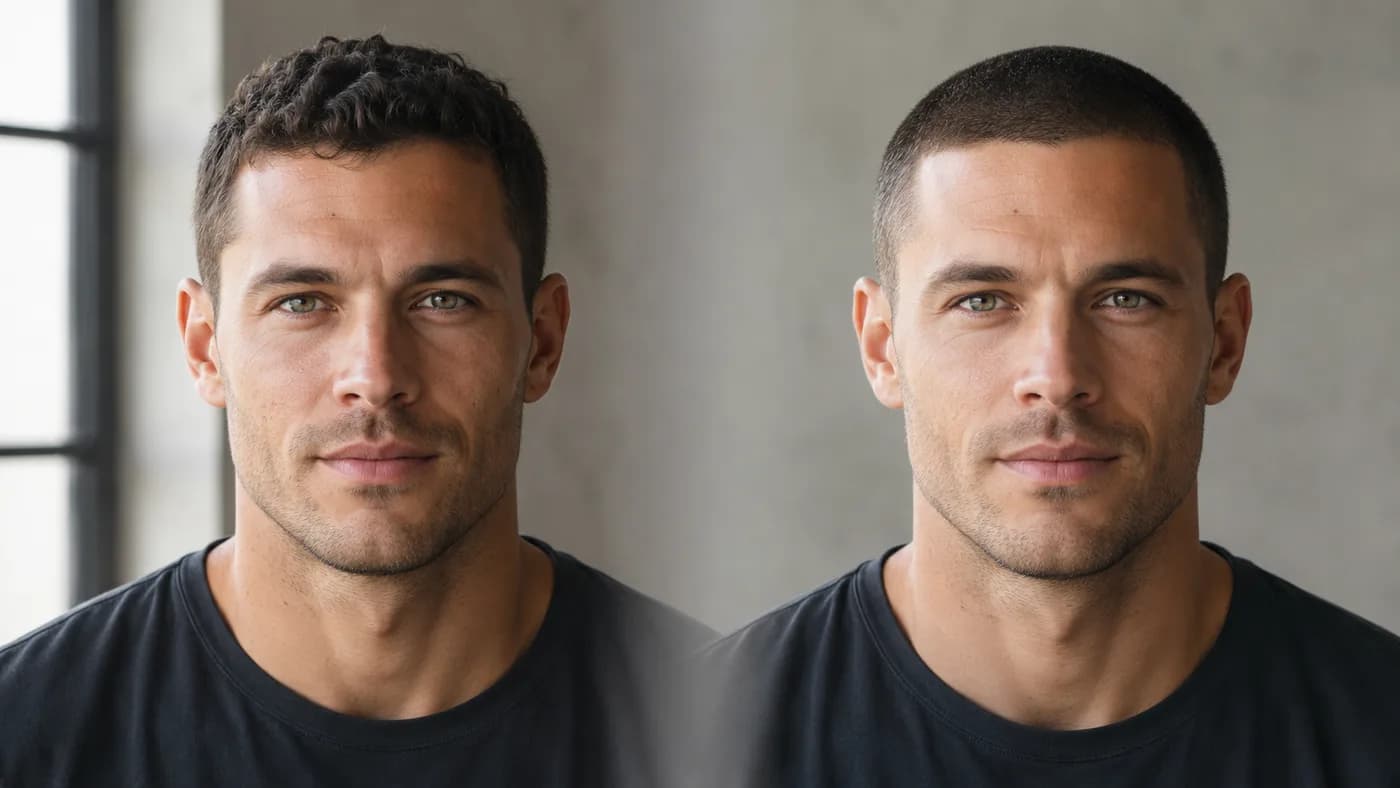
If you are worried about a buzz cut with a high hairline, the fear is understandable: short hair seems like it will put a spotlight on your forehead. But a high hairline is not automatically a bad hairline, and it does not automatically make a buzz cut look worse.
In fact, a short, even cut can make a naturally high or mature hairline look more deliberate. It removes the longer fringe or styled volume that often keeps pulling attention toward the front. The key is to avoid treating three different things as though they are the same: a high hairline, a mature hairline, and active recession.
The useful question is not, “Can I hide my forehead?” It is: does shorter hair make the whole frame of my face look calmer and more balanced?
Quick read
A higher forehead can be natural or stable. Look for change over time and density behind the front edge before calling it hair loss.
With solid density, a #2 keeps the result conventional and even without relying on front coverage.
A soft low fade can refine the cut. An aggressive skin fade can make strong sides and a weaker top look disconnected.
Quick answer: does a buzz cut suit a high hairline?
Usually, yes—provided the hair behind the line is dense enough and the shape is stable. A buzz cut does not lower your hairline, but it can stop your hairstyle from arguing with it. Instead of trying to create a lower front with volume, you get a clean outline that lets the face carry the look.
This is especially true when your hairline is high but fairly even. In that situation, a shorter cut often looks intentional rather than exposed. The outcome changes when the temples are moving back, the front is becoming wispy, or crown thinning is part of the same picture. Then the haircut is not just about forehead height; it is about contrast between strong and weak areas.
The American Academy of Dermatology notes that male-pattern hair loss often develops gradually as a receding hairline, thinning, or a crown bald spot. Cleveland Clinic similarly describes temple recession and crown loss as common parts of the pattern. Neither source makes a high forehead a diagnosis—which is exactly why a photo from today alone cannot settle the question.
A buzz cut should simplify the picture
If the haircut looks cleaner in daylight, from the side, and after a normal day—not only when freshly styled—it is probably helping. If it makes the top look much lighter than the sides, go shorter, soften the fade, or compare it with shaved.
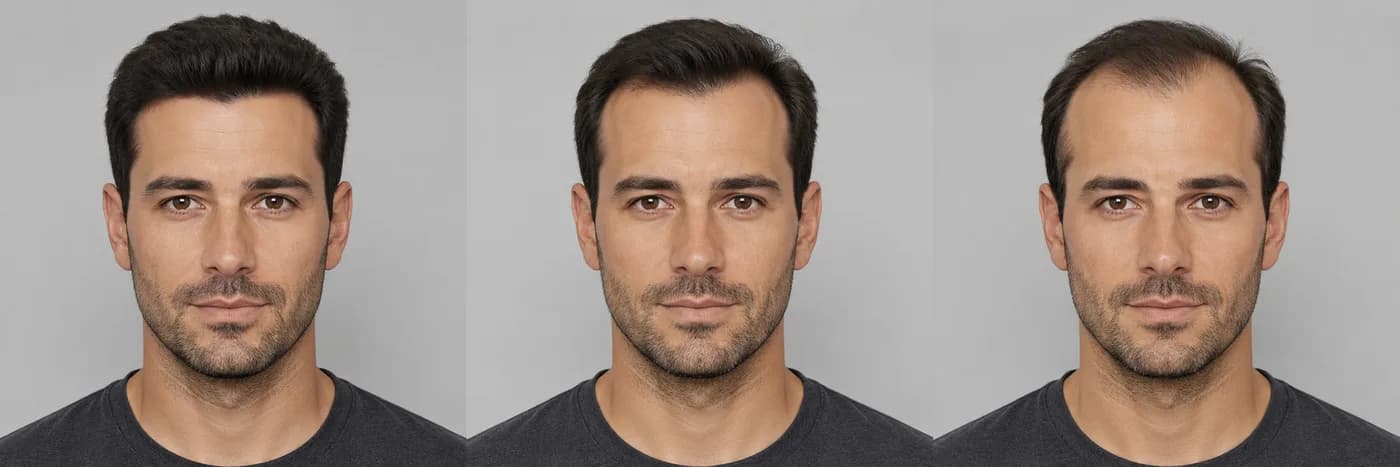
High hairline vs mature hairline vs recession
Forehead height is a poor shortcut for deciding whether you are losing hair. Use pattern and progression instead.
| What you see | What it can mean | What to check before buzzing |
|---|---|---|
| High but even hairline | Often a natural facial proportion | Is density immediately behind the line still strong and even? |
| Slightly higher, adult-looking corners | Often a mature hairline | Has the shape been stable across photos from the last year or two? |
| Temples continuing to deepen | Possible recession | Is the movement becoming less symmetrical or paired with front thinning? |
| Thinner front or visible crown too | More than a forehead-height question | Compare the whole top and sides in overhead light and photos |
A mature hairline can sit higher than your teenage hairline without being a problem. It may lift slightly at the corners and then settle. A receding hairline is more about movement: deeper temples over time, reduced density behind them, or a similar change appearing at the crown.
For a fuller self-check, see Mature Hairline vs Receding Hairline and Hairline Test: Is Your Hairline Mature or Receding?. If hair loss is sudden, patchy, painful, itchy, or comes with redness or scaling, skip the haircut diagnosis and speak with a dermatologist. Those signs can have causes other than gradual pattern loss.
Why short hair can make a high hairline look better
The paradox is that longer hair does not always make a high forehead less noticeable. A longer top can create a clear contrast between a low-looking fringe and the actual line behind it. Wind, gym sweat, daylight, or a phone camera then exposes the gap—and the cover-up becomes the focal point.
A buzz cut removes that negotiation. It makes the line visible, but it reduces the amount of hair that can separate, flatten, or look like it is trying to move forward. That tends to shift attention back to your eyebrows, eyes, jawline, beard, glasses, and overall grooming.
The result often works best when:
- the hairline is high but the top is evenly dense;
- your temples are only mildly mature rather than actively thinning;
- your current style needs product or careful positioning to look right;
- you prefer a clean, low-maintenance haircut over a camouflage strategy.
It can feel harsher when dense sides are paired with a translucent front or crown. That is not proof you “cannot pull off” short hair. It is a clue that the comparison should include a shorter guard, one-length buzz, or shaved head rather than stopping at the first cut.
Best buzz cut lengths for a high hairline
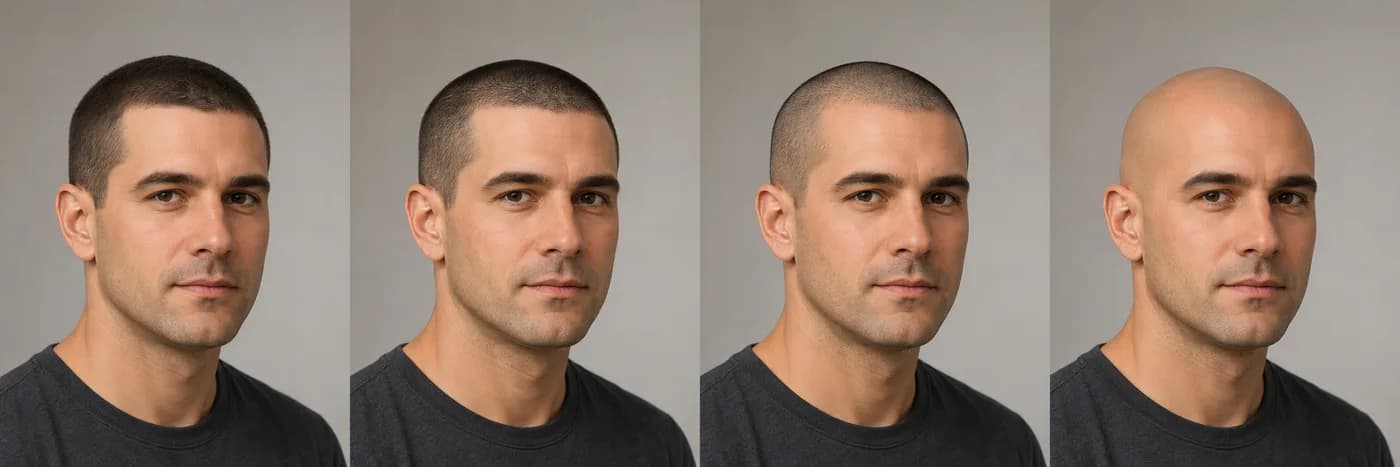
Guard length changes how strongly the forehead and density read. The goal is proportion, not blindly going as short as possible.
For a genuinely high, dense hairline, begin with a #2. It proves whether you like the cleaner frame without making the first cut feel extreme. Move to #1 if the #2 still leaves the front soft or separated. A #3 is fine when density is excellent, but it is not automatically safer. And if the top is already weaker than the sides, compare #1 and shaved instead of trying to force a longer buzz to act like full coverage.
Fade choices: when they help and when they expose too much
Fades are useful because they remove bulk at the sides, but they are also where a buzz cut can become more contrast-heavy than it needs to be.
| Style | Usually works when | Be careful when |
|---|---|---|
| One length | You want the most honest read of density and a calm, uniform silhouette | You want strong barbershop detail around the ears |
| Soft low fade | You have good top density and want a little polish without making the temples the focus | The fade is taken too high or blended too tightly |
| Mid fade | Your buzz is even and you like a more defined profile | The top is already visibly lighter than the sides |
| High skin fade | You deliberately want a bold, high-contrast style | You are worried that temple recession or a thin front is being emphasized |
For most men testing a buzz cut high hairline, one length or a soft low fade is the safest brief. It lets the high hairline be part of the shape without creating two very dense side panels around it. Avoid an artificial hard lineup that tries to redraw receded corners; it usually calls attention to the exact area you want to stop overthinking.
If your concern is deeper temple movement rather than forehead height, Buzz Cut With a Bad Hairline and Buzz Cut M-Shaped Hairline cover the more recession-specific decision. The next post in this cluster will compare fade types in more detail.
Balance the rest of the frame, not just the forehead
A buzz cut makes the whole face more visible, which is useful—not a problem to solve. Treat it as a styling system:
- Beard or stubble: A neat stubble length or short beard can add lower-face weight if you want more balance, but it is optional. See Bald With Stubble for practical combinations.
- Glasses: Frames can add structure around the eyes and work particularly well when short hair increases face focus. Bald With Glasses explains the balance.
- Skin and scalp care: If you go very short, moisturize and use sunscreen on exposed scalp. A clean scalp is part of what makes the cut look intentional.
- Clothing: A simple neckline and well-fitting layers often look sharper once the face, shoulders, and jawline carry more of the silhouette.
Do not add every styling element at once to compensate for a high hairline. First find the hair length that feels right. Then keep the beard, glasses, and clothes consistent enough to see what actually improves the overall frame.
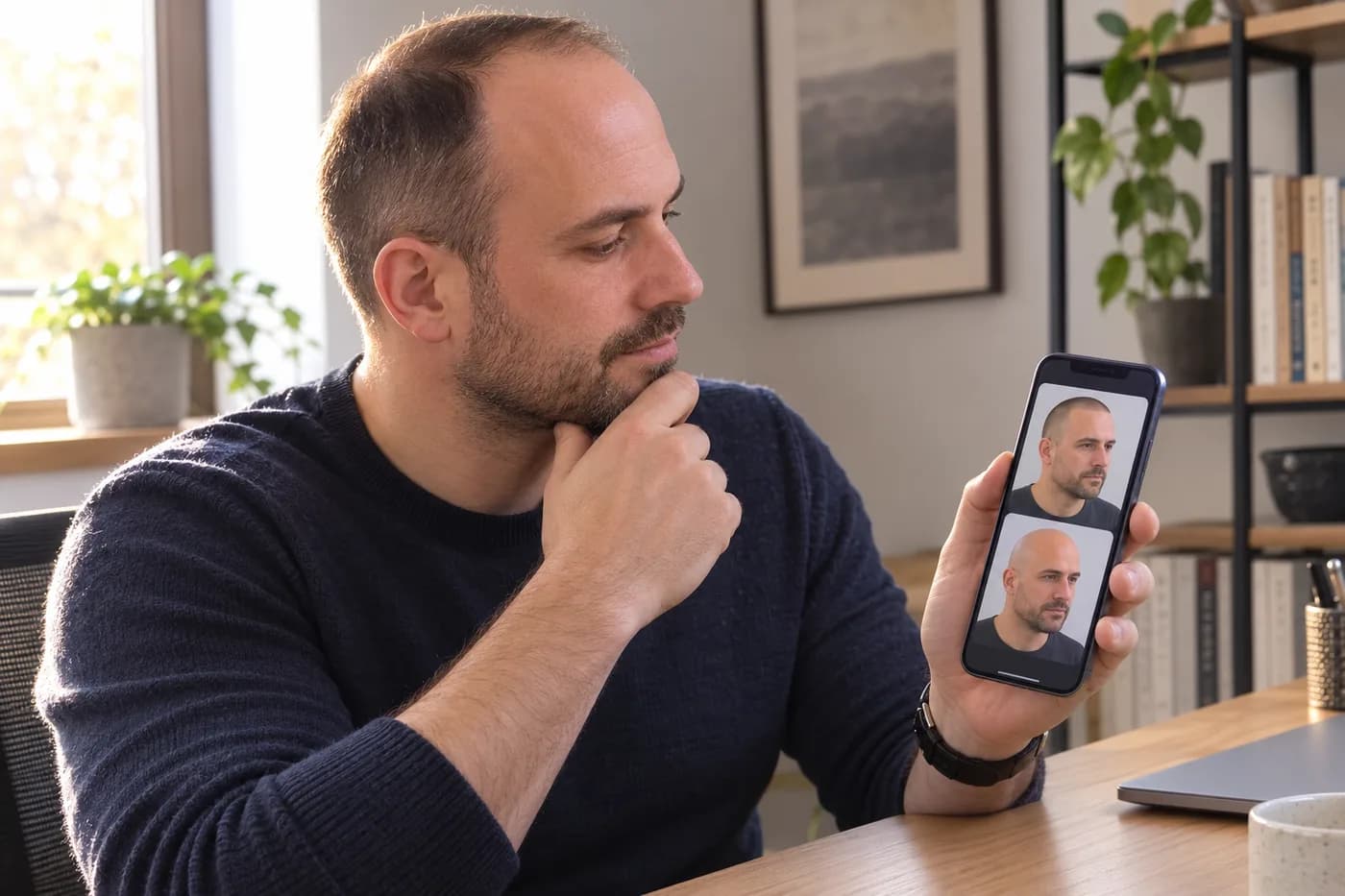
A low-risk way to test the decision before the barber
Your bathroom mirror is not a great simulator. It is close up, familiar, and usually lit differently from every place you actually live and work. Use a simple comparison instead:
BaldLooks Free Analysis gives you a starting read from one photo. The paid plans are more useful once you want to compare the shaved direction across angles, outfits, and locations. It is not a medical diagnosis or a promise about a barber result; it is a more realistic way to decide whether your face feels stronger with less hair before you make the change.
Final takeaway
A high hairline is not a reason to rule out a buzz cut. If it is natural or mature and the density behind it is strong, a #2 buzz with one length or a soft low fade can look exceptionally clean. If the temples are progressing or the top is thinning, a #1 or shaved comparison may be more honest and more flattering than leaving extra length.
Do not ask whether short hair can hide a high forehead. Ask whether it makes your current hair and face look more intentional together. Test the line over time, judge short styles in normal light, and preview buzzed and shaved before the clippers make the decision for you.