
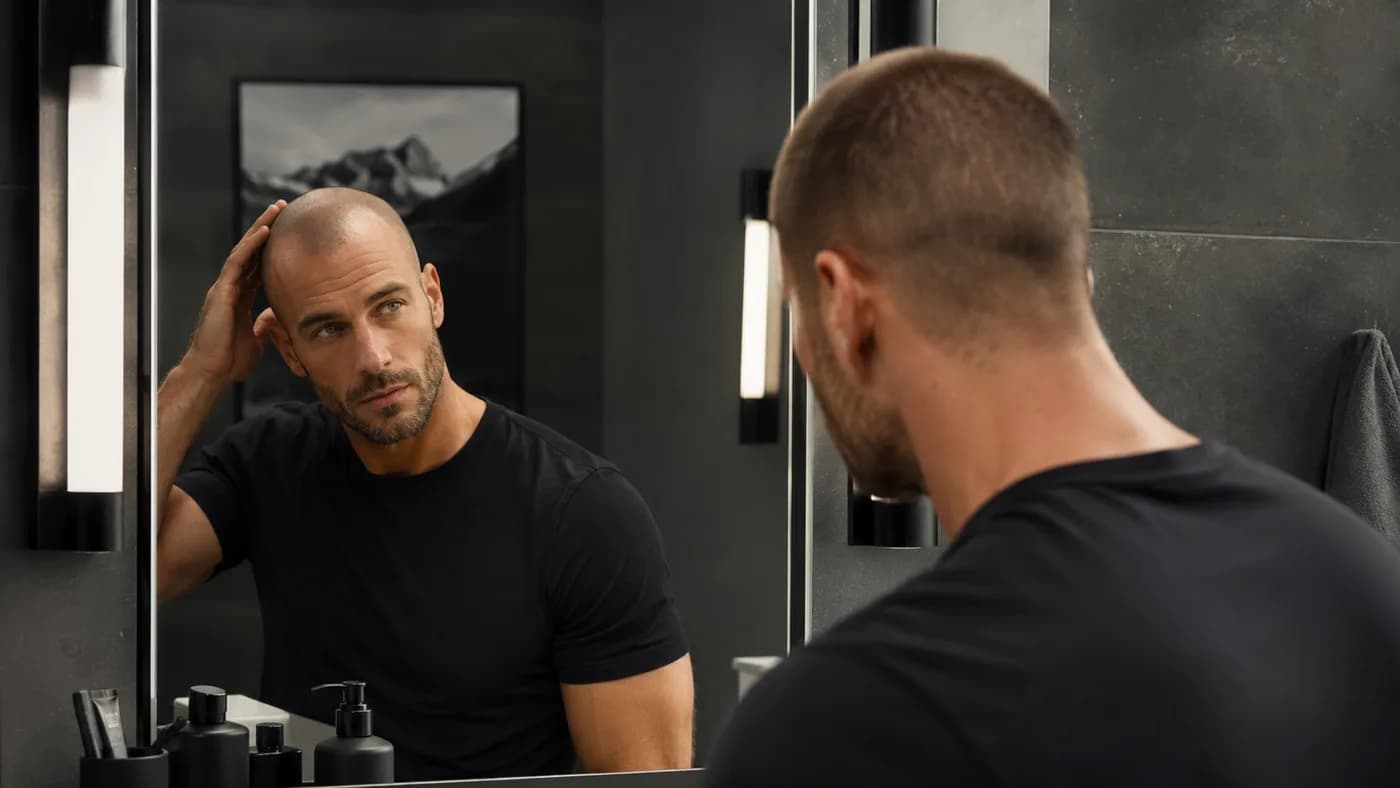
If you are considering a buzz cut with a bad hairline, you probably want one practical answer: which length will make the front look cleaner instead of more exposed?
The short answer is this: a #1 or #2 buzz is the safest starting point for most high, uneven, M-shaped, or mildly receding hairlines. A buzz cut usually helps when the shorter length makes the shape look intentional. It usually hurts when it exposes weak density without reducing the contrast between the top and sides.
Quick read
They usually shorten the hair enough to calm the recession without going fully scalp-forward right away.
A good fade can make the cut look crisp. An aggressive fade can make a weak front look even weaker by comparison.
If the top no longer adds enough to the frame, the cleaner answer may be fully shaved rather than a longer buzz.
Quick answer: when a buzz cut improves a bad hairline
A bad hairline buzz cut usually helps when:
- the concern is mostly the shape—high, uneven, M-shaped, or mildly receded—rather than major top thinning,
- the top still has enough density to look even at a short length,
- your longer hairstyle keeps collapsing, separating, or exposing the front,
- you want the haircut to look honest instead of defensive.
It usually helps less when:
- the top is already much thinner than the sides,
- the crown is also thinning and the whole upper scalp looks weak,
- a longer buzz keeps outlining the weak front,
- you are using the buzz cut only to delay the cleaner shaved option.
The American Academy of Dermatology and Cleveland Clinic both describe recession and crown thinning as common male-pattern loss patterns. That matters because a buzz cut is a contrast tool, not a disguise.
The goal is not to hide the hairline
A buzz cut works best when it makes the haircut look chosen. If the whole result still feels like damage control, you probably need a shorter guard or a different option.
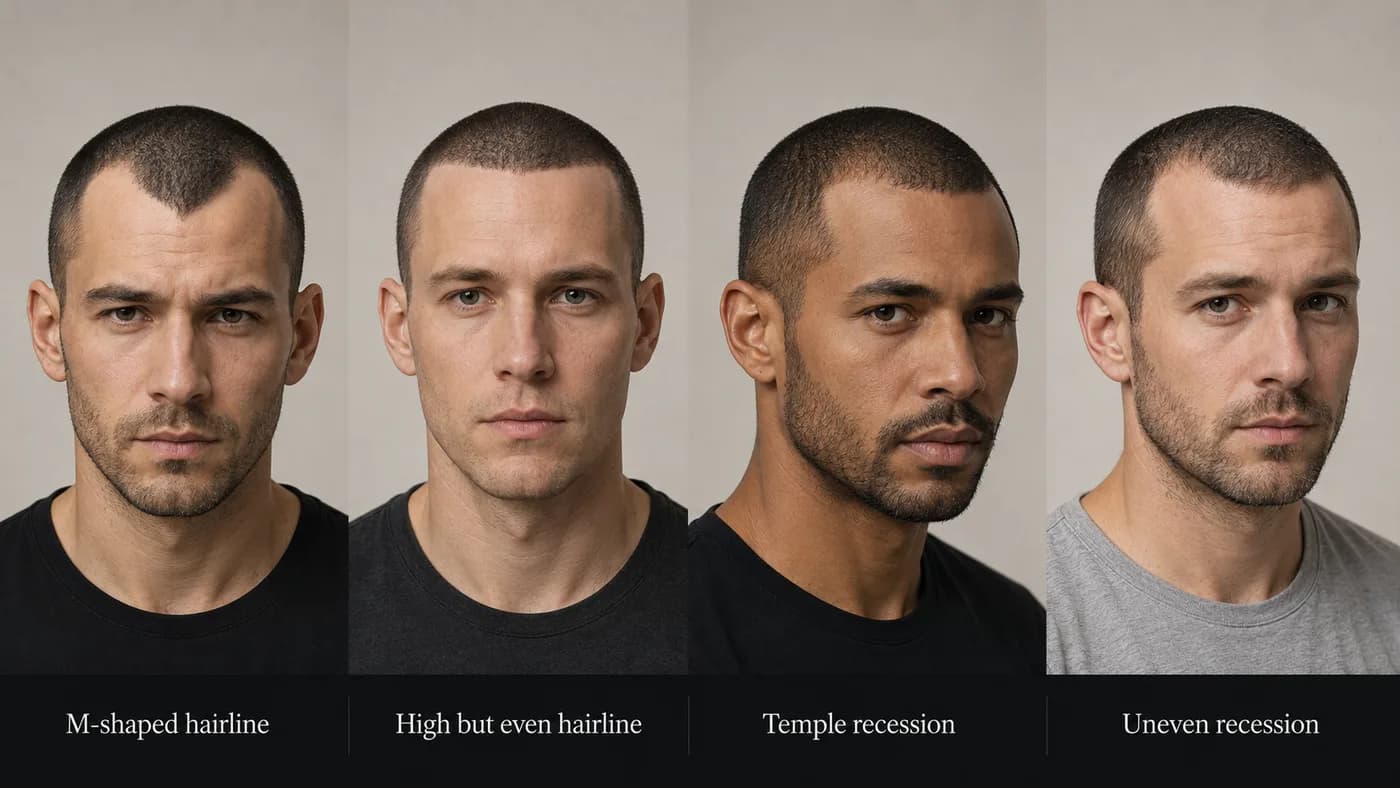
What "bad hairline" usually means
Men use that phrase for a few different problems:
- M-shaped hairline: the temples move back while the middle stays more forward.
- High hairline: the forehead is large, but the line may still be even.
- Temple recession: the corners are the main weak spot.
- Uneven recession: one side pulls back faster than the other.
Not every "bad" hairline is actively receding. A naturally high hairline can be stable, and a slightly uneven line can simply be your normal shape. What matters for a buzz cut is whether the density behind the line is strong enough to look even when shortened.
Buzz cuts usually work best on a high or uneven hairline with solid density, and on mild M-shaped or temple recession. They work less well when the top is weak enough that any extra length keeps outlining the problem. If your hairline is clearly moving backward rather than simply difficult to style, the Buzz Cut for a Receding Hairline guide is the more specific next step.
Why a buzz cut often makes recession look cleaner
Longer hair usually makes a bad hairline harder to manage because it keeps asking the front to behave like a stronger hairline than you actually have. A buzz cut changes that in three ways:
- It lowers the contrast between the temples, top, and sides.
- It removes weak styling tricks that collapse in daylight or wind.
- It puts more attention back on your face instead of the failing front edge.
That is why a short buzz often feels like relief. It does not erase the hairline, but it can stop the haircut from looking fragile. For guard-by-guard advice focused specifically on active recession, see Buzz Cut for a Receding Hairline. If your main uncertainty is whether the shaved look might be stronger still, compare Buzz Cut vs Bald and What Would I Look Like Bald?.
Best buzz length for a bad hairline: #0 vs #1 vs #2 vs #3
The phrase "buzz cut" is too broad to be useful on its own. The difference between #3, #2, #1, and #0 is often the difference between "cleaner" and "still not right."
| Guard length | Best for | Common risk |
|---|---|---|
#3 | Early recession with strong top density | Leaves enough hair for the shape of the hairline to stay obvious |
#2 | Mild to moderate temple recession or a high hairline with decent density | Can still look soft if the front is weak |
#1 | Obvious recession, uneven temples, or a hairline that looks worse with any top length | Feels very short at first if you are used to covering the front |
#0 | Advanced recession, weak top density, or men already close to shaving fully | Shows scalp texture and head shape much more clearly |
For most men searching "buzz cut with bad hairline", #1 or #2 is the smartest starting point. Choose #2 if density behind the hairline is still good. Choose #1 if the recession is obvious. Choose #0 if every shorter step keeps improving the haircut. Be careful with #3 unless your loss is genuinely early.
Does a fade help or hurt a bad hairline?
A fade can help, but it is one of the easiest places to get wrong.
When a fade helps
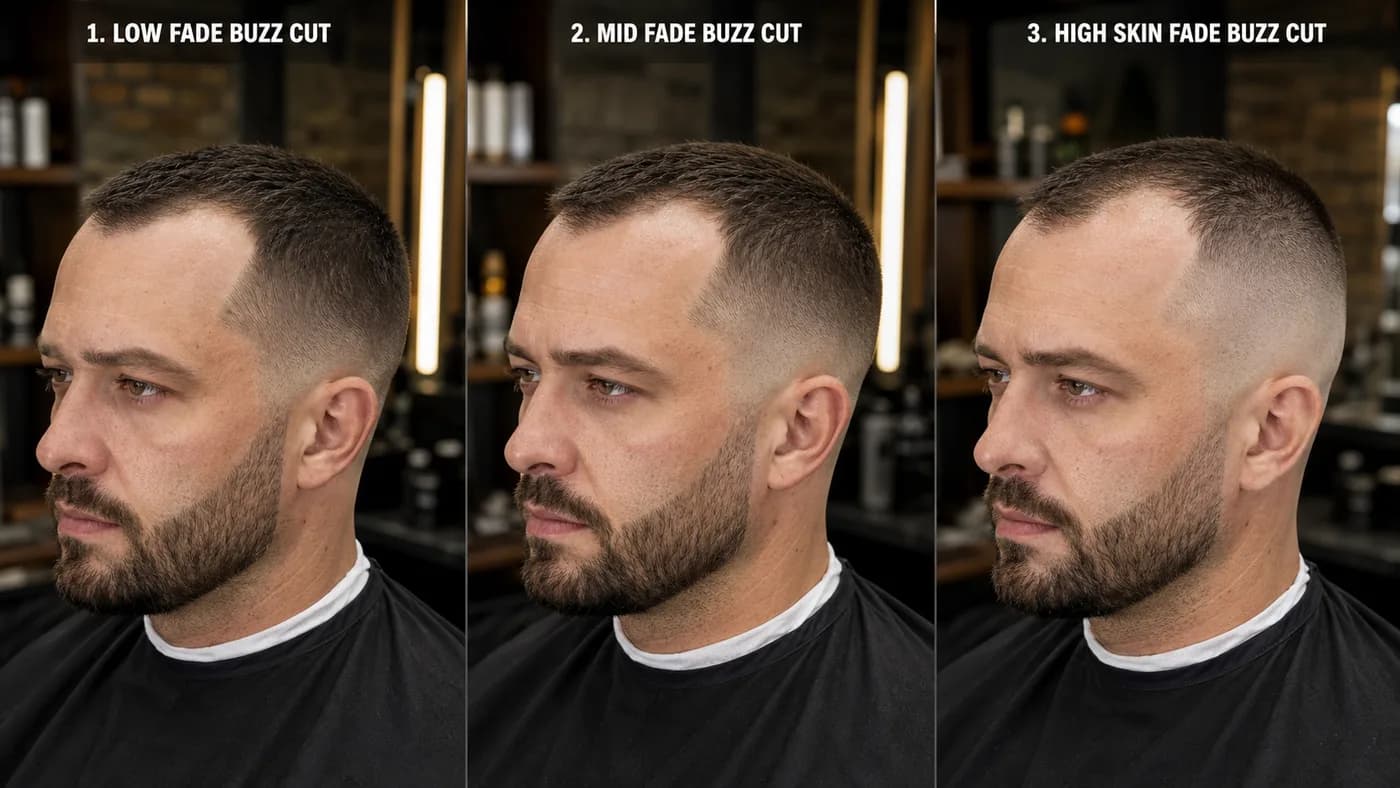
A low or mid fade usually works when:
- the top still has enough density to hold its own,
- you want the haircut to feel sharper around the sides,
- the fade reduces bulk that would otherwise overpower the front.
In those cases, the fade makes the cut feel tidier and more deliberate.
If the fade is the main decision, the Buzz Cut Fade for a Receding Hairline guide compares low, mid, high, and skin fades in more detail.
When a fade hurts
A fade hurts when the barber creates very crisp, very dense sides while the top and front remain weak.
Watch for:
- very high skin fades,
- hard lineups that emphasize already-receded temples,
- too much softness on top with extremely sharp sides.
Buzz cut, Caesar cut, textured crop, or shaved head?
This is the part many men actually need. A buzz cut is not the only short-hair answer.
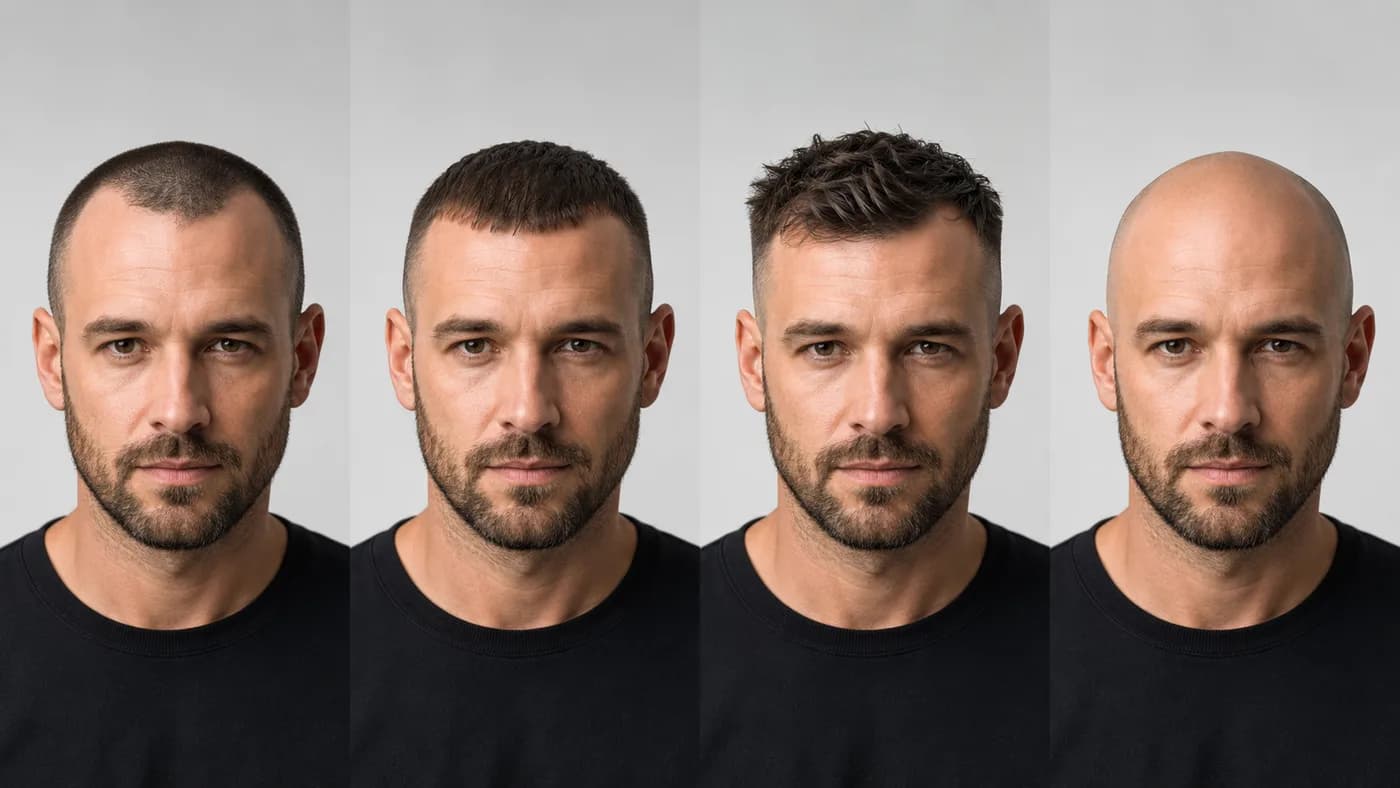
| Option | Usually works best when | Main weakness |
|---|---|---|
| Buzz cut | You want the cleanest honest short cut and the top still has enough density to justify keeping hair | Can expose weak density if you stay too long |
| Caesar cut | You have enough front density for a short forward fringe to look natural | Looks forced if the front is too thin or patchy |
| Textured crop | You want some texture and your recession is mild enough to carry it | Can become obvious camouflage under bright light |
| Shaved head | The top and front are too weak to balance dense sides, or every shorter buzz looks better | Bigger identity shift and more scalp upkeep |
Choose a Caesar cut when you still have enough density for a short forward fringe to look natural. Choose a textured crop only when the top is still dense enough that the texture looks like style, not camouflage. Choose shaved when the front is thin, the crown is joining the problem, and the sides are much denser than the top.
The signs your bad hairline is pushing you toward shaved
There is no mandatory stage where you have to shave. But there are clear signals that the buzz cut may be acting more like a transition than a final answer.
How to decide without regretting the cut
Keep the decision comparative, not emotional:
- Judge your current hair in normal light and recent photos.
- If the problem is mainly recession, test a #2 or #1 first.
- If the haircut still feels soft, compare it against #0 or fully shaved.
- If beard, glasses, or outfits change your look a lot, compare those too.
BaldLooks Free Analysis is useful for that first answer from one photo, and the paid previews make more sense when you want multiple angles, outfits, and shaved-head comparisons before committing.
Final answer: does a buzz cut make a bad hairline better or worse?
A buzz cut makes a bad hairline look better when the front problem is mostly about shape and the top still has enough density to support short hair. It makes it look worse when the top is already too thin, the fade is too aggressive, or the haircut keeps outlining weak areas instead of reducing contrast.
So the practical rule is simple: buzz it if short hair makes the hairline look intentional; shave it if keeping hair only highlights the weakness.