
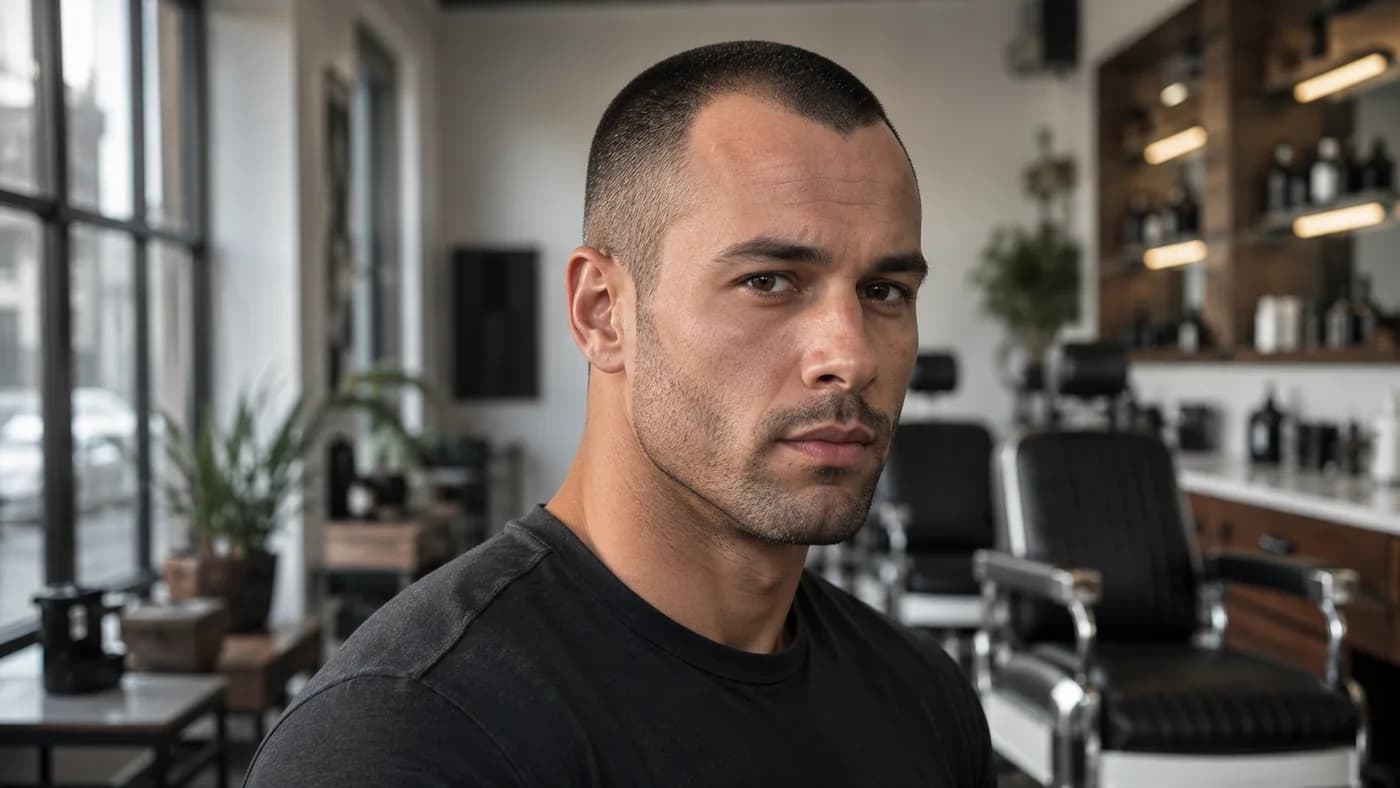
An M-shaped hairline can make a buzz cut look unexpectedly good. The short length stops asking the front corners to look full, so the temples become part of a clean outline instead of the weak point of a longer style.
That does not mean every M-shaped hairline needs the same cut. A small, stable M with solid density can handle a #2. Deeper recession with thinner hair behind it usually looks better at #1 or #0. And if the crown is also thinning, fully shaved may create the strongest overall frame.
The goal is simple: make the haircut look intentional at normal distance, in daylight, and in photos—not only in the mirror after ten minutes of styling.
Quick read
Temple depth matters, but density directly behind the hairline and at the crown matters more than the letter shape alone.
It is short enough to calm contrast at the temples while still letting you assess whether keeping hair improves the overall frame.
A restrained fade can sharpen the cut; an aggressive fade can make a weaker top look even weaker by comparison.
Quick answer: can an M-shaped hairline pull off a buzz cut?
Yes. A buzz cut with an M-shaped hairline often looks better than a longer haircut when the shorter length makes the temple recession feel honest and cohesive.
The cut tends to work when your top still has reasonably even coverage and the M shape is mainly a change at the front corners. It gets harder when the hair behind those corners is also thin, the crown is visibly opening, or the sides are much denser than the top.
An M shape can be a common part of male pattern hair loss rather than a diagnosis by itself. Cleveland Clinic describes deeper temple recession at Norwood stage 3 as potentially forming an M or U shape, while the American Academy of Dermatology notes that male pattern hair loss may begin with a receding hairline or thinning at the crown. If you are seeing a fast change, patchy loss, pain, or scalp inflammation, it is worth speaking with a dermatologist rather than assuming it is routine recession.
The style question, however, is more practical: does a shorter cut reduce visual contrast, or does it expose density that is no longer there?
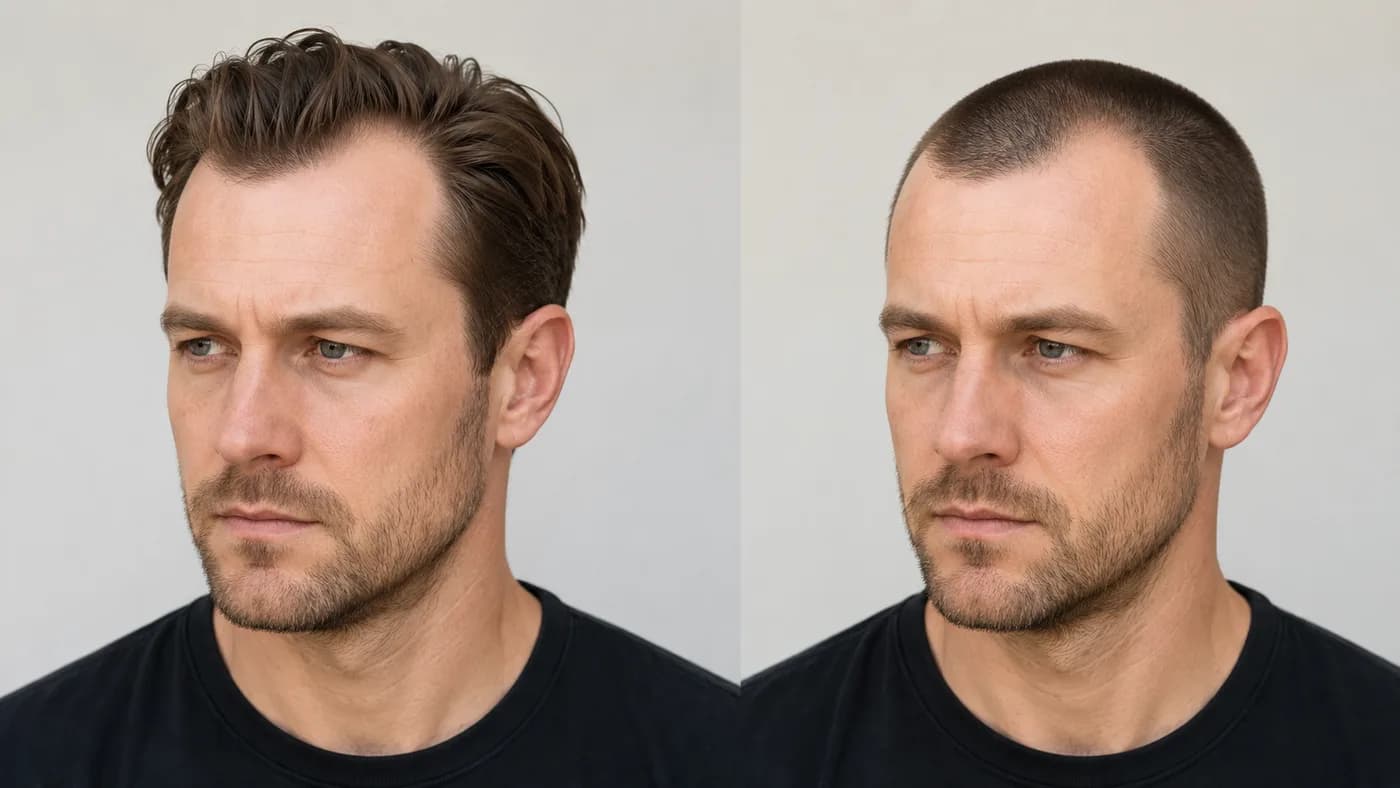
Why M-shaped recession can look sharper when hair is very short
Longer hair makes an M-shaped hairline carry a lot of visual weight. There is more volume behind the centre of the hairline, less at the temples, and more opportunity for the front to separate under wind, overhead light, or product.
A short buzz does not hide the recessions. It reduces the difference between the centre, temples, and top, which can make the outline look purposeful rather than like an attempt to fill in two corners.
An M shape can look intentional; a cover-up rarely does
The best buzz cut does not pretend the temples are unchanged. It makes the hair you still have look even enough that the whole cut feels chosen.
Best buzz cut lengths for an M-shaped hairline
The difference between guards is small in millimetres but big in how the hairline reads. Start with density, then choose length.
For an obvious M-shaped hairline, #1 is usually the strongest place to start. It is short enough to stop the front from looking fragile, but it is not so close that you lose the useful comparison with a shaved head.
Choose #2 when your hairline shape is the main issue and the hair behind it still looks dense. Choose #0 when the top is becoming see-through, the centre is thinning too, or every shorter cut you have tried has looked better. For a broader guard-by-guard comparison, read Number 1 vs Number 2 Buzz Cut for Balding Men.
Fade choices: low, mid, or no fade?
The fade should support the buzz, not create a dramatic contrast with the receded front.
| Fade choice | When it works | What to watch for |
|---|---|---|
| No fade / one length | You want the most honest, low-contrast test of your density | Can feel plain if you like sharper side detail |
| Low fade | You have solid sides and want a clean edge without over-emphasising the temples | Keep the transition soft and proportional |
| Mid fade | Your #1 or #2 buzz still has even top density and you want more definition | A very tight mid fade can make a thin top look lighter |
| High skin fade | Rarely the safest starting point with visible recession | It can make strong side density and a weak front look disconnected |
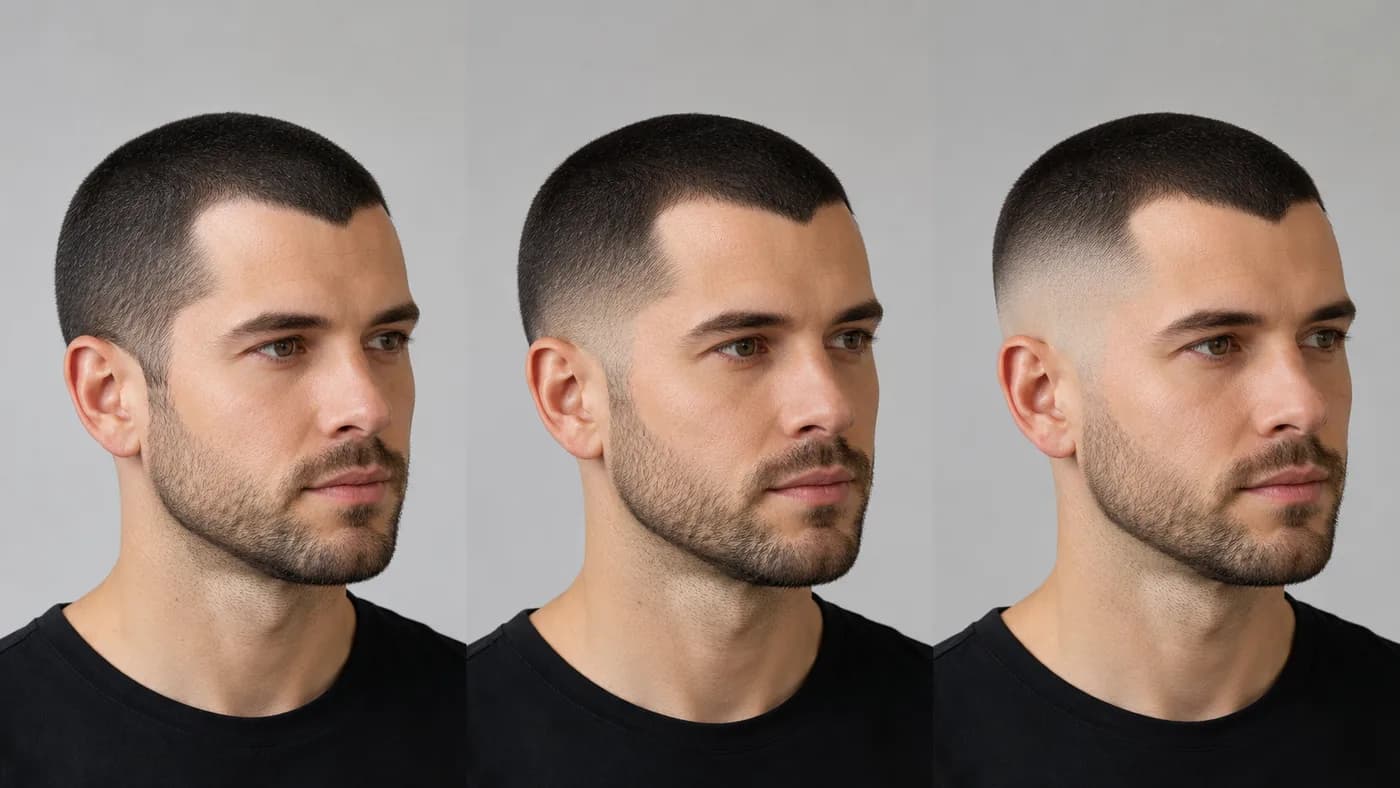
A low fade is often the best stylistic upgrade for an M-shaped hairline because it cleans up bulk around the ears without turning the sides into a loud frame around a thin top. Ask for a soft low fade with no artificial attempt to push the corners forward. A hard lineup at receded temples usually draws more attention to the exact shape you are trying to balance.
Beard and stubble: how to balance a higher forehead
A beard is not required for a buzz cut, but it can create balance when a shorter cut makes your forehead feel more prominent. The practical move is proportion, not maximum beard length.
- Light stubble keeps the look crisp and works well with a #0 or #1 buzz.
- A short boxed beard adds some jaw definition when you want the overall frame to feel more grounded.
- A neat goatee can suit patchy cheek growth while still adding lower-face structure.
Do not grow a beard just to distract from your hairline. Choose the version that actually fits your growth pattern and how polished you want to look. Our guides to Bald With Stubble, Shaved Head With Goatee, and Bald With No Beard can help with that next decision.
When a buzz cut is no longer the strongest option
There is no rule that an M-shaped hairline must progress to bald. But shaving often becomes the cleaner option when the buzz no longer creates evenness.
If you are on that border, do not decide from one bathroom mirror. Compare your current style, a #1 buzz, and a fully shaved preview using the same front-facing photo. BaldLooks Free Analysis can give you a fast starting point from one photo; paid BaldLooks plans are useful when you want to assess the shaved direction in more angles, outfits, and locations before you change your actual hair.

A simple barber brief for an M-shaped buzz cut
Do not ask only for a “short buzz.” Give the barber the decision you have already made.
Try this: “I have receding temples and want the cut to look even, not like it is trying to hide them. Start with a #1 on top, keep the sides proportional with a soft low fade or one length, and do not create a hard lineup into the recessed corners.” Check it outside, from the front, both three-quarter angles, and the crown—not only under barbershop lights.
If you are still unsure about the line between a buzz and a shave, continue with Buzz Cut vs Bald, Buzz Cut for a Receding Hairline, and Should I Shave My Head?.
Final takeaway
An M-shaped hairline does not make a buzz cut a bad idea. It often makes a short, even cut the most honest and flattering direction.
Begin at #1 if the recession is noticeable, move to #2 only if density is still strong, and consider #0 or fully shaved when the top and crown no longer create enough balance. Keep fades modest, groom your beard or stubble to suit your own face, and judge the result in real light.
The best version is not the one that makes your old hairline disappear. It is the one that makes your current look feel deliberate.