
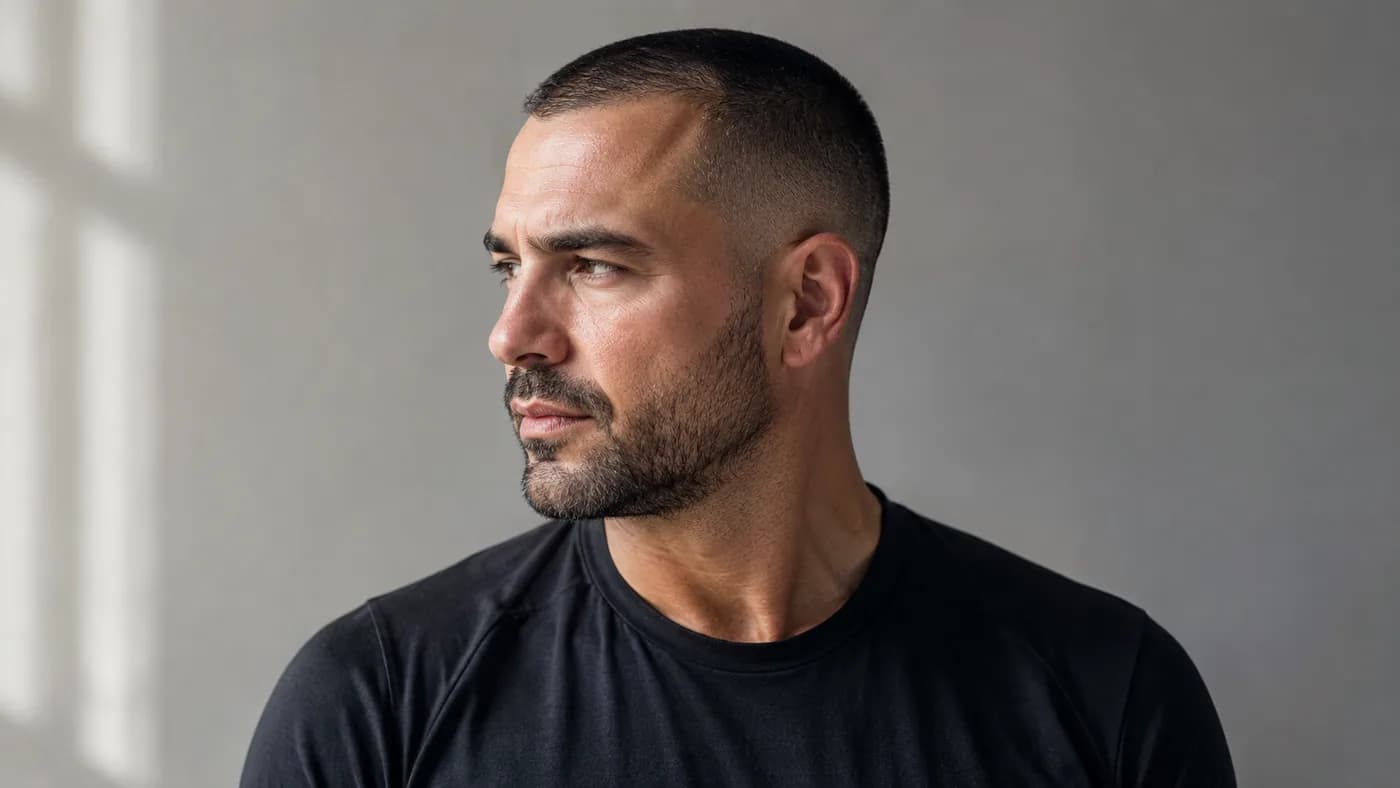
If you are considering a buzz cut fade for a receding hairline, you are choosing where the sides become lighter—and that choice changes how your temples read.
A good fade does not hide a receding hairline. It makes the haircut feel deliberate, so the hairline is part of a clean silhouette. A poorly matched fade can remove all the side weight and point straight at the corners you hoped to soften.
The practical answer is this: start lower and softer than you think. With a receding hairline, a low fade or conservative mid fade usually gives a buzz cut structure without isolating a thin front. High and skin fades can still work—but they need a denser top, milder recession, or a very intentional preference for contrast.
Quick read
The higher the fade climbs, the more it exposes the temples and makes the short top look like a separate panel.
A low, softly blended fade keeps the cut tidy while preserving enough side weight to make the whole head look connected.
A dense #1 or #2 can carry more contrast. A wispy front or thin crown often looks better with less dramatic sides—or a shave.
Quick answer: does a fade help a receding hairline?
Often, yes. The right fade replaces an awkward “short on top, bulky at the sides” shape with a clean progression. That can make a buzz cut look designed rather than like a last-minute fix for the hairline.
What it cannot do is fill in the temples. Male-pattern hair loss commonly shows up as gradually deepening recession at the temples, thinning on top, or crown loss, as the American Academy of Dermatology explains. Cleveland Clinic likewise describes recession around the temples and thinning at the crown as common pattern locations. A fade is a styling decision, not a diagnosis or treatment.
For a broader guide to deciding whether short hair suits the line itself, see Buzz Cut Receding Hairline. This guide is narrower: it is about the fade line and what it does to the outline of your face and head.
Why fade height matters more than the guard number
With a standard buzz, the top and sides are close in length, so the eye reads one simple surface. A fade turns the sides gradually lighter toward the ears and neckline. That can sharpen the jaw and cheek area, but it can also create a visual arrow that ends at the temples.
If the fade rises too high, the upper corners can feel more exposed than they do with an even buzz. Judge the cut in normal photos and daylight, not only under barber lights. The aim is enough contrast to look intentional—not enough to divide your head into strong sides and a weaker top.
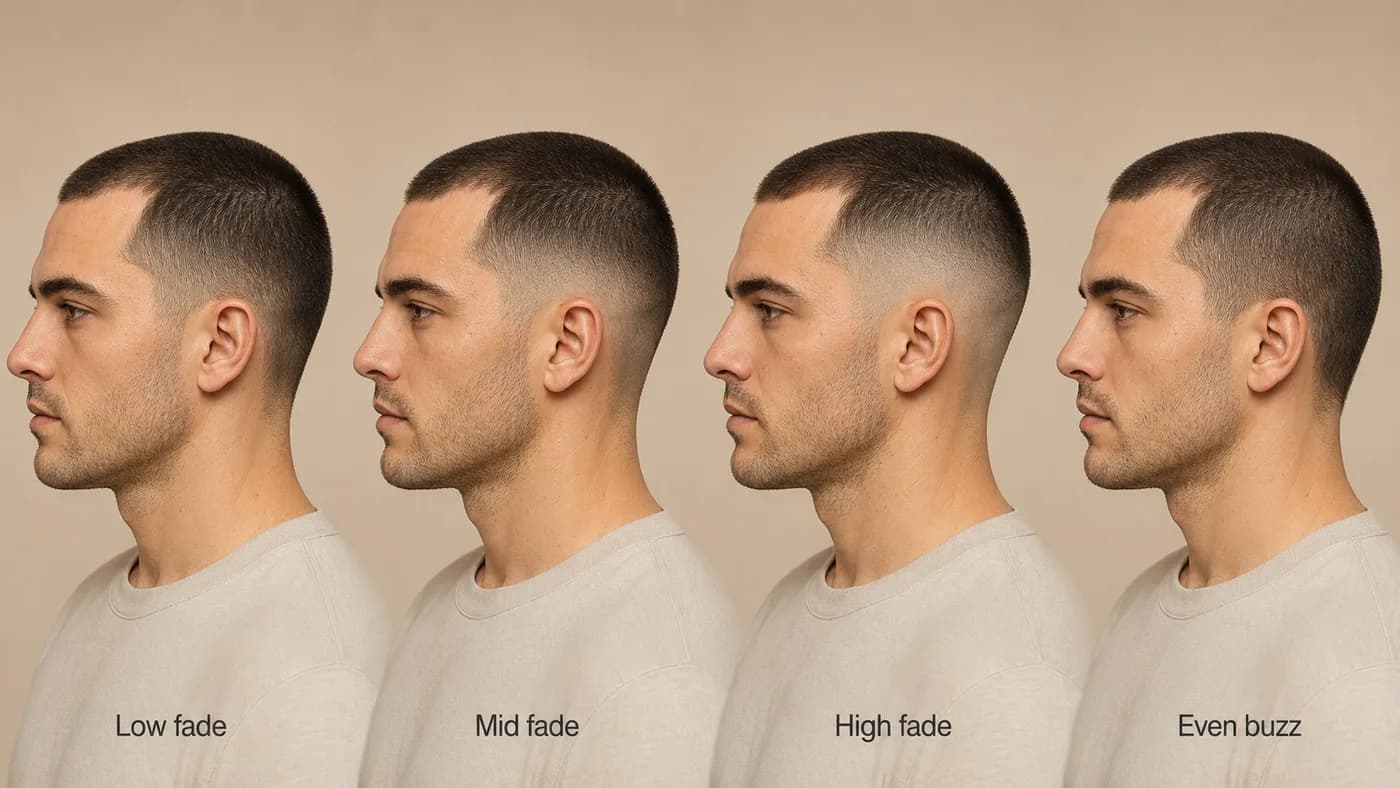
Low fade, mid fade, high fade, or skin fade?
Use this as a starting map for the conversation with your barber. It is not a rulebook; your head shape, density, beard, and personal style still matter.
| Fade option | What it does visually | Best starting point when | Watch out for |
|---|---|---|---|
| Low fade | Keeps the transition below the temples and preserves side weight | Your recession is noticeable, the top is a little weaker, or you want a subtle result | Asking for the blend too tight can still create a harsh pale band |
| Mid fade | Adds definition around the upper sides without taking everything high | The top has decent density and you want more shape than a low fade | A blunt line placed at temple height can mirror the recession |
| High fade | Creates a strong athletic contrast and makes the sides disappear quickly | Your buzzed top is dense and you genuinely like a bolder, exposed profile | It can isolate a thin top or make deep corners the focal point |
| Low skin fade | Gives a clean finish near the ear while keeping the fade low | You want a polished skin fade but need balance around the temples | The skin section should stay low and blend gradually |
| One-length buzz | Keeps the entire head visually calm and even | You are unsure about density or want the most neutral comparison | It has less sculpted shape, so edge cleanup and beard balance matter more |
Low fade: usually the safest move
For most men with a receding hairline, the low fade is the easiest place to start. It cleans the sideburn and lower side area without climbing into the temple zone. The result still looks sharp, but the eye travels around the head rather than stopping at the hairline.
Ask for a soft low fade into a #1 or #2 buzz, with no hard shelf at the upper edge. The important word is soft. A low fade that jumps suddenly from skin to dark hair can be just as distracting as a high one. Your barber should blend the transition so it reads as a gradient, not a stripe.
Mid fade: useful when the top is holding up
A mid fade can work when recession is mild and the hair behind the front edge is still dense. It gives more cheekbone and jaw definition than a low fade. The risk is placement: if the upper blend lands at the deepest temple corner, it can repeat that shape and make it seem sharper.
High fade: bold, but less forgiving
A high fade can look excellent with a close buzz and solid top coverage, but it embraces exposure. The high sides make the remaining top more prominent, which is only helpful when it looks intentionally even. If the front is weak, a buzz cut for a bad hairline is usually more convincing with calmer sides.
Skin fade: cleanest finish, strongest contrast
A skin fade means the shortest part near the ear or nape is taken nearly to the skin before it blends upward. It can look polished and modern, but because it exposes scalp at the side, it also increases the contrast with the hair on top.
For a receding hairline, a low skin fade tends to be more adaptable. Keep the bare section low, use a gentle blend, and let the top remain a simple buzz. Start low; you can always take it higher next time.
Do not use a fade to hide a changing hairline
If your temples, crown, or density are changing quickly—or you have sudden, patchy, itchy, painful, or inflamed hair loss—speak with a dermatologist. The AAD notes that a dermatologist can distinguish hair loss from excessive shedding and identify the cause. A haircut can help you feel more put together today, but it cannot answer the medical question.
How to choose your fade by hairline pattern
The phrase “receding hairline” covers a lot of different looks. Match the fade to the pattern rather than copying a photo of someone whose density is nothing like yours.
The Norwood scale can give you language for discussing temple and crown patterns, but it is not a haircut prescription. A photo from the front can miss crown thinning; a mirror view from above can make any hairline look harsher. Use front, profile, and top-back photos in ordinary light before you decide that a certain fade is the answer.
Beard balance: the part people often forget
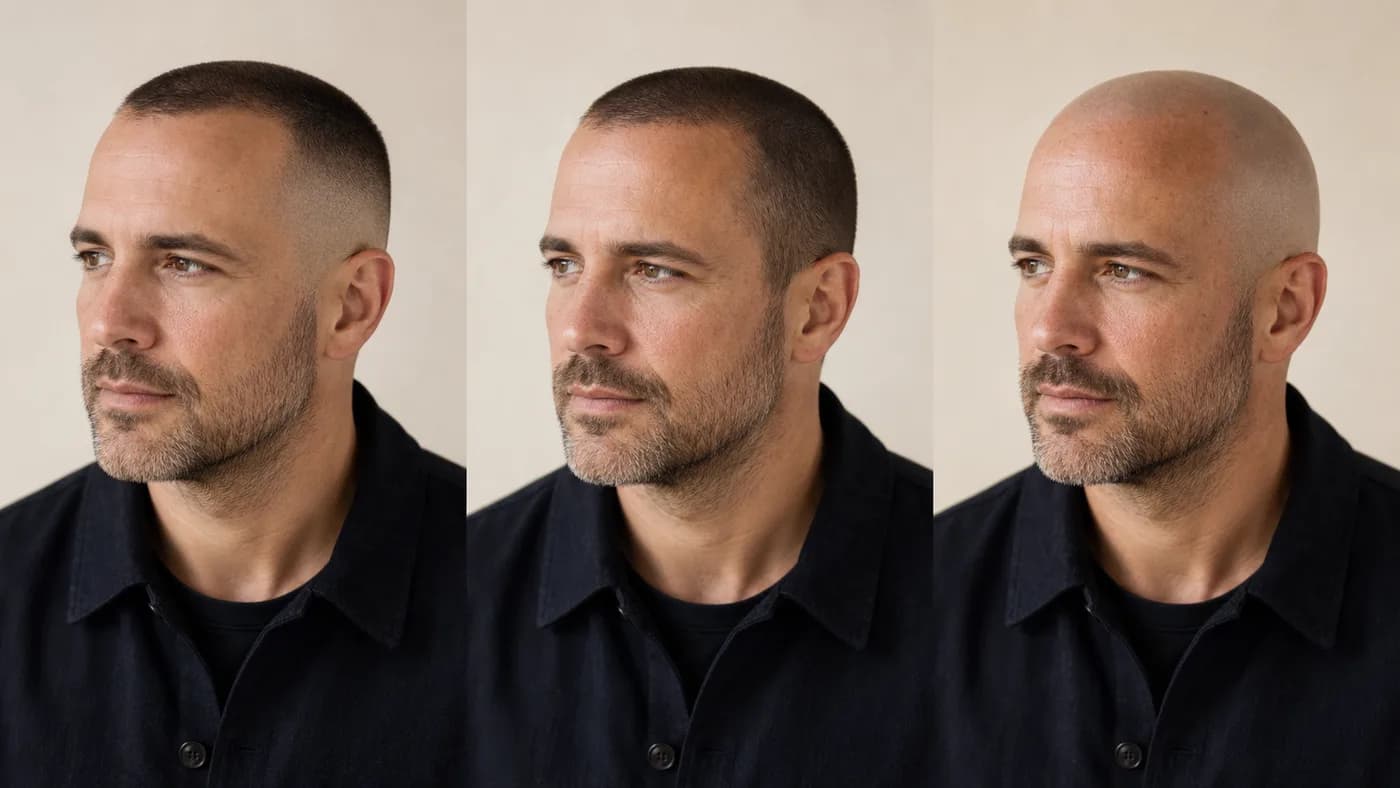
A fade changes the sideburn area, so it changes the relationship between your haircut and beard. That is useful when handled softly. Short stubble, a close boxed beard, or a neatly blended sideburn can add lower-face structure and keep the whole look balanced once the hair is very short.
Three practical guidelines help:
- Keep the beard scale believable. With a #0 or #1 buzz and a high fade, an extremely long, sharply outlined beard can make the top and bottom feel disconnected. A short-to-medium beard or stubble is often easier to balance.
- Blend, do not carve. A gentle transition from the fade into the sideburn looks more natural than a sudden beard start. This is particularly helpful if the temples are already angular.
- Use beard density as an accent, not camouflage. A beard can add definition, but it should not be a reason to ignore a haircut that looks uneven from the front or crown.
If facial hair is part of the plan, explore Bald With Stubble, Bald Men With Beards, and Shaved Head With Goatee. They can help you compare the facial-hair choices after you settle the haircut’s basic proportion.
What to say to your barber
Specific language is more useful than asking for “a fade that hides my hairline.” Try this instead:
“I’m wearing the top at a #1 or #2. My temples are receding, so I want a soft low fade that stays below them and blends gradually—no hard line or high disconnect. Please leave the shape natural rather than pushing the lineup back.”
Then show the barber your hair in its usual state, not only wet or combed into place. Ask them to check the crown and profile before committing to a high fade. A good barber can make a recommendation, but you should be clear that your goal is balance, not an artificial attempt to redraw the hairline.
Final answer: should you get a buzz cut fade with a receding hairline?
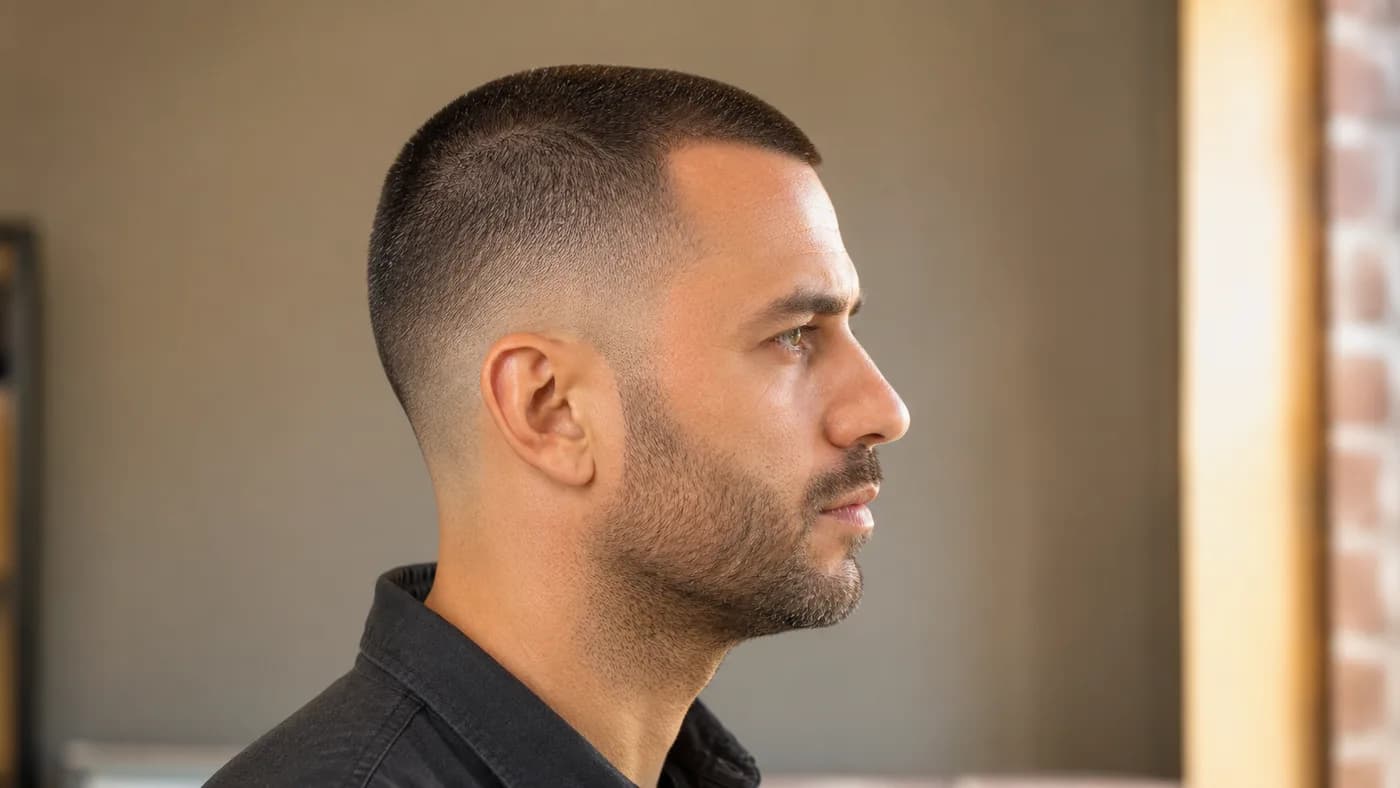
Yes—if the fade supports the overall shape instead of creating more contrast around the temples. Start with a #1 or #2 buzz and a soft low fade. That combination is clean, easy to maintain, and forgiving while you learn how your density looks short.
Move to a mid, high, or skin fade only when you like the stronger exposure and your top remains visually even from the front, side, and crown. If your top is much lighter than the sides, or every shorter version looks better, compare a close buzz with a shaved head before trying to solve the issue with a more dramatic fade.
Next, read Buzz Cut vs Bald, Buzz Cut High Hairline, Receding Hairline: Shave Head?, and How Often Should You Shave Your Head?.