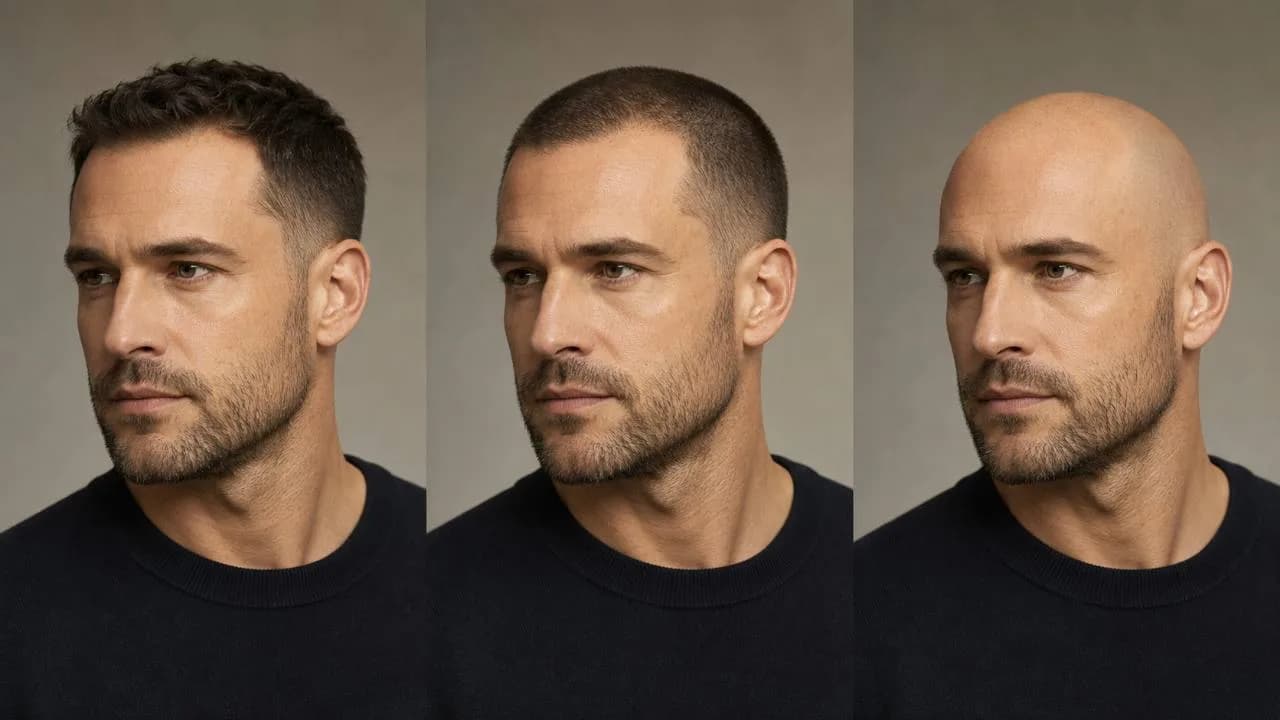
What Norwood Am I? A Simple Hairline Stage Test
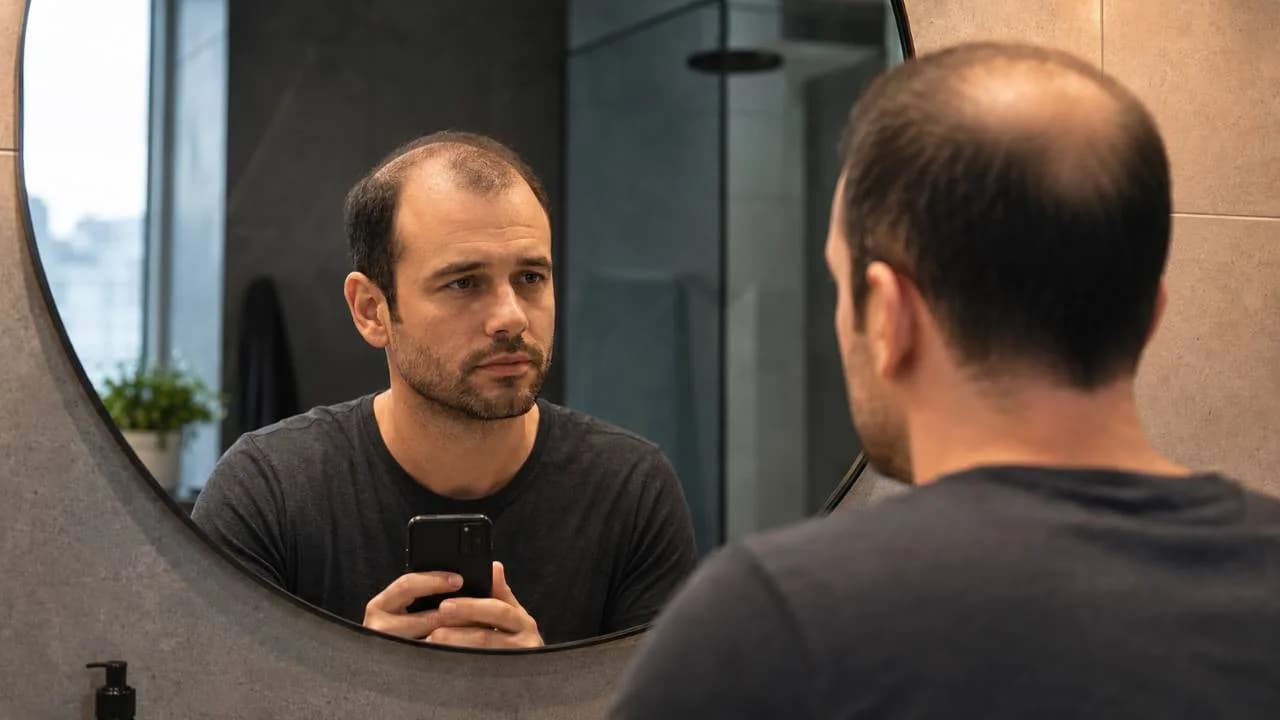
If you are asking "What Norwood am I?", you are probably not looking for a textbook diagram. You want to look at your own hairline and know whether you are seeing a mature shape, early recession, a Norwood 3 pattern, or a stage where a buzz cut or shaved head may look cleaner.
This is a practical Norwood scale test for doing exactly that. It starts with your photos, asks the right questions about temples, crown, and top density, then turns the result into a sensible next style move.
The short answer: map the pattern across your front hairline, both temples, top density, and crown. Norwood 1–2 is usually mild change, Norwood 3 is deeper front recession, and crown involvement means you should not judge your stage from the mirror alone.
Quick read
Your likely stage comes from the front, temples, top, and crown together—not from a stressed selfie or harsh bathroom light.
Mild temple corners often fit Norwood 2. A deeper, obvious M or U shape is more consistent with Norwood 3.
Use the result to compare your real options: keep length, go shorter, try a buzz, or preview a shaved look.
What this Norwood scale test can and cannot tell you
The Hamilton–Norwood scale describes common male-pattern hair-loss patterns, from little recession to extensive top loss. The Cleveland Clinic describes seven stages, while DermNet notes that male pattern loss commonly affects the front and top of the scalp.
It puts a name to what you can see; it does not diagnose the cause, predict progression, or prescribe treatment. The American Academy of Dermatology notes that hair loss has many causes, so sudden or unusual loss deserves professional input.
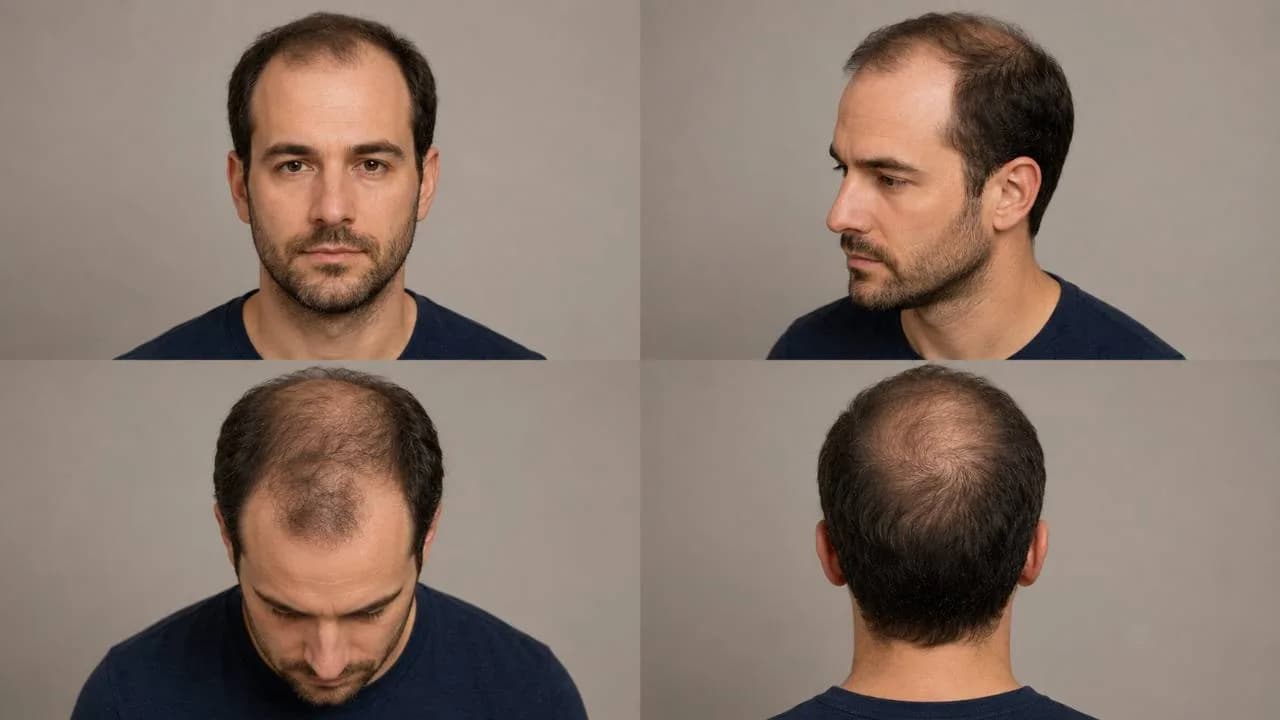
Step 1: take the four photos that make the test useful
Do not name your stage while leaning into a mirror. Take these photos first:
- Front: head level, hair dry, relaxed hairline, no flash.
- Left and right temples: turn about 45 degrees so the corner shape is visible.
- Top: use even overhead or window light to compare top density with the sides.
- Crown: ask someone to take it, or use a timer and rear camera.
Use the same conditions for older photos: dry hair, similar length, even light, and no strategic styling. Hair texture, length, contrast, and lighting can all change apparent coverage. A fair comparison beats a flattering one.
Step 2: score the front and temple pattern
Start at the temples. They are often the first place a standard male-pattern change becomes visible.
Give yourself the description that fits your normal, unstyled hair—not the version after you pull it forward.
| What you see | Likely range | What to check next |
|---|---|---|
| Front line is intact with little or no temple movement | Norwood 1 | Compare with old photos before calling it progression. |
| Small, fairly even triangular corners; density behind the line is solid | Norwood 2 | Check whether the shape has stayed stable for 6–12 months. |
| Deeper corners that create a clear M or U shape | Norwood 3 | Check top density and crown before choosing a haircut. |
| Deep recession plus visible thinning through the front or top | Norwood 4+ range | Make the crown photo part of the decision, not an afterthought. |
The Cleveland Clinic describes stage 2 as slight temple loss and stage 3 as deep temple recession that can make an M or U shape. That is why Norwood 2 vs 3 is less about measuring millimetres and more about visual impact: can you see a mild corner, or does the recession now define the outline of your haircut?
Step 3: check the crown and top before naming a stage
Your front hairline tells only half the story. The Cleveland Clinic lists crown thinning, temple thinning, and a receding hairline among common male-pattern signs. Do not judge your stage from the front alone.
Look for a visible area that expands across comparable photos, not a normal cowlick in bad light. For a focused check, use Hair Thinning at Crown and Crown Balding vs Normal.
Step 4: use this quick Norwood self-mapping quiz
Choose the row that sounds most like your combined photo set. This is not a medical score; it is a way to turn vague concern into a cleaner haircut conversation.
What hairstyle makes sense at each likely range?
Face shape, beard, texture, and your comfort with short hair still matter. The pattern simply shows when longer hair adds support and when it mostly adds contrast.
When not to rely on a Norwood scale quiz
The Norwood scale fits gradual male-pattern hair loss best. It is not the right tool for every shedding or scalp problem. The AAD advises that hair loss has many causes.
Get medical advice instead of self-mapping if the loss is:
- sudden or rapidly worsening,
- patchy rather than a front-and-crown pattern,
- paired with itch, pain, inflammation, or scaling,
- happening with broader health changes,
- or causing significant distress.
The most useful answer to “What Norwood am I?”
The honest answer comes from the whole pattern: temple depth, density, crown visibility, and comparison photos. Norwood 2 may only need monitoring. At Norwood 3, shorter styles are worth testing. If the crown is joining in, compare buzzed and shaved options.
For more detail, read Norwood Scale Explained, then use Hairline Test if the front is your main concern. When you are ready for a visual answer, upload a photo to BaldLooks: the free analysis gives you a first read, while paid plans help you see a shaved-head direction across angles, outfits, and locations before making a real change.