
Crown Balding: Signs, Haircuts and What to Do Next
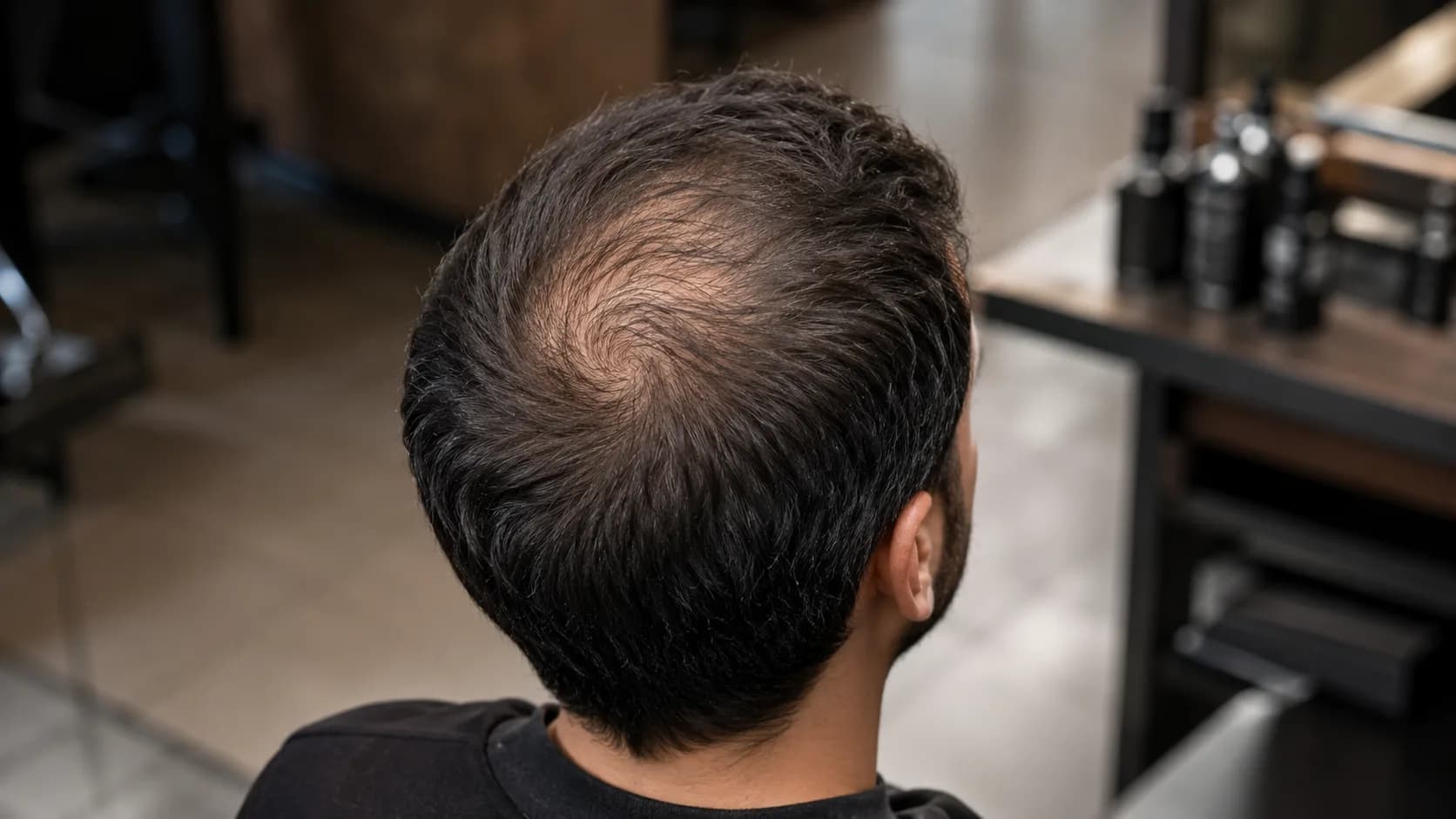
If you are worried about crown balding, you are usually dealing with one frustrating detail: the problem often shows up in photos, mirrors, or bright overhead light before you feel sure it is real.
That uncertainty is normal.
The crown is one of the hardest areas to judge on your own. It sits on the back-top of your head, it often includes a natural cowlick, and it can look dramatically different depending on hair length, product, moisture, and camera angle.
The short answer is this: crown balding usually becomes a real concern when scalp visibility at the crown is showing up repeatedly over time, not only in one bad photo or one harsh lighting setup.
Quick read
It may begin as a lighter-looking swirl or small see-through spot before it becomes a clear bald patch.
You can have crown thinning without major frontal recession, and the next step depends on that specific pattern.
A shorter cut often reveals whether the crown looks cleaner, or whether the top has become too thin to preserve.
The quick answer
You may be dealing with crown balding if:
- the crown looks thinner in repeat photos,
- a small bald spot on the crown keeps appearing in normal light,
- the visible area seems larger than it used to be,
- the surrounding hair feels less dense than before,
- the top and crown are looking weaker than the sides.
The Mayo Clinic notes that hereditary hair loss often happens gradually and in predictable patterns, including gradual thinning on top of the head. The Cleveland Clinic notes that male pattern baldness commonly shows up as thinning on the top of the head or a hairline that moves farther back.
That distinction matters because crown balding is not exactly the same problem as a receding hairline. Some men mainly thin at the front. Others keep a decent front hairline for a while but start opening at the crown. Some experience both.
This page is the action hub once crown loss looks repeatable. If you are still deciding whether the swirl is normal, use Normal Crown vs Balding Crown. If you already want the detailed progression, use Crown Balding Stages.
Crown balding is not the same as hairline recession
Men often treat all hair loss like one issue, but the crown behaves differently.
Hairline recession changes the front outline of your face. Crown balding changes how dense the top looks from above and behind. It often becomes visible later to you than to other people, simply because you do not naturally see that angle all day.
That is why some men think their hairline is fine, then discover the crown is the actual issue. Others assume one bad crown photo means they are rapidly balding when it may only be a cowlick plus overhead light.
If you are not sure whether you are dealing with early signs more broadly, our guide on am I balding helps you separate patterns from panic.
Early signs of crown balding
Early crown thinning rarely looks like a dramatic bald spot right away. More often, it starts with a subtle change in how the crown reflects light.
Possible early signs include:
- a crown swirl that looks more scalp-visible than before,
- a small lighter patch that shows up in multiple photos,
- less density around the cowlick rather than only at its center,
- styling that no longer covers the crown the way it used to,
- more obvious scalp visibility after haircuts.
One of the trickiest parts is that the crown can look worse when:
- your hair is wet,
- the hair is separated by product,
- the haircut is too long and starts splitting,
- the light is directly overhead,
- your phone camera is angled down from above.
Do not diagnose the crown from one photo
If a crown spot appears once, that is a clue. If it appears repeatedly in similar conditions over time, that is more meaningful.
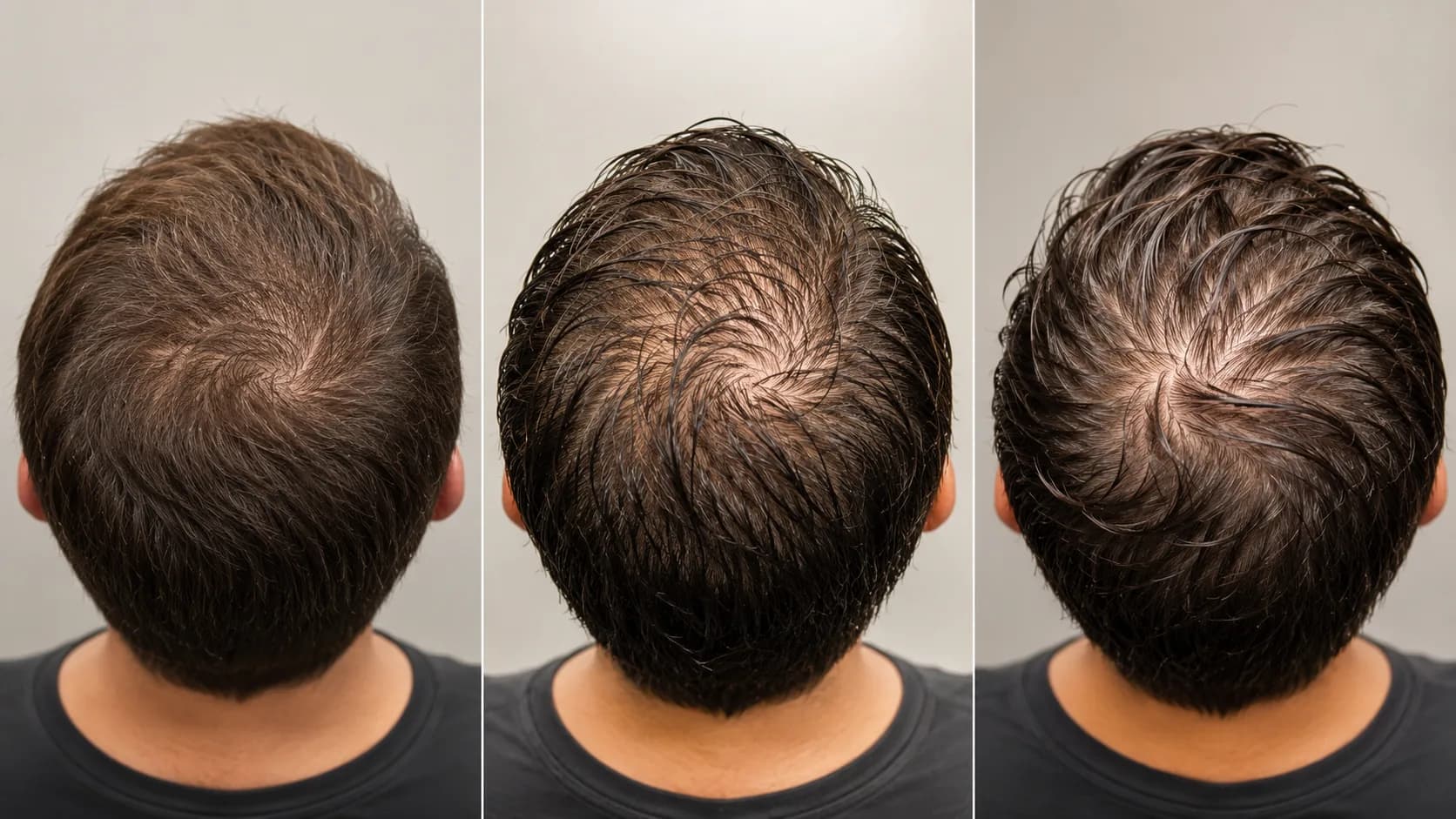
How crown balding usually progresses
There is no single universal crown timeline, but most men notice a pattern like this.
The table below is the short overview. The dedicated crown balding stages guide explains each stage and its decision points in more detail.
| Stage | What it often looks like | What usually helps |
|---|---|---|
| Early crown thinning | Slightly more visible scalp at the swirl, mostly under bright light or in photos | Track photos, shorten the haircut, monitor the pattern |
| Visible crown spot | Small but repeatable bald spot on crown, easier to notice from above | Shorter haircut, buzz cut, treatment consultation if desired |
| Expanding crown loss | The thin area is wider and the surrounding density is weaker too | Buzz cut or shaved-head evaluation, professional treatment discussion |
| Diffuse crown + top thinning | Crown loss blends into broader thinning across the top | Very short buzz or shaved head often looks cleanest |
1. Early crown thinning
This stage is easy to question. The crown may look normal from most angles but still show a little more scalp than before. This is where monthly photos help most.
2. Visible bald spot on crown
At this stage, the crown is no longer just a suspicion. The spot shows up repeatedly, and the surrounding hair may look weaker too. A normal haircut can start drawing more attention to it.
3. Expanding crown
The visible area gets larger, and the hair around it loses some density. This is often where men start deciding whether to shorten the haircut aggressively, try treatment, or move toward a buzz cut.
4. Diffuse thinning across crown and top
The crown no longer looks like an isolated spot. The whole upper scalp starts reading as thinner. At this stage, preserving more length often adds more contrast than style.
Cowlick vs crown balding
This is the question almost everyone asks.
A cowlick is a natural spiral growth pattern. It can show scalp in the center even on a healthy head of hair. Crown balding is different because it tends to expand beyond the center or make the surrounding area look less dense.
Signs it may be just a cowlick:
- it has looked similar for years,
- it is mainly visible only in harsh top light,
- the surrounding hair still looks strong,
- the visible spot does not seem to be growing.
Signs it may be crown thinning:
- the visible area is larger than it used to be,
- you see it in normal daylight, not only harsh light,
- the nearby hair seems finer or weaker,
- the crown looks worse across several haircuts and several months.
If you can, compare current crown photos with photos from 6 to 12 months ago. That is usually far more useful than trying to decode the crown in real time every morning.
What to do next if your crown is thinning
Once you think the crown really is changing, the next step is not panic. It is choosing the lowest-friction response that matches the stage.
Option 1: Keep monitoring and shorten the haircut
This is often the best move in the earliest stage. Shorter hair can reduce separation and make the crown look tidier. It also makes the real density easier to judge.
Option 2: Try a buzz cut
A buzz cut often works well when the crown is thinning but the top still has enough density to look fairly even once shortened. It reduces contrast and removes the weak styling tricks that can make the crown look more exposed.
If you are deciding between those two end points, the breakdown in buzz cut vs bald is the most practical next read.
Option 3: Consider a shaved head
A shaved head often becomes the cleaner answer once the crown is obviously see-through or the top and crown are both much weaker than the sides. At that point, keeping a little hair may only highlight the thinning pattern.
Option 4: Talk to a qualified professional about treatment
If you want to preserve hair rather than only style around the loss, this is the point to talk to a dermatologist or other qualified healthcare professional. The American Academy of Dermatology notes that treatment tends to work best when started early and that different options may slow further loss or help some men regrow hair.
Avoid treating an internet article like a diagnosis. Hair loss has multiple causes, and sudden, patchy, or unusual shedding patterns deserve professional evaluation. The AAD also emphasizes getting the cause right before deciding on treatment.
When a shorter haircut helps, and when it stops helping
Shorter hair usually improves crown balding until it does not.
It helps when:
- the crown is only mildly thin,
- the surrounding top still has decent density,
- longer hair splits and exposes the swirl more,
- the problem is more about contrast than true scalp visibility.
It helps less when:
- the crown is already clearly visible at short lengths,
- the top is diffusely thin as well,
- the sides are much denser than the top,
- every shorter haircut looks better until you are nearly shaved anyway.
If your crown is thinning and you want to preview the shaved option without guessing, BaldLooks can help. Free Analysis gives you a quick read from one photo, and paid plans let you see the shaved look from more angles, outfits, and locations before you commit.

Final answer: crown balding is about patterns, not one bad angle
Crown balding usually starts quietly, then becomes obvious once the spot keeps showing up across photos, overhead light, and shorter haircuts.
If your crown only looks questionable in one angle, keep monitoring it. If it is repeatedly visible and seems to be expanding, treat that as useful information rather than a reason to panic.
The practical path is simple:
- Track clear crown photos over time.
- Shorten the haircut and judge the result honestly.
- Decide whether the crown looks cleaner, unchanged, or more exposed.
- If needed, choose between a buzz cut, a shaved head, or a professional treatment discussion.
The goal is not to preserve the maximum amount of hair at all costs. It is to choose the option that makes the whole top of your head look cleaner, more balanced, and easier to live with.