Male Haircut Simulator: Try Buzz, Bald, and Beard Styles
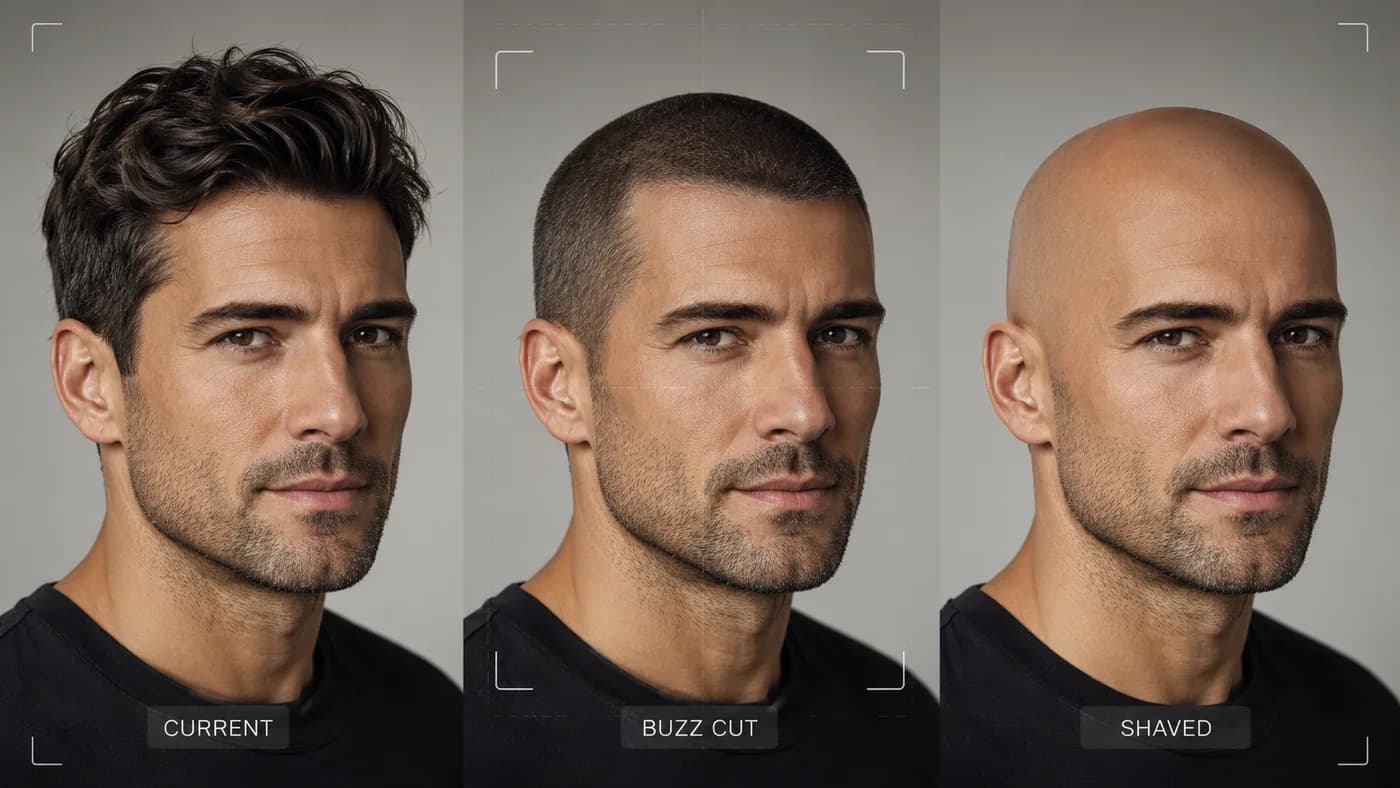
If you are searching for a male haircut simulator, you usually do not want entertainment. You want to avoid a bad decision before it reaches your barber, your camera roll, or your mirror.
For most men, the real question is not just, "What haircut is trending?" It is:
What looks better on my actual face right now: my current hair, a shorter cut, a buzz cut, a shaved head, or a different beard balance?
That is why a generic hairstyle app is often not enough. A useful haircut simulator for men should help you compare the changes that actually affect how men evaluate their appearance:
- hair length,
- recession visibility,
- crown exposure,
- beard balance,
- glasses,
- and the overall feeling of whether the result looks cleaner or more intentional.
Quick read
The useful question is not whether one haircut looks good in isolation. It is which option looks best on your own face.
Buzz cuts, shaved heads, beard styles, and even glasses can change the answer more than the haircut name alone.
When recession or thinning is part of the decision, a simulator helps you compare shorter options before making the cut in real life.
What a male haircut simulator should actually help you decide
A haircut filter for men is only valuable if it answers practical questions.
For example:
- Would a shorter crop look sharper than your current hair?
- Would a buzz cut calm down recession or expose it more?
- Would a shaved head look cleaner than trying to preserve weak density?
- Would your face need stubble or a beard once the hair gets shorter?
- Would the result still feel right outside a bathroom mirror, in work clothes, or in dating photos?
That is why the strongest simulator is not only a hairstyle toy. It is a decision tool.
Other men can give you inspiration, but they cannot give you your answer. Their face shape, forehead, hairline, beard growth, and scalp contrast are not yours. A haircut that looks strong on someone else may look too soft, too harsh, or too unfinished on you.
Why men use haircut simulators before going to the barber
Most men wait too long to test a new direction because they treat haircut changes as irreversible identity moves instead of small experiments.
A simulator reduces that pressure.
Instead of debating in your head, you can preview the likely direction before you spend money, sit in a chair, or take clippers to your own scalp. That matters for:
- men trying a short haircut for the first time,
- men moving from styled hair to a buzz cut,
- men dealing with receding hairlines or crown thinning,
- men considering a shaved head,
- and men whose haircut question is tied to beard, glasses, or overall style.
If your situation is specifically about going shorter because of hair loss, Buzz Cut Filter, Buzz Cut vs Bald, and Shaved Head Filter go deeper on those narrower decisions.
The haircut changes worth comparing first
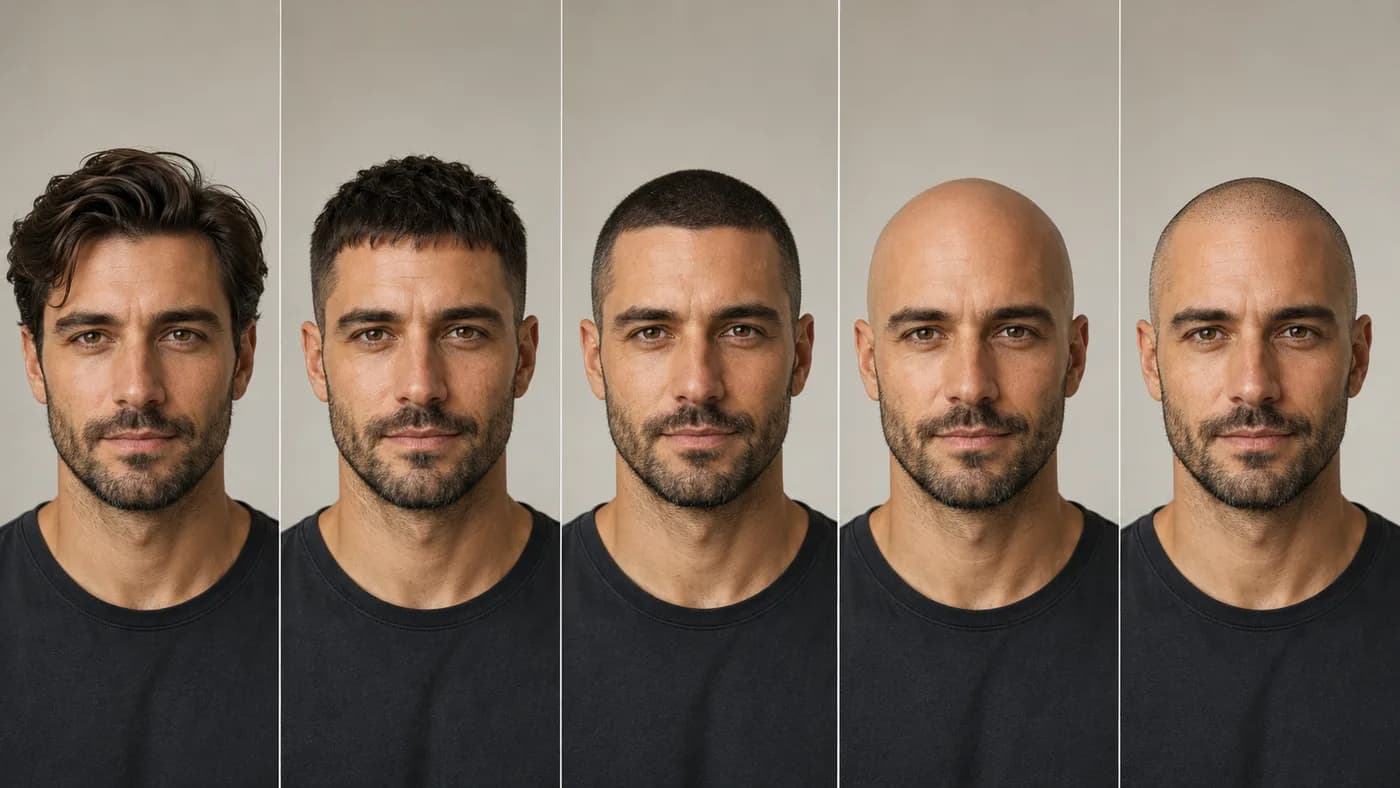
A lot of men make the mistake of jumping straight from "current hair" to "totally bald" and then rejecting the result too fast.
A better workflow is comparison by steps:
- Current hairstyle.
- Shorter version of what you already wear.
- Controlled buzz cut like
#3or#2. - Very short buzz like
#1or#0. - Fully shaved head.
- Facial-hair variation on top of the preferred base.
That sequence matters because it helps you locate the threshold where the look starts improving.
Sometimes the answer is not "go bald." Sometimes the answer is simply that a clean #2 buzz looks far better than hair you keep trying to style longer than it wants to be. Other times the simulator shows that every shorter step looks better until the shaved version is the clearest winner.
What to judge in a haircut simulator result
Do not only ask whether the preview looks dramatic. Ask whether it looks more balanced.
The best result usually feels simpler, cleaner, and easier to maintain. That matters more than whether it feels familiar on first glance.
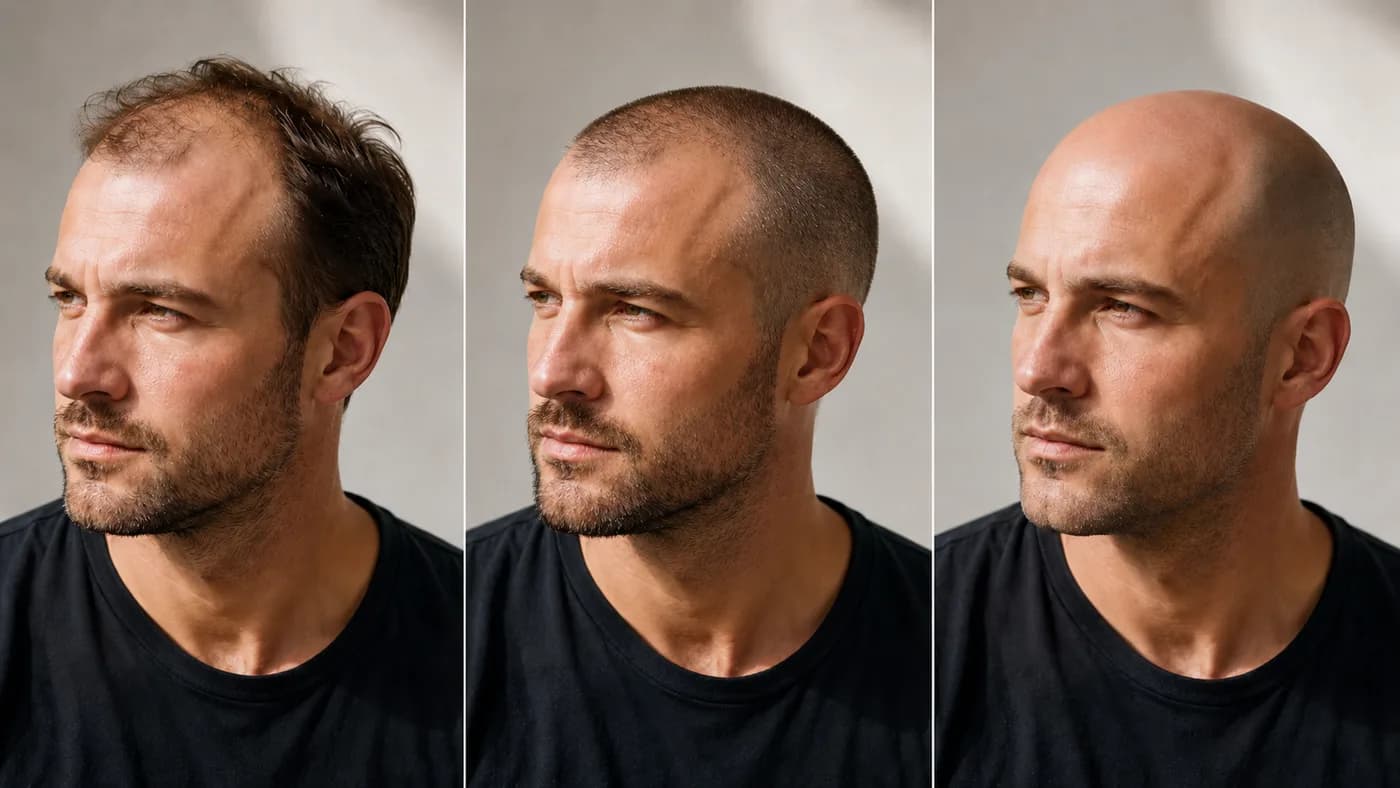
Why a male haircut simulator is especially useful for balding men
This is where the tool becomes more than general grooming content.
When you are thinning, the question is often not "Which haircut is fashionable?" It is:
Which direction makes my current situation look the most intentional?
That might mean:
- a shorter crop that reduces contrast,
- a buzz cut that makes the hairline feel deliberate,
- or a shaved head that removes the visual conflict altogether.
For balding men, the simulator is useful because it replaces vague forum advice with a side-by-side test of your own face. That is a better decision framework than letting fear or habit run the process.
The goal is not to save every strand
The goal is to find the cleanest version of your look now. Sometimes that means keeping some hair. Sometimes it means buzzing shorter. Sometimes it means shaving and moving on.
If that is your situation, Best Haircuts for Receding Hairline, Norwood 3 Hairline and Hairstyles, and Hair Thinning at Crown are useful follow-up reads.
Hair alone is often not enough
Men rarely change just one thing.
A haircut decision often overlaps with:
- whether to keep the beard or trim it,
- whether light stubble adds structure,
- whether glasses help frame the face,
- and whether clothing changes the impression from "unfinished" to "intentional."
That is why BaldLooks fits the category well. The free analysis gives you a low-friction first read from one photo. The paid plans are for the second stage, when you want to compare more angles, more outfits, more locations, and more style combinations instead of forcing a verdict from one image.
This matters when the answer is close. A buzz cut may look decent with no beard, but clearly better with stubble. A shaved head may feel too stark in one context but look strong once the beard and outfit are corrected. That is a real decision advantage, not a cosmetic gimmick.
If beard direction is a large part of the question, Beard Filter, Goatee Filter, and Mustache Filter can help you narrow the next layer.
Basic haircut filter vs realistic simulator
Not every AI haircut simulator for men gives the same quality of answer.
Here is the difference that matters:
| Tool type | Good for | Weak point |
|---|---|---|
| Basic haircut filter | Fast curiosity, rough first impression | Often too generic, weak on hairline realism, beard balance, and scalp shape |
| Better photo-based simulator | Comparing multiple short styles on your own face | Still depends heavily on the photo quality you provide |
| Deeper multi-angle preview | High-confidence decisions before a real change | Usually belongs to paid tools because it needs more output depth and variation |
The right level depends on the decision. If you only want a first read, free is enough. If you are deciding between several haircut directions and want to reduce regret, a deeper preview is worth more.
How to get a result that is actually useful
The simulator is only as good as the input.
Use:
- one clear face,
- front-facing angle,
- visible forehead and temples,
- neutral expression,
- even natural light,
- and no heavy shadow across the jawline or scalp area.
Avoid:
- group photos,
- hats,
- dramatic wide-angle selfies,
- wet hair covering the hairline,
- and low light that distorts your features.
The cleaner the input, the more useful the output. This is one reason men often misjudge themselves with bad filters. They assume the haircut was wrong when the real problem was the photo.
A practical way to use BaldLooks
For most users, the smartest sequence is simple:
- Upload one strong photo to BaldLooks Free Analysis.
- Use that first answer to see whether the shorter or shaved direction is even worth pursuing.
- If it is, move to the paid plans to compare the specific haircut and style combinations that matter to you.
That second step is where BaldLooks becomes more than a bald-only tool. You can use it to compare:
- buzz cut versus shaved head,
- bald with and without facial hair,
- different outfit contexts,
- and multiple angles that feel closer to a real decision.
That is especially useful if your haircut choice is tied to work image, dating photos, or hair-loss anxiety. A realistic preview can reduce the emotional noise and leave you with a simpler question: which version of me looks the cleanest and most believable?
The bottom line
A male haircut simulator is most useful when you treat it like a comparison tool, not a novelty filter.
The best answer usually does not come from asking whether one haircut is good. It comes from seeing which version of your own face looks calmer, sharper, and more intentional right now.
For some men, that is a shorter haircut. For others, it is a buzz cut. For others, it is a shaved head plus the right beard balance.
The value is not in being told what is trendy. The value is in reducing uncertainty before you make the visible change.