
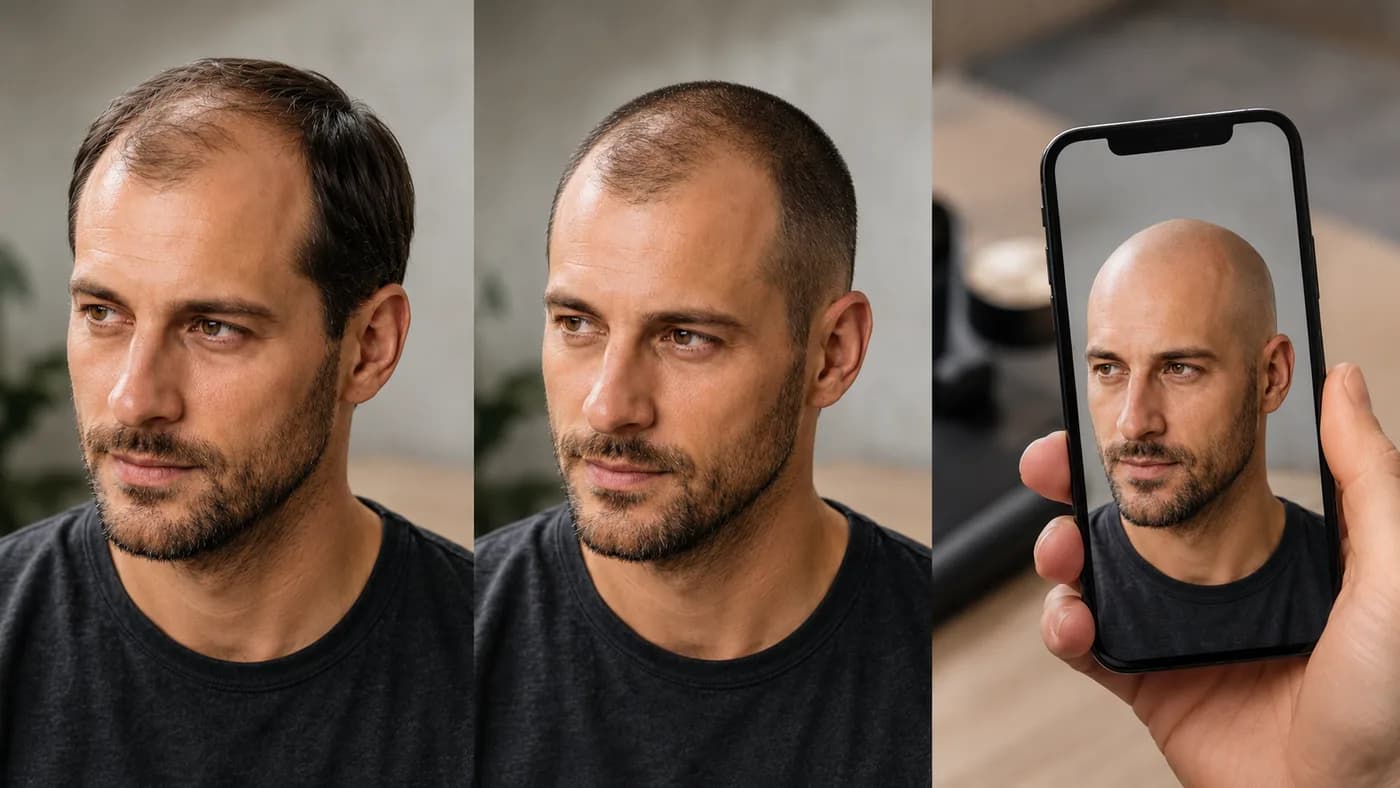
If you are searching for a buzz cut filter, you usually are not asking for a novelty effect. You are trying to answer a practical question:
Would I look better with a buzz cut, a very short buzz, or a fully shaved head?
That is a different decision from a general bald filter search. Here, the real issue is comparison. You may not need to jump straight from your current hairstyle to skin-close bald. You may simply need to see whether a #3, #2, #1, or #0 looks cleaner than the hair you have now.
That is why a buzz cut filter is useful. It turns a vague haircut idea into something you can judge on your own face.
Quick read
Do not ask only whether a buzz cut looks good. Compare several guard lengths against your current hair and the shaved option.
A #3 can still show weak density. A #1 can look deliberate. A #0 may tell you that fully shaved is the cleaner answer.
Early recession, crown thinning, diffuse thinning, and stronger side density do not all respond the same way to a buzz cut.
Quick answer: when a buzz cut filter is worth using
A buzz cut simulator is worth using when you are somewhere in the middle:
- your current hair feels worse than it used to,
- you suspect shorter would help but you do not know how short,
- you are not sure whether a shaved head would be too much,
- or you want to compare buzzed and bald before making the cut in real life.
The short answer is this: a buzz cut usually wins when short hair still creates an even frame, and bald usually wins when keeping any hair mostly highlights thinning.
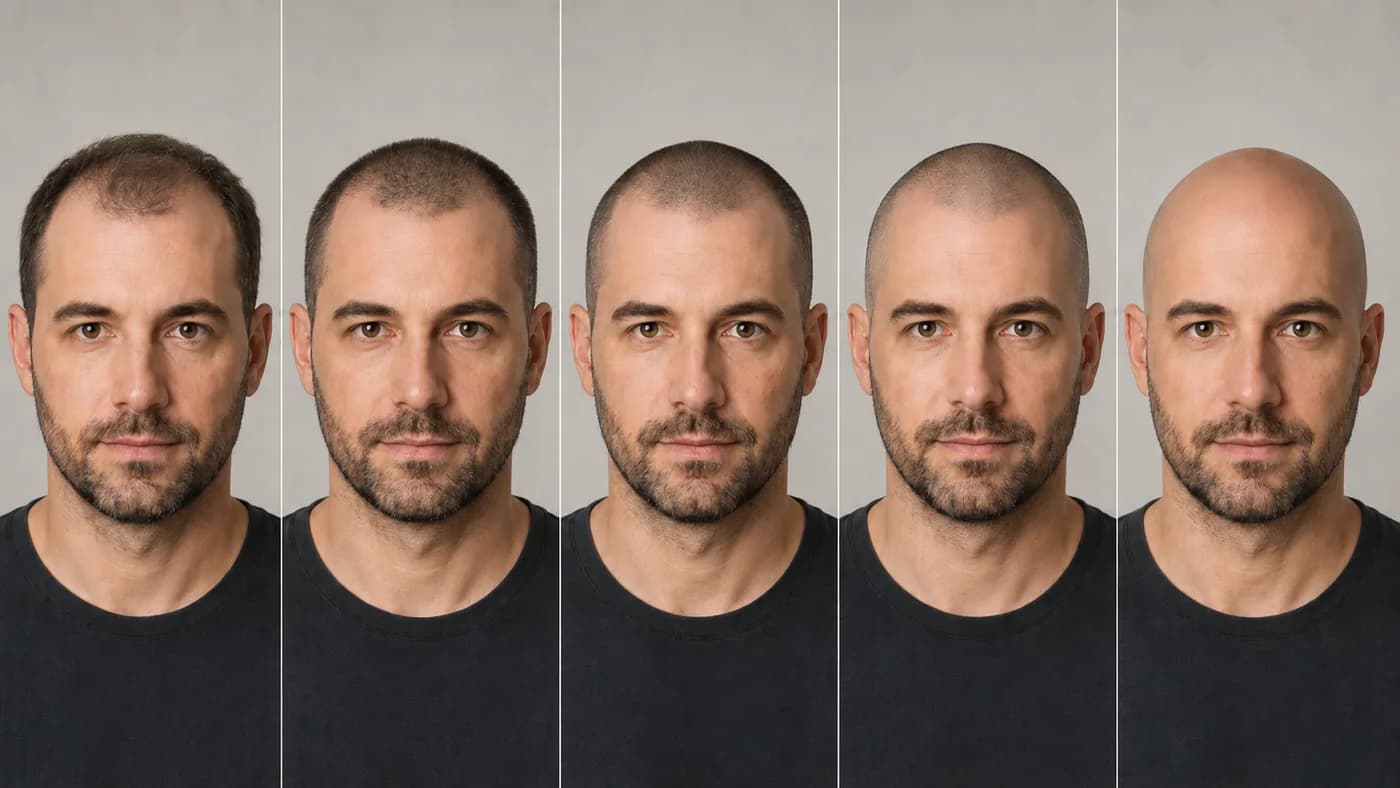
That is why the filter should not stop at one result. It should help you compare the full ladder:
- Current hair.
- Softer buzz like a
#3. - Safer middle options like
#2and#1. - Near-bald
#0. - Fully shaved head.
If you are only shown one generic buzz length, you are missing the most important part of the decision.
What a buzz cut filter should actually show you
The useful outcome is not "you look cool with short hair." The useful outcome is whether shorter hair improves the balance of your full face.
That means a good preview should help you judge:
- how much your hairline still matters once the hair is shortened,
- whether your crown stays distracting or calms down,
- whether the top still reads as even at short lengths,
- whether stubble, beard, or glasses improve the result,
- and whether buzzed or bald looks more intentional than your current style.
This is where a buzz cut filter is more helpful than random haircut inspiration photos. Other men do not share your density, head shape, beard growth, or contrast pattern.
If you want the broader shaved-head decision, Shaved Head Filter covers that side. If you already know the real comparison is between keeping a little hair and removing it all, Buzz Cut vs Bald goes deeper on that exact tradeoff.
Why guard length matters more than most men expect
Men often talk about a buzz cut as if it is one haircut. It is not. The jump from #3 to #2, #2 to #1, or #1 to #0 can completely change how the hairline and crown read.
As a rough guide:
- #3 keeps more softness and texture,
- #2 usually looks cleaner and more controlled,
- #1 often works best when recession is obvious,
- #0 gets very close to the shaved look without going fully smooth.
That is why the best buzz cut filter is not only a haircut preview. It is a decision tool for threshold testing.
When a buzz cut helps thinning hair
A buzz cut usually helps when the problem is mostly about contrast and shape, not full top collapse.
That often includes:
- a receding hairline with decent density behind it,
- mild crown thinning that looks worse in long hair than in short hair,
- early-stage thinning where styling is becoming fragile,
- or a haircut that only looks good from one angle.
Shortening the hair can make all of those look calmer because it removes the false promise of volume. It stops asking weak hair to behave like stronger hair.
The American Academy of Dermatology notes that male pattern hair loss often begins gradually with signs like a receding hairline, visible thinning, or a bald spot on top. Cleveland Clinic likewise describes common patterns including temple recession, crown thinning, and hair loss across the top. Those patterns matter here because a buzz cut does not fix every version of hair loss equally. Sources: AAD, Cleveland Clinic.
If your pattern is mostly about the front corners, a filter may show that a #2 or #1 already looks intentional enough. If your current style is longer, that can be a big improvement without going fully bald.
When bald usually looks cleaner than buzzed
This is the part many men try to avoid, but it is the whole reason the comparison matters.
A buzz cut stops helping when leaving short hair behind mostly preserves the evidence of thinning:
- the top is much weaker than the sides,
- the crown is clearly see-through,
- the whole top is diffusely thin,
- or every shorter guard already looks better than the last one.
In those cases, a buzz cut may look tidy but still compromised. The haircut reads as "thinning hair cut short" rather than "clean intentional look."
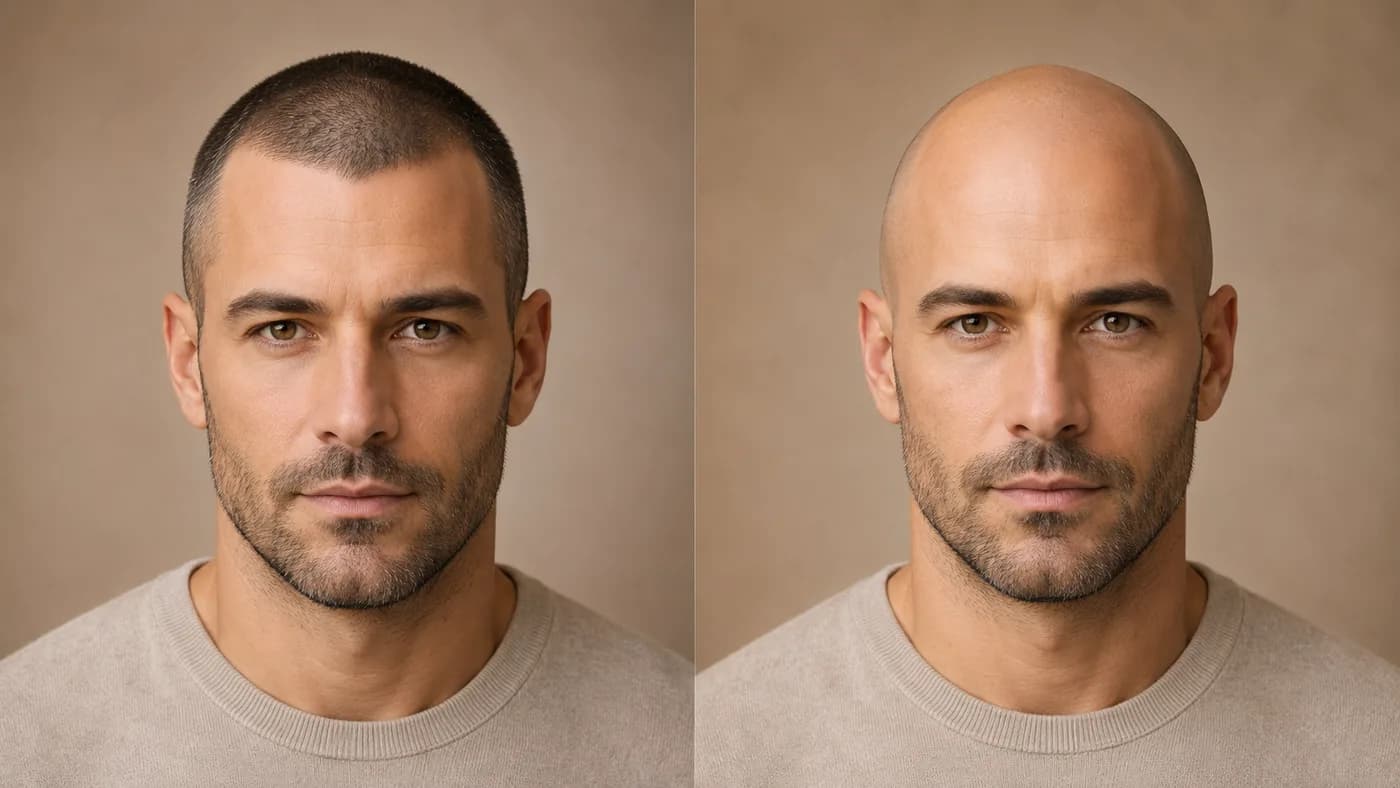
That is where a buzz cut vs bald preview becomes more valuable than a simple buzz cut filter. If the preview shows that the #1 is decent but the shaved version looks calmer, sharper, and easier, that is not a failure. It is clarity.
Do not judge from shock alone
The first time you see a very short buzz or shaved preview, the change can feel bigger than it really is. Judge the balance of the face, not only the surprise of seeing less hair.
The best uses for a buzz cut simulator
The strongest use cases are practical.
1. You are thinning but not obviously ready to shave
This is the sweet spot. You do not need opinions from ten strangers. You need to know whether shorter improves the look and where the improvement stops.
2. You want to compare multiple short directions
A lot of men do not need an answer to "hair or no hair?" They need an answer to "Which is better: #3, #2, #1, or shaved?" That is exactly what a good simulator should help with.
3. You are considering the paid BaldLooks plans
This topic naturally connects to the paid product because one static answer is often not enough. A free BaldLooks analysis is a good first step from one photo. Paid plans make more sense when you want to compare:
- a buzz cut against a shaved head,
- different angles,
- different beard options,
- different outfits,
- and different settings that change how the style reads.
That matters because a hairstyle decision is rarely isolated. The same buzz cut can feel different with stubble, glasses, office clothes, or outdoor light.
4. You want to avoid haircut regret
The best haircut decisions usually happen before the clippers touch your head. A preview does not guarantee perfection, but it can stop you from making a blind jump.
How to use the preview without fooling yourself
The input photo still matters. If the photo is weak, the answer gets weaker too.
If you want a practical sequence, do this:
- Start with a free photo-based read.
- Compare
#2and#1first. - If both still look compromised, compare
#0and shaved. - Notice whether shorter keeps improving the result or whether there is a clear sweet spot.
That sequence turns a style decision into evidence instead of guesswork.
Final answer: a buzz cut filter is most useful when it helps you choose a length
A buzz cut filter is not valuable because it tells you "yes" or "no" in one shot. It is valuable because it helps you compare the lengths that actually matter.
For many men, the answer is not dramatic. It is practical:
- a #3 still looks too soft,
- a #2 looks cleaner,
- a #1 looks strongest,
- or the shaved head finally removes the contrast that short hair could not fix.
That is the real point of the preview.
If your hair still adds something, a buzz cut can keep enough structure to look sharp without going fully bald. If your remaining hair mostly advertises thinning, the shaved option often looks cleaner. The best way to know is not to guess from fear. It is to compare the options on your actual face.