
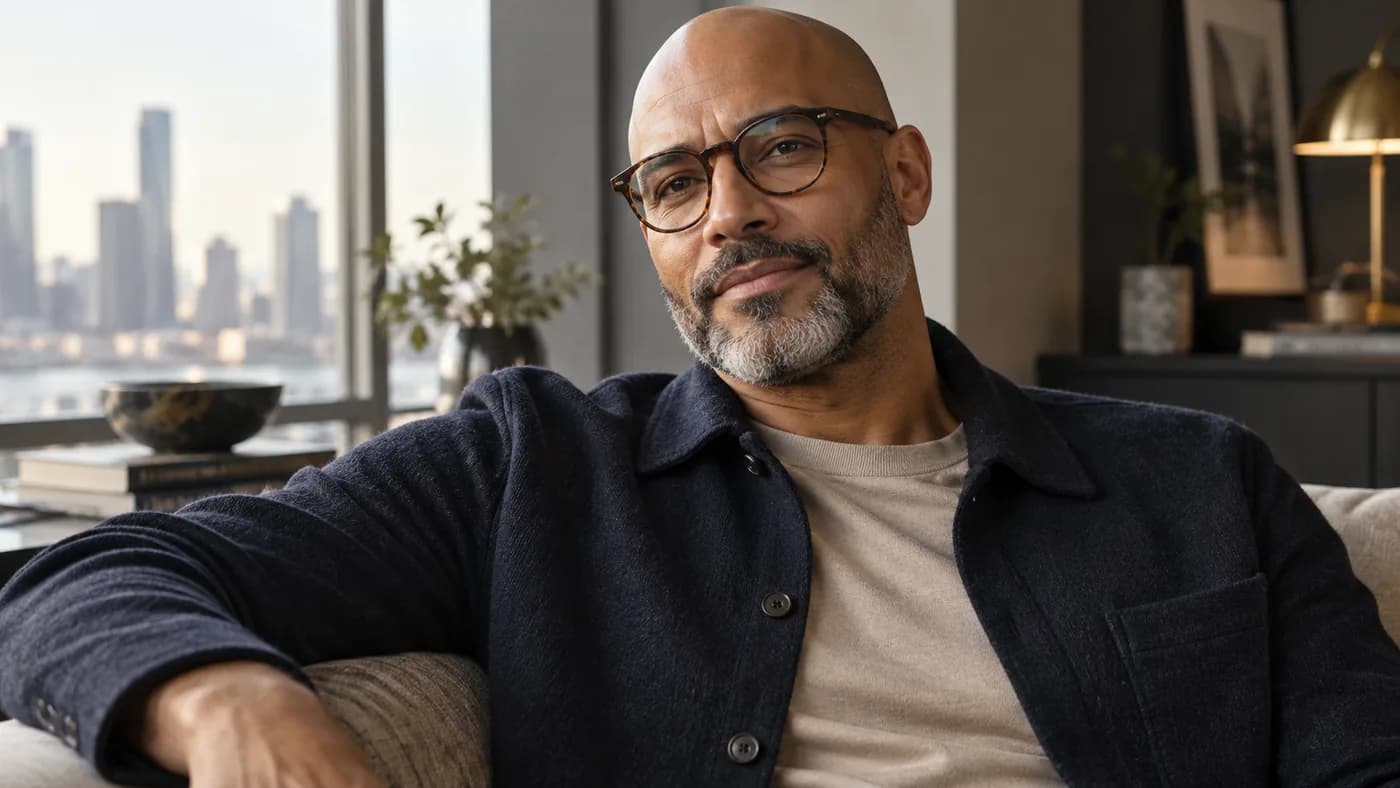
A bald head, beard, and glasses look most balanced when each element has a job: the scalp creates a clean silhouette, the frames focus the eyes, and the beard supports the lower face. You do not need to make all three equally bold. In fact, the combination usually looks strongest when one element leads and the other two support it.
That is the practical challenge behind bald with beard and glasses. Once hair is no longer framing the head, glasses and facial hair become more noticeable. A heavy dark frame plus a full dark beard can feel confident and graphic; a slim frame plus soft stubble can feel calm and professional. Neither is inherently better. The useful skill is seeing visual weight before buying frames or carving more beard away.
This guide is a matching system, not a replacement for the dedicated glasses guide or bald beard styles guide. Start here when you wear both and want the whole face to look considered.
Quick read
Let either the beard, the frames, or a strong outfit detail be the boldest element. When every detail is heavy, the face can feel crowded.
A thick frame and a dense beard can work together; a light frame and neat stubble can too. Balance their presence first, then fine-tune color.
Frames should sit comfortably, align with your face, and keep your pupils well positioned. A great-looking frame that slides or pinches is not the right frame.
Quick answer: balance the upper and lower face, then simplify the rest
For most men, a medium-weight frame with tidy heavy stubble or a short beard is the easiest place to start. It gives the eyes and jaw enough definition without asking either feature to dominate. If you have a fuller beard, move toward a cleaner or lighter frame before assuming you need a smaller beard. If you wear thin metal frames, stubble or a short beard often gives the lower face enough substance to keep the look from feeling too minimal.
Check the result in a normal-distance photo, not only two inches from the mirror. A beard and frames that feel intense close up can look perfectly proportionate in conversation or on camera. Conversely, an almost invisible frame may not provide enough eye-level structure once the whole scalp is visible.
A useful rule—not a restriction
Think in visual weight, not in prescriptions. A dark full beard and thick black frames can be an excellent intentional look. It simply benefits from clean cheek and neckline work, a simple collar, and a quick photo check rather than another bold accessory competing for attention.
The three anchors: scalp, frames, and beard
A shaved head gives the outline of the head a clean, uninterrupted role. Glasses draw a horizontal line around the eyes; a beard adds texture and mass around the jaw and chin. Together, they make a clear top-to-bottom composition.
Scalp: the quiet anchor
The scalp does not need to be perfectly matte or perfectly reflective. It needs to look comfortable and intentional in the light you actually live in. A gentle routine, familiar moisturizer, and scalp SPF when exposed are more useful than chasing a plastic-looking finish. If razor bumps or irritation are stealing attention from the rest of the look, solve comfort first; Razor Bumps on a Shaved Head covers cautious next steps.
Frames: the eye-level anchor
Frames should usually relate to the width of your face at the temples, rather than hanging far past it or stopping noticeably short. Warby Parker’s fitting guidance makes the same practical point: frame width should align with face width at the temples (How glasses should fit). The frame measurements printed inside an arm—lens width, bridge width, and temple length—are useful clues, but two frames with the same numbers can still sit differently.
Comfort is visual, too. All About Vision notes that well-fitting frames should sit around the middle of the face, avoid digging into the nose, and stay secure without slipping (frame-fit guide). Have an optician adjust a pair you otherwise love; do not let a sliding bridge become part of your signature look.
Beard: the lower-face anchor
A beard’s job is not to “compensate” for baldness. It can add texture, jaw definition, or a softer counterweight to sharp frames. Its length, density, cheek line, and neckline matter more than growing it as large as possible. For the detail work, see Beard Neckline for Bald Men; this article is about how that finished beard relates to your glasses.
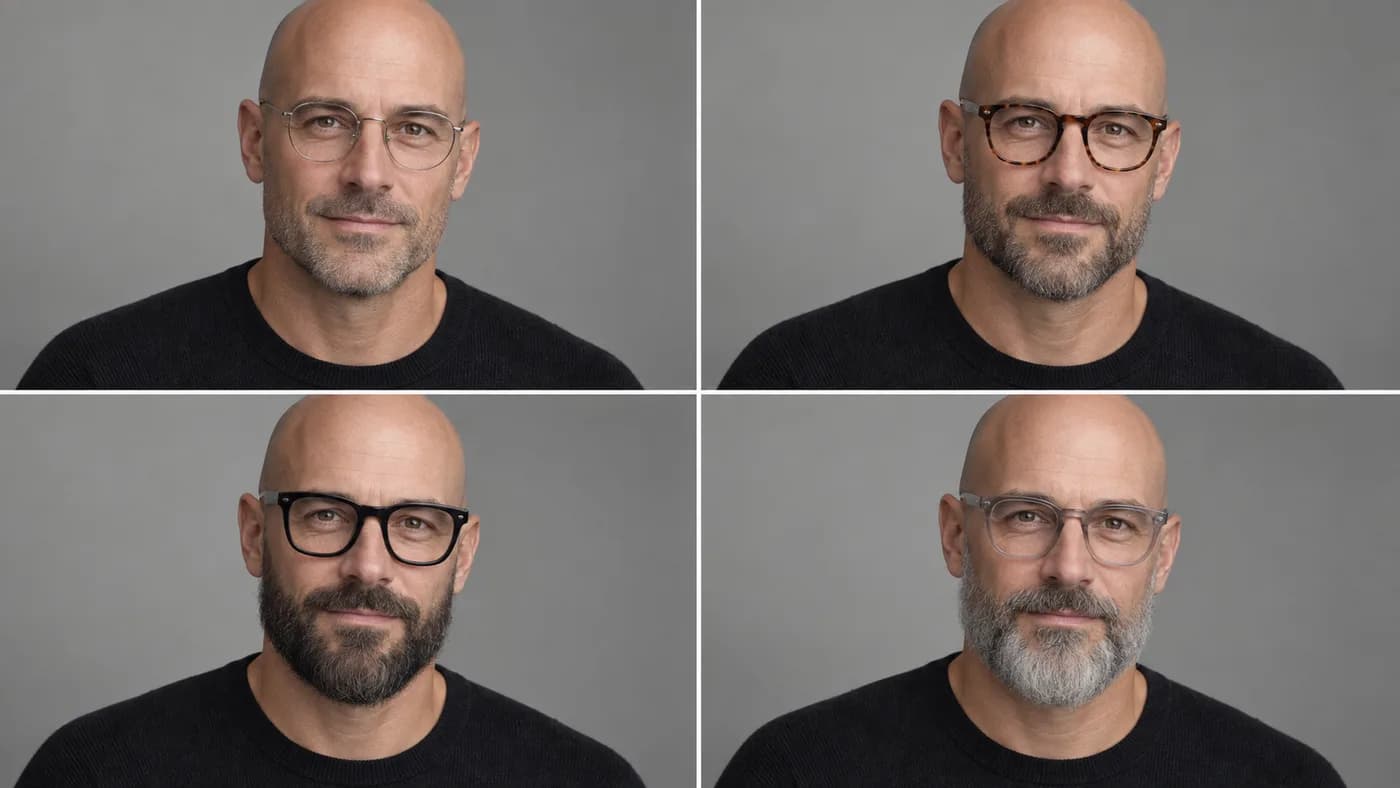
Use this frame, beard, and outfit matrix
The matrix below gives starting combinations, not a grading system. Face shape, beard growth, prescription needs, work context, and personal taste still win.
| Frame weight | Beard weight | Outfit contrast | Why it tends to work | Watch for |
|---|---|---|---|---|
| Light metal or clear | Clean shave or light stubble | Medium or higher | The outfit and brow area stay visible; the result feels clean and open. | Frames that disappear entirely or a shirt that is also too faint. |
| Medium acetate or browline | Heavy stubble or short beard | Low to medium | A reliable everyday balance: enough eye structure, enough jaw definition. | Overly sharp beard edges plus a very severe collar. |
| Bold acetate | Full, controlled beard | Low or medium | A deliberate, graphic look with clear top and bottom anchors. | Adding a loud pattern, oversized jewelry, or an untrimmed beard. |
| Warm tortoiseshell or muted color | Gray or salt-and-pepper beard | Medium | The variation in beard color and frame warmth feels textured rather than harsh. | Assuming black is the only “serious” option. |
| Dark medium frame | Short beard or goatee | Higher | The frame can lead while the beard provides a smaller chin anchor. | A very narrow frame that makes the head feel wider by contrast. |
Heavy frames with a full beard: edit, do not panic
This is the combination people most often overcorrect. Heavy frames and a full beard can look strong, especially if your style is more rugged, creative, or deliberately classic. The key is editing the boundaries: keep lenses clean, frames level, moustache hairs controlled, and the neckline natural. Then lower the volume elsewhere with a plain tee, knit polo, open-collar shirt, or jacket with a calm texture.
If the face feels dense in photos, test a medium tortoiseshell, smoke, or metal frame first. You may find that a modest frame change gives the beard more room to read naturally. Do not reduce a healthy beard to stubble solely because an oversized frame was doing too much.
Thin frames with stubble: add enough definition
Thin metal frames and stubble can feel polished and lightweight. They work especially well when your brows, eyes, jaw, or clothes already have clear definition. The risk is that every element becomes faint at once: pale metal, short sparse stubble, a washed-out tee, and bright flat light.
Add definition selectively. A frame with a slightly stronger top bar, a warmer metal tone, a darker shirt near the face, or tidier stubble may be enough. The aim is not to make the look louder; it is to make it legible.
Gray beards: use contrast with a softer hand
Gray facial hair creates natural texture. It can work beautifully with charcoal, navy, olive, cream, clear blues, warm brown, and translucent smoke frames, depending on your skin tone and wardrobe. Instead of trying to match the beard exactly, choose frames that keep the eyes present.
A very black, very thick frame can be a striking contrast against gray, but it will become the lead anchor. That is fine if it suits your taste. For an easier everyday direction, medium tortoiseshell, understated navy, or brushed metal often lets the beard and glasses share attention.
Adapt the balance to your face length
Face-shape labels are shorthand, not a verdict. The helpful question is whether the combination adds unwanted length, width, sharpness, or softness.
| If your face reads… | Start with | Consider avoiding |
|---|---|---|
| Rounder or softer | Medium angular frames with tidy stubble or a short beard | Extremely round tiny frames plus a beard that adds width at the cheeks |
| Longer or rectangular | Frames with useful lens depth and a beard that adds modest chin width, not extra length | Narrow shallow frames and a long pointed beard that elongates the face further |
| Square or strongly angular | Softer rectangular or rounded frames with a controlled beard edge | Making every line hard: boxy frame, razor-sharp cheeks, hard jaw, and severe collar |
| Oval or balanced | The weight pairing you genuinely enjoy, checked in photos | Assuming “anything works” means fit and scale do not matter |
Your cheek lines matter as much as beard length. Clean, natural cheek lines let glasses remain the eye-level focus. If every beard boundary is cut into a dark, rigid angle, strong frames can make the upper and lower face look like two competing logos. Leave the overall geometry believable.
Let clothing complete the combination
The visible frame is usually chest-up: scalp, glasses, beard, neck, collar, and shoulders. That makes the shirt you wear near the face more important than another tiny accessory.
- With dark frames and a dark dense beard, choose a solid or textured shirt with enough separation from both; charcoal-on-black can work, but test it in your usual light.
- With clear or light metal frames and stubble, a deeper navy, forest green, burgundy, or warm neutral top can provide the contrast the face is not getting from the accessories.
- With a gray beard, use color deliberately instead of defaulting to black. See Clothing Colors for Bald Men for an easy daylight-test framework.
- Keep collars in proportion. A crisp collar, knit polo, crewneck, or open overshirt can frame the beard quietly. Avoid stacking a very busy collar, bulky scarf, large chain, bold frames, and big beard all at once.
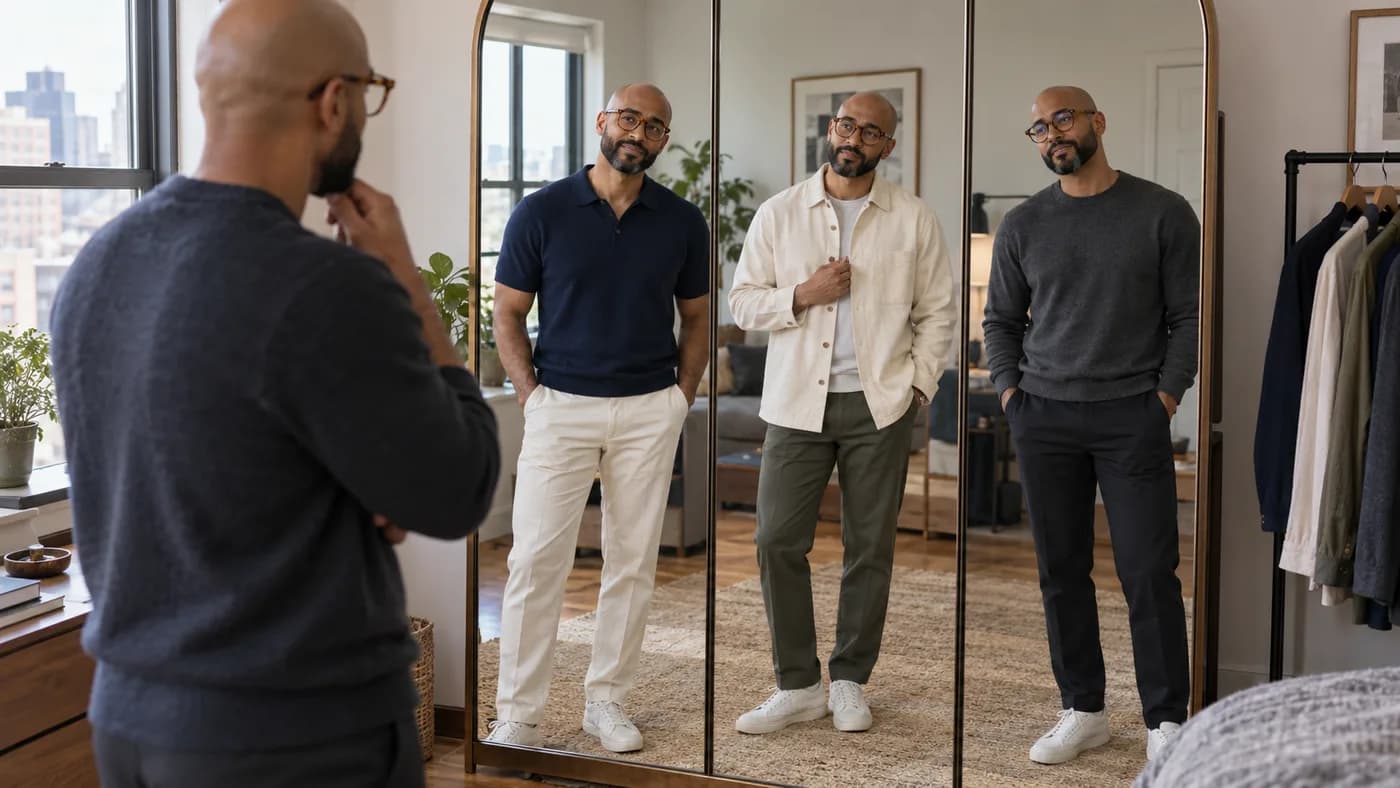
Run a five-minute real-world test
Before buying another frame or changing your beard shape, test the combination you already own.
- Clean both sides of the lenses and brush the beard into its normal shape.
- Take a front, three-quarter, and side photo in indirect daylight, wearing your usual top.
- Change one thing: switch frames, shorten beard bulk slightly, or change the shirt color. Do not change all three.
- Step back from the screen. Ask whether your eyes are still visible, the beard supports rather than overwhelms the jaw, and the shirt gives enough separation.
- Repeat in the lighting that matters to you—an office, restaurant, video-call desk, or outdoor setting.
For comfort as well as appearance, maintain facial hair with a gentle routine. The American Academy of Dermatology recommends cleansing the beard and skin, moisturizing appropriately, and using shaving oil, cream, or gel before trimming; it also advises shaving in the direction of hair growth when clearing the neck to reduce irritation (healthy beard tips). If repeated irritation, painful bumps, or persistent redness is part of the picture, slow down and seek a dermatologist’s advice instead of taking closer and closer passes.
Preview the combination before committing
Your everyday glasses, facial hair, and favorite shirt are not separate decisions. They are the way people recognize you in a profile photo, meeting, date, or ordinary conversation. A quick photo test is useful because it shows what the whole system does at a natural distance.
BaldLooks Free Analysis gives you a bald-look report from one photo. If you want to explore further, paid BaldLooks plans let you compare beard, glasses, outfits, locations, and angles on your own shaved-head look. It is a practical way to decide whether you want a bolder frame, lighter beard, or simply a better shirt contrast before you spend money or trim away too much.
The practical takeaway
The best bald-with-beard-and-glasses look is not a universal recipe. It is a clear hierarchy: a clean scalp silhouette, frames that make your eyes easy to find, and facial hair that supports your jaw without becoming a second focal point. Start in the middle—medium frames, tidy stubble or a short beard, and a calm shirt—then move one element bolder only if that direction feels like you.
Use the mirror for grooming and photos for proportion. That is how you keep a strong three-part combination looking intentional rather than overbuilt.