
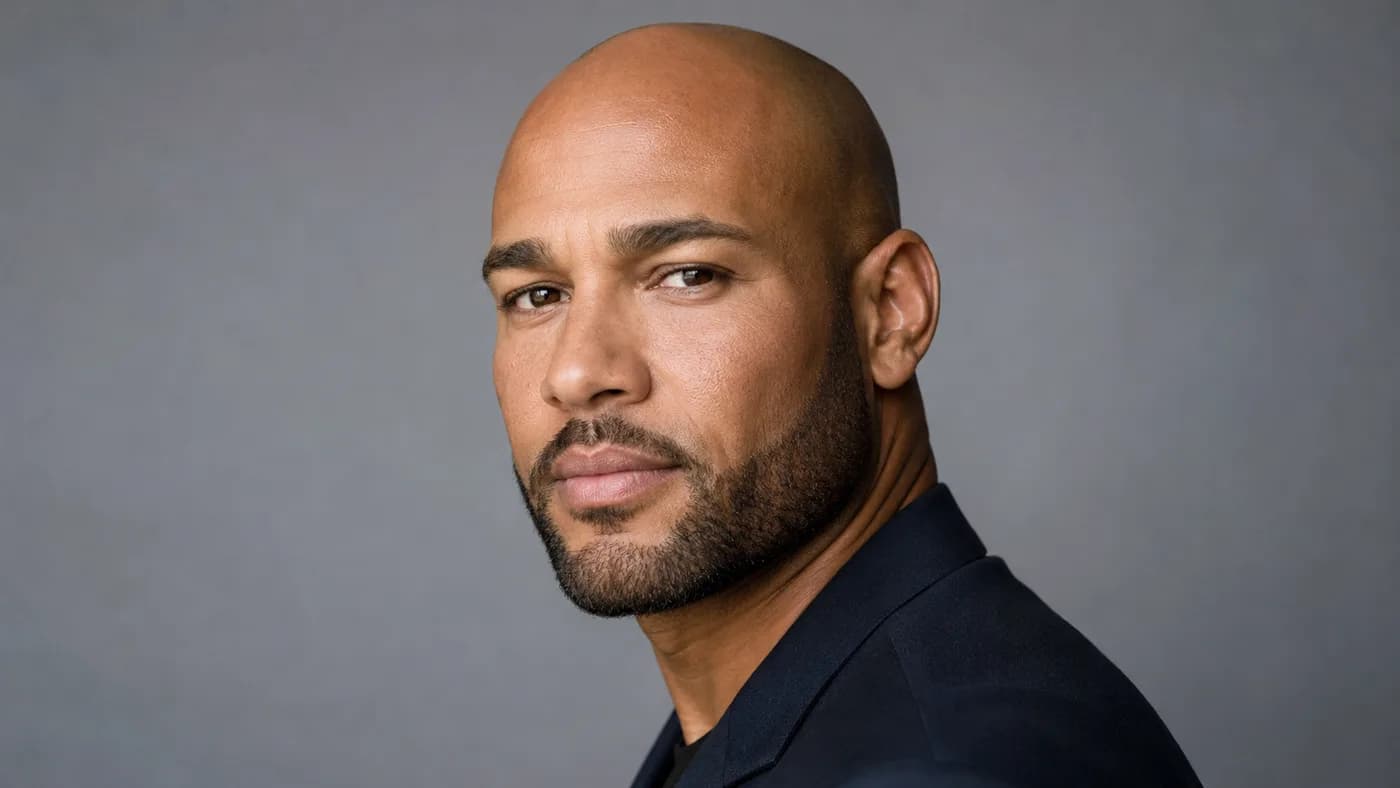
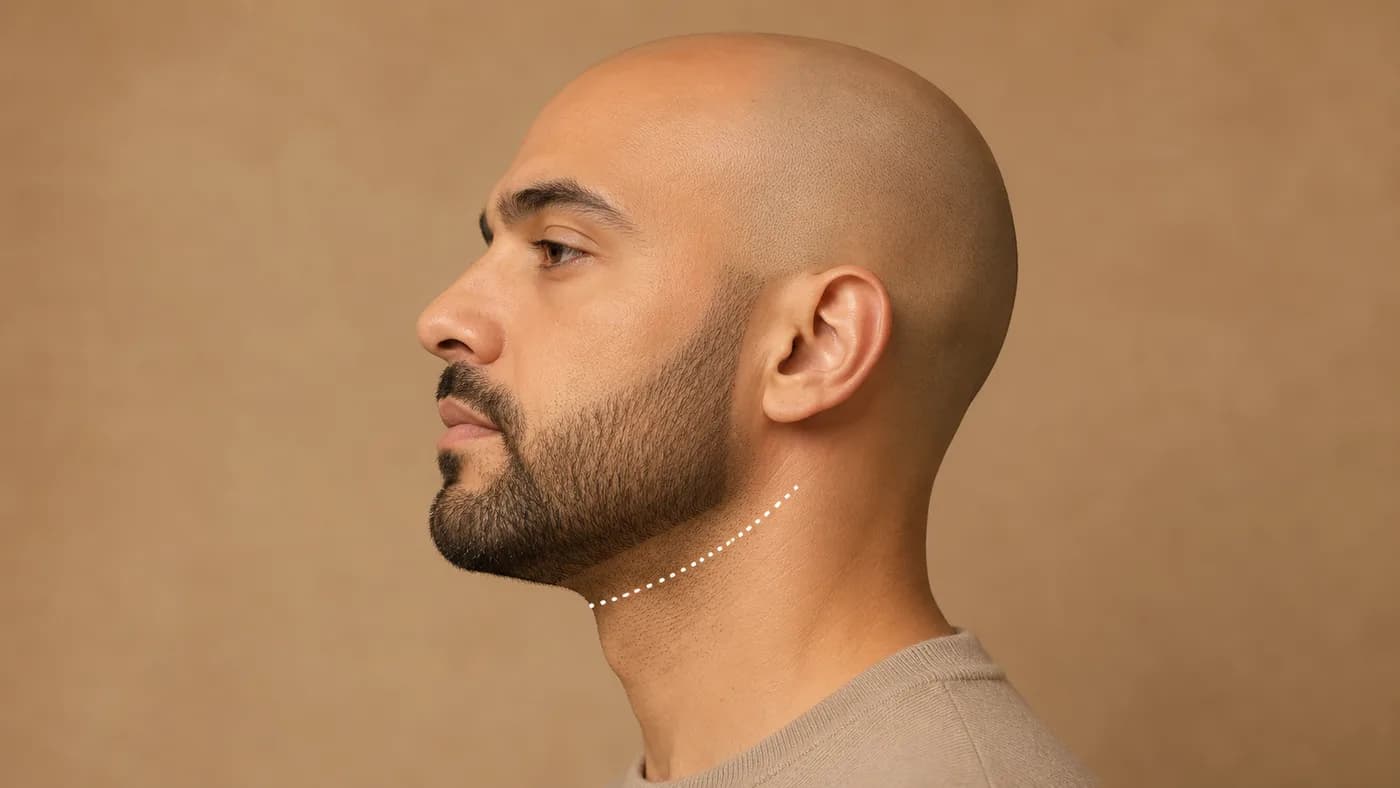
A good beard neckline for bald men usually starts above the Adam's apple, stays below the jaw, and rises in a shallow curve toward each side of the face. It is a small line with a large effect: a shaved head makes the beard outline more visible, so an undefined neck can make a sharp beard look unfinished, while a line cut too high can make the beard feel disconnected from the jaw.
The goal is not a universally perfect arc. Your beard density, chin length, face shape, and preferred beard style all change the best finish. What matters is that the line supports the lower face and looks even from the front, three-quarter view, and profile.
Quick read
The jaw is the beard's support structure. Preserve the hair under it; clean the neck below a gradual curve instead of drawing a hard line across the jaw.
Use a trimmer to establish a conservative center point and inspect both sides before you shave more. You can always lift a line later.
Stubble, a goatee, a short boxed beard, and a fuller beard need different degrees of definition and depth.
Quick answer: where to trim your beard neckline
Stand upright and look straight into a mirror. Place one or two fingers above your Adam's apple; that gives most men a sensible center starting point, not an immovable rule. From that point, imagine a shallow U that travels back and upward, meeting the underside of the beard behind the jaw corners. Remove the hair below it, leaving the hair tucked under the jaw intact.
Philips uses a similar practical cue: identify a point just above the Adam's apple, work downward from it, and judge the result with your head in a normal position (Philips beard-neckline guide). The exact height varies. If a high line makes your beard look like it stops at the chin, lower it. If a very low line turns into an indistinct patch on the neck, bring it up gradually.
Why the neckline matters more with a shaved head
Hair usually softens the transition from sideburn to jaw and gives the eye other places to land. With a shaved head, the scalp, brows, beard, glasses, and collar form a cleaner graphic frame. That makes the lower beard edge easier to see—especially in side photos, bright light, and open-collar shirts.
The neckline does not create a new jaw; it simply decides where the beard stops. A well-placed line can make a short beard look intentional without making the lower face feel boxed in. A line that is too high often exposes too much of the underside of the jaw. A line that is too low can blur the transition from beard to neck. Neither is a character flaw; both are easy geometry adjustments.
For the bigger question of beard length and face balance, read Bald Beard Styles by Face Shape. This guide stays tighter: it helps you draw the lower boundary of the style you already chose.
Find your personal line with three landmarks
Do this before reaching for a razor. Use a well-lit mirror, keep your neck relaxed, and take a normal-distance photo afterward. Stretching your neck upward while you plan the line is the fastest way to set it too high once you stand normally.
1. Set the center anchor
With your chin level, place a finger immediately above the Adam's apple. One to two finger widths above that area is a useful conservative anchor for a short or medium beard. It leaves room for the beard to wrap under the jaw instead of ending on it. Adjust only in millimeters: a slightly lower, softer center can preserve substance; very short stubble may sit a touch higher.
2. Preserve the jaw transition
Turn slightly to the side. The line should rise from the center anchor and meet the beard behind the visible jaw corner, not slice across the jawbone. Think of a shallow bowl that holds the beard's underside. Use a rounder connection for a relaxed look or a slightly squarer one for a boxed beard.
3. Check the two sides at normal distance
Set the center, make a short line on each side, then step back. Look straight ahead, turn left and right, and use a rear camera or second mirror for profile. Do not chase microscopic symmetry: the useful standard is a beard that reads balanced in a conversation-distance photo.
Cut conservatively on the first pass
Start below the line you think you need. You can raise a neckline once, but you must wait for it to grow back if you take away the under-jaw support. If you are uncertain before an event or photos, ask a barber to set the first shape and maintain that outline at home.
Adapt the neckline to your beard style
The anchor method is a starting framework. The amount of edge definition should match the amount of beard you are wearing.
| Beard style | Neckline approach | What to avoid |
|---|---|---|
| Light or heavy stubble | Keep a soft, modest boundary; clear obvious neck growth rather than carving a high arc. | A razor-sharp, high line that makes short stubble look disconnected. |
| Short boxed beard | Use the full shallow curve, with a clean but not severe connection behind the jaw. | Cutting directly along the jaw or making the curve a straight horizontal stripe. |
| Fuller beard | Keep the center lower and let the beard retain under-jaw mass; clean the neck beneath it. | Removing too much support while trying to make a long beard look smaller. |
| Goatee or circle beard | Shape the lower edge around the chin section and clear separate neck growth. | Extending a broad invisible neckline across bare cheeks and jaw. |
Stubble: tidy without making it theatrical
Stubble already has a soft edge, so you do not need a visible ruler line. Remove scattered lower-neck growth and stop before creating a narrow, sharply edged band under the chin. Let the change to bare skin feel clean, not drawn on.
Short boxed beard: define the shape, then soften the transition
Build the shallow curve from the center out, then use a slightly shorter guard just above it if the transition is abrupt. Keep cheek lines and the sideburn transition consistent too; a shaved head makes a disconnect more visible. See Bald Men With Beards for the complete shape system.
Fuller beard: preserve substance beneath the jaw
With more length, the outer silhouette carries the shape; the neckline simply stops the beard disappearing into the neck. Keep it lower and gradual, comb downward, check profile, then remove neck hair beneath the silhouette. Avoid cutting away dense hair under the chin.
Goatee: make the center intentional
A goatee is not a tiny full beard. Its neckline ends around the chin, not behind both jaw corners. Choose its width from the front, keep the bottom rounded or gently squared, and clear isolated neck growth. The Bald With Goatee guide compares compact and broader options.
How to trim the neckline without irritating the skin
Line work involves repeated passes over sensitive neck skin. Start with a clean trimmer to map the line; use a razor only if you want a closer finish and your skin tolerates it.
The American Academy of Dermatology recommends softening hair with water, using shaving cream or gel, shaving in the direction of hair growth, rinsing the blade after strokes, and replacing disposable blades after five to seven shaves (AAD shaving guidance). For beard trimming specifically, AAD also advises using a shaving oil, cream, or gel to help avoid irritation, then moisturizing after the shave (AAD healthy-beard tips).
Keep the technique simple:
- Trim your beard to its planned length first; the neckline is easier to judge when the bulk is controlled.
- With your head upright, make the center anchor and establish the curve with a trimmer in short, light strokes.
- Clear below the line, working with your hair growth if you are prone to bumps. Do not press hard or reshave the same patch repeatedly.
- Rinse away clipped hair, pat dry, and apply a familiar gentle moisturizer or aftercare product.
- Recheck in daylight several minutes later. Redness immediately after trimming can make a line look uneven when it is not.
If bumps, pain, persistent redness, or recurring ingrown hairs do not improve when you change technique, a dermatologist can help; do not keep escalating the closeness of the shave. Razor Bumps on a Shaved Head has a cautious troubleshooting guide that applies to irritation patterns more broadly.
The common neckline mistakes—and the calm correction
Trimming directly on the jaw
This is the most common error. It feels logical because the jaw is easy to see, but it removes the beard's underside and can make a fuller beard look like a narrow chin strap. Let the beard sit beneath the jaw; put the cleanup line lower.
Making a straight line from ear to ear
Most necks are curved, and most beards need a gradual rise to meet the sides. A straight stripe can look abrupt from profile. Use a shallow U instead, keeping the center lowest and the corners higher.
Overcorrecting natural asymmetry
One side may grow denser or sit slightly differently. Do not keep lifting both sides until they are identical at two inches from the mirror. Check the whole face at normal distance; usually a tiny difference disappears while an over-trimmed neckline does not.
Ignoring the context
The neckline is most visible above an open collar and in profile photos. Inspect it in the contexts you actually use. A low-maintenance stubble line may suit daily life, while a barber-shaped boxed beard may be worth refreshing before photos; Bald Groom Style Guide has an event timeline.
Use a photo to decide before you make it permanent
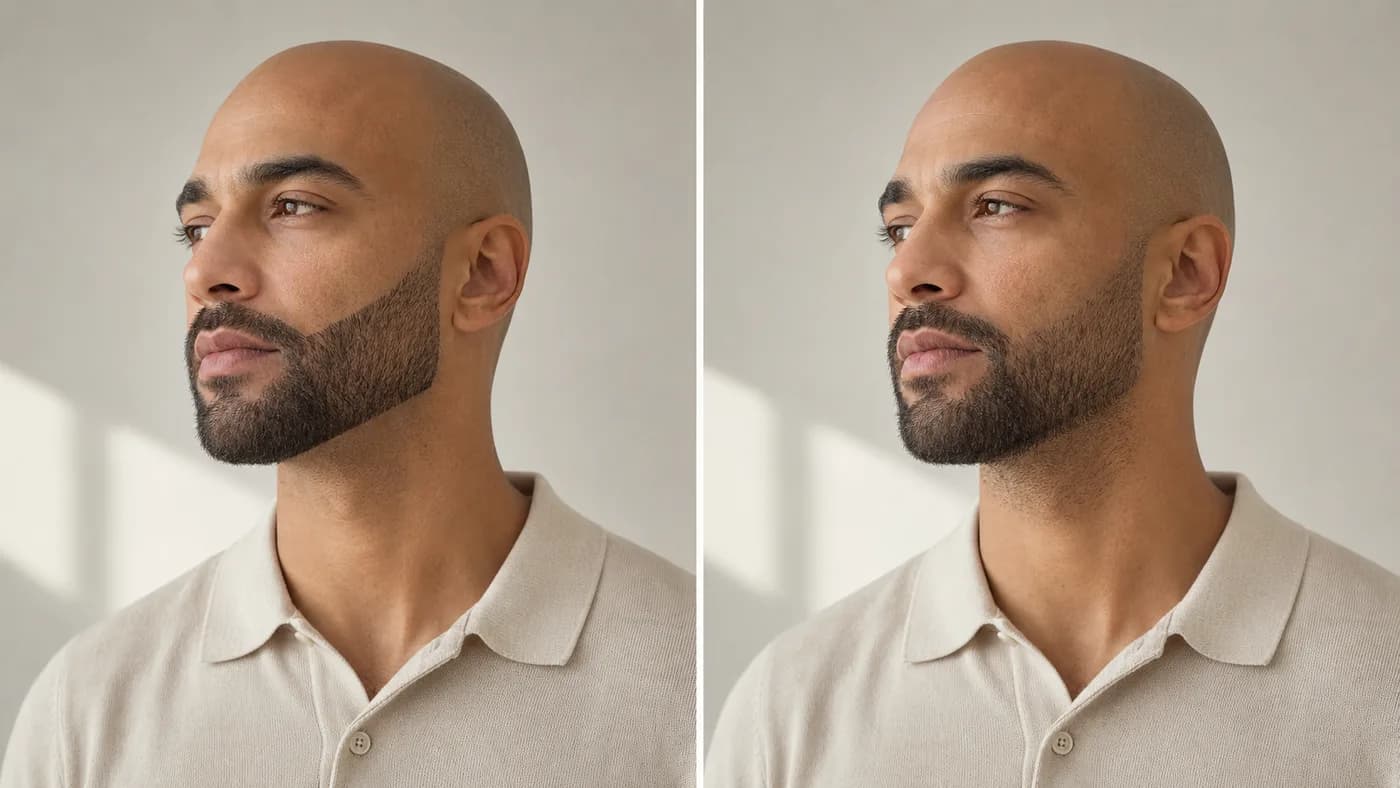
Necklines are difficult to judge because you cannot naturally see the underside of your jaw from every angle. Take front, three-quarter, and side photos in soft daylight before and after a conservative cleanup. Ask: does the beard still support the jaw, look calm against the collar, and stay even when you turn?
BaldLooks Free Analysis can give you a bald-look report from one photo. With a paid BaldLooks plan, you can compare your shaved-head look with different beard densities, outfits, locations, and angles—useful for choosing the overall beard weight before you commit to a more defined trim.
The practical takeaway
For most bald men, the best neckline sits between neck growth and the jaw: begin one or two finger widths above the Adam's apple, preserve the hair under the jaw, and curve gently to the sides. Keep it soft for stubble, defined for a boxed beard, lower for fuller growth, and compact for a goatee. Work conservatively, judge it upright in a normal-distance photo, and prioritize skin comfort alongside precision.