
Types of Receding Hairline: 6 Common Patterns
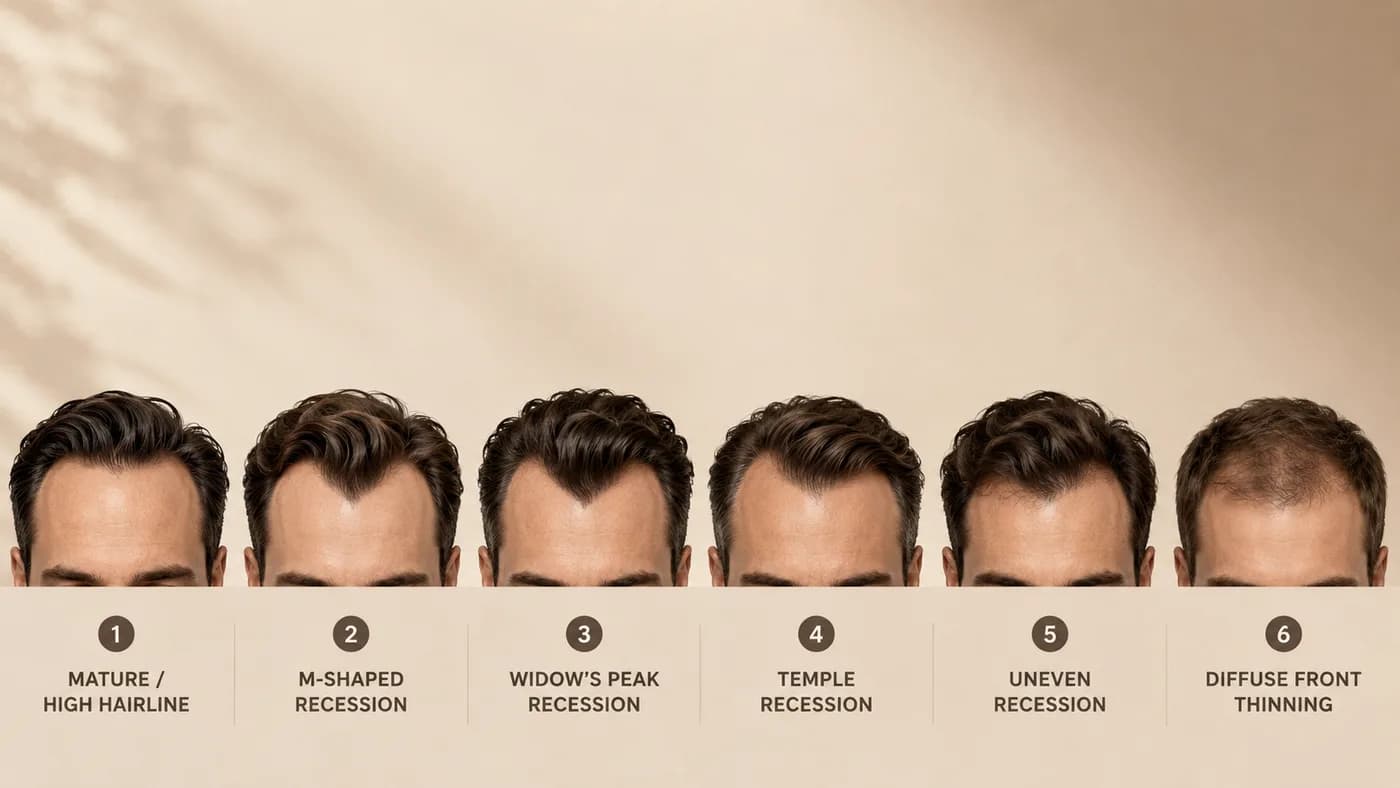
If you are searching for types of receding hairline, you usually want a more precise answer than "your temples are going back."
You want to know what kind of recession you are looking at, whether it is mild or progressive, and what haircut direction actually fits that pattern.
That matters because not every receding hairline points to the same decision. Some men are looking at a stable, mature-looking line that only needs perspective. Others are looking at clear temple loss that will soon push them toward a tighter crop, a buzz cut, or a shaved head.
The short version is this: the pattern matters, but progression and density matter more than shape alone.
Quick read
M shape, high forehead, temple loss, or diffuse thinning give you a useful starting label, but the label is not the full diagnosis.
A hairline that changed slightly and stayed stable is very different from one that keeps moving back every few months.
The best cut for mild temple recession is not always the best cut for diffuse front thinning or an advanced Norwood 3 hairline.
What counts as a receding hairline?
A receding hairline usually means the front edge of the hairline is moving back, most often around the temples, front corners, or both.
The American Academy of Dermatology explains that male pattern hair loss often begins with a receding hairline or a bald spot on the crown. The Cleveland Clinic describes a similar pattern, where recession often starts above the temples and may later involve the crown.
That broad definition is useful, but it is still too general for real grooming decisions. What you need is a way to classify what you are seeing.
Do not classify your hairline from one bad mirror check
Wet hair, overhead light, phone-camera distortion, and one stressful haircut can all exaggerate recession. Use repeatable photos before deciding your pattern.
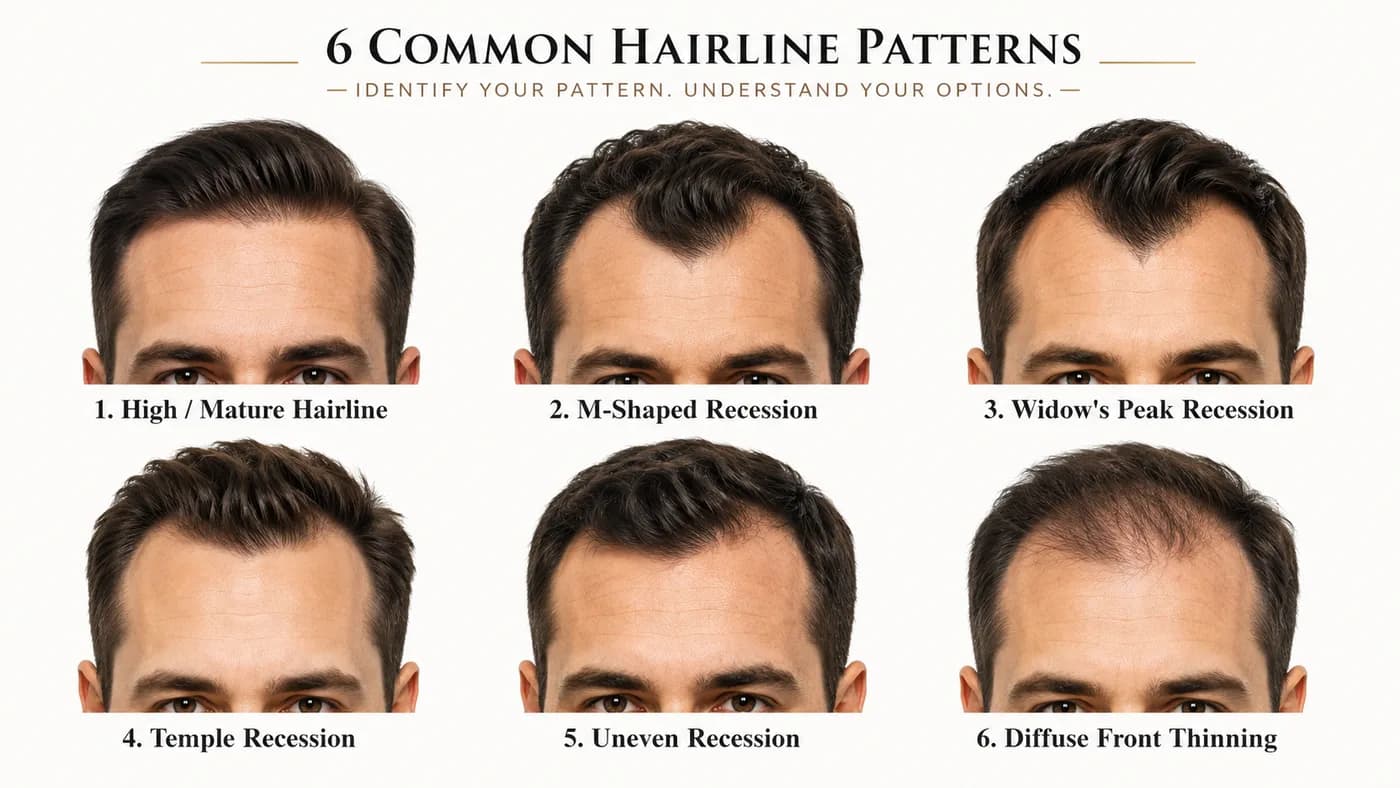
The six main types of receding hairline
These categories are not medical diagnoses. They are practical visual buckets that help you understand what is happening and which haircut choices usually improve the look.
| Type | What it looks like | What usually matters most |
|---|---|---|
| High or mature-looking hairline | Hairline sits higher than it did in your teens, but still looks balanced | Stability over time |
| M-shaped recession | Front corners move back more than the center | Temple depth plus front density |
| Widow's peak recession | Center point remains while both sides recede | Whether the peak still looks intentional |
| Temple recession | Loss is concentrated at the temples first | Symmetry and how deep the corners are |
| Uneven recession | One side recedes faster than the other | Whether haircuts can balance the asymmetry |
| Diffuse front thinning | Front edge looks softer and less dense instead of sharply moving back | Density, scalp show-through, and crown involvement |
1. High or mature-looking hairline
This is the pattern that gets overdiagnosed online.
A high hairline is not automatically a bad sign. Some men naturally have more forehead height. Others shift from a low juvenile hairline into a more adult, slightly higher line and then stay there for years.
The key question is whether it is stable.
If the outline is fairly even, the density behind it still looks strong, and your recent photos do not show obvious deepening at the corners, you may be looking at a mature pattern rather than active recession. That is where Mature Hairline vs Receding Hairline becomes the more useful follow-up than panic-searching worst-case charts.
Best haircut directions here are usually simple:
- crew cut,
- short textured crop,
- #2 or #3 buzz if you want less contrast,
- or even keeping your current style if density is strong.
2. M-shaped recession
This is the pattern most men picture when they think of a receding hairline.
The middle stays relatively forward while both front corners move back, creating a more obvious M shape. MedlinePlus Genetics describes androgenetic alopecia in men as often beginning above both temples and forming this more recognizable shape over time.
An M shape can range from mild to advanced. The mild version can still look strong, especially if the density behind the line is solid. The advanced version starts pushing you closer to the Norwood 3 hairline decision zone, where shorter often starts outperforming styled hair.
Usually best haircut directions:
- #1 or #2 buzz,
- short Caesar,
- tight crop,
- shaved head if the top behind the M is also weakening.
Usually worst haircut directions:
- tall quiffs,
- long combovers,
- slicked-back volume that exposes the corners,
- medium-length tops with very tight sides.
3. Widow's peak recession
This pattern creates confusion because a widow's peak can exist with or without meaningful hair loss.
Some men simply have a central point in the hairline. Others have that point plus clear recession on both sides, which makes the peak look sharper and more isolated over time.
The useful test is whether the peak still feels like part of a balanced hairline or whether it has become the last strong section of a weakening front edge.
If it still looks symmetrical and the density behind it is good, you may not need an aggressive change. If the sides are getting weaker and the peak is starting to look stranded, a shorter haircut often makes the whole line look cleaner and less fragile.
Usually best haircut directions:
- short crop with light texture,
- #2 buzz if density is strong,
- #1 buzz if the sides of the peak are clearly thinning.
4. Temple recession
Temple recession is often the earliest obvious sign of male pattern loss.
Instead of the whole front moving back evenly, the loss starts by opening the corners. The middle front may still look good, which is why many men feel confused: the hairline does not look "gone," but it does not feel solid anymore either.
This is the stage where lighting and haircut choice start changing the result a lot. A haircut that looks normal indoors can suddenly show much deeper corners in daylight or photos.
Temple recession usually responds well to honesty. If you keep the top short enough, the recession often reads as masculine and intentional rather than stressed. If you leave too much length, the same corners can become the first thing people notice.
If this is your main pattern, Buzz Cut for a Receding Hairline is the most tactical next read.
5. Uneven recession
This is one of the most frustrating patterns because it feels harder to style than symmetrical loss.
One temple or front corner moves back faster than the other, so even good haircuts can look slightly off unless they are short enough to reduce the imbalance. Men with uneven recession often spend too much time trying to force a side part or fringe to compensate, when the simpler fix is usually reducing length.
The rule here is straightforward:
- the more asymmetrical the recession,
- the less helpful longer styling tends to be,
- and the more useful short, even cuts become.
Usually best haircut directions:
- #1 or #2 buzz,
- even crew cut,
- short crop without exaggerated parting.
6. Diffuse front thinning
This pattern is different because the problem is not only where the line sits. It is that the entire front edge starts looking softer, weaker, and more see-through.
Instead of sharp temple loss, you may notice:
- more scalp under bright light,
- a weaker front edge after styling,
- less density behind the line,
- a flatter look across the top.
This is often where men misread the problem. They think the hairline has not moved much, so it must not be serious. But density loss can be more important than a slightly higher outline.
Diffuse front thinning usually favors shorter cuts earlier than men expect. A #2 can work if the density is still decent. Once the top is obviously transparent, a #1, #0, or fully shaved head often looks stronger than trying to preserve softness that no longer reads as fullness.
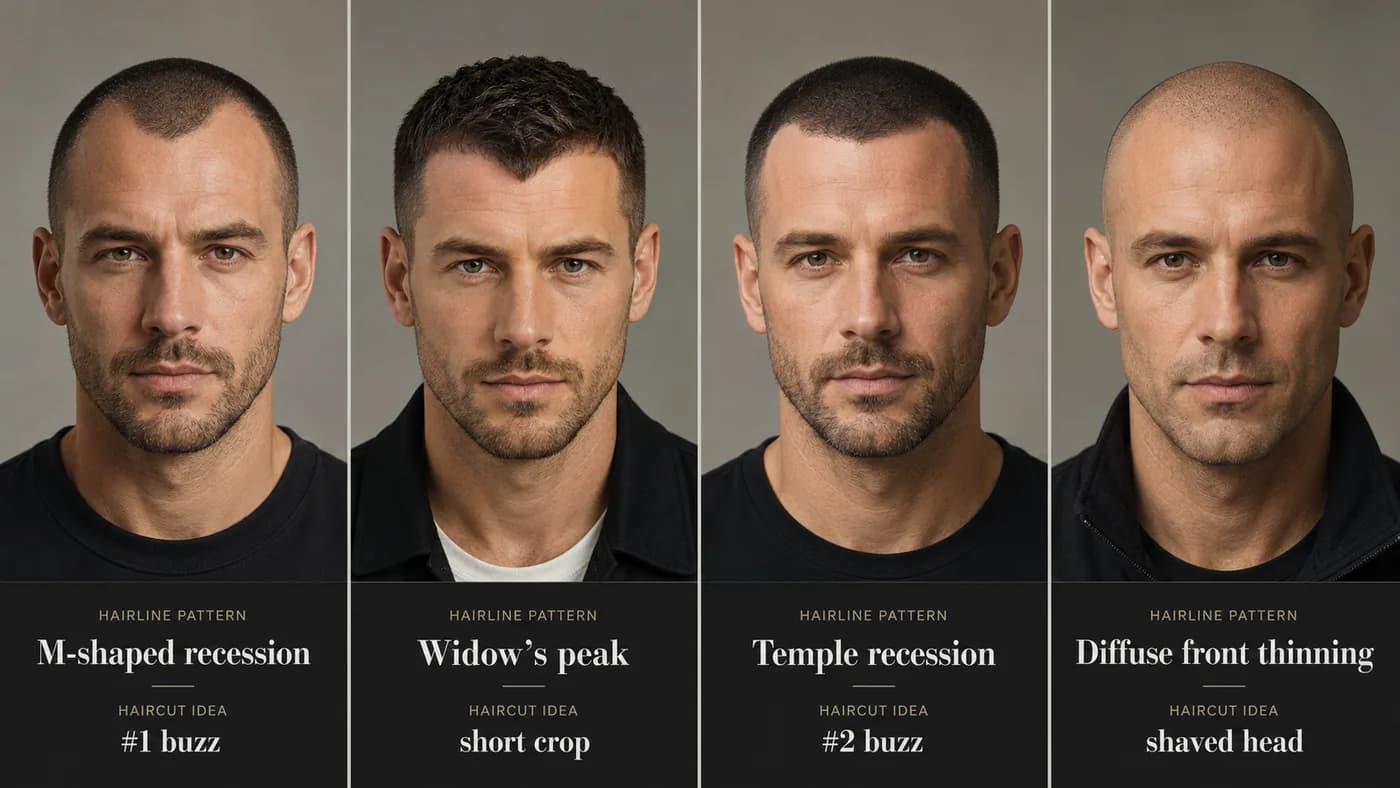
Which haircut usually works best for each type?
This is the part most readers actually care about.
| Hairline type | Usually safest haircut | Works if density is strong | Usually risky choice |
|---|---|---|---|
| High or mature-looking | Crew cut or short crop | #2 or #3 buzz | Overreacting with an unnecessary full shave |
| M-shaped recession | #1 or #2 buzz | Caesar or tight crop | Long front-heavy styling |
| Widow's peak recession | Short crop | #2 buzz | Slicked-back volume |
| Temple recession | #1 or #2 buzz | Crew cut | Longer tops that expose the corners |
| Uneven recession | Even short cut | #2 buzz | Asymmetrical styling tricks |
| Diffuse front thinning | #1 buzz or shaved | #2 only if top density still holds | Medium-length hair that separates under light |
If you notice that every shorter cut keeps looking better, that usually matters more than the category label.
How to tell whether your pattern is stable or progressing
The Mayo Clinic notes that hereditary hair loss typically happens gradually and in predictable patterns. That means the clearest signal is not today's mirror check. It is the trend across time.
Use this simple framework:
If your pattern is stable, you may only need a smarter haircut and less anxiety. If it is progressing, you are usually better off thinking ahead instead of forcing an older hairstyle to survive.
When to compare a buzz cut with a shaved head
Not every receding hairline needs shaving. But some patterns are much closer to that conversation than others.
A buzz cut usually makes sense first when:
- the main issue is temple shape,
- the top still has decent density,
- you want a lower-risk transition,
- or you are not ready to lose all scalp shadow.
A shaved head starts making more sense when:
- the top is visibly weaker than the sides,
- diffuse thinning joins the hairline recession,
- the crown is changing too,
- or every shorter guard already looks better than the last one.
That is the point where Receding Hairline: When Is It Time to Shave? becomes more useful than searching for one more haircut trick.
Do not ask only whether your hairline is receding
Ask whether your current hair still improves your face more than a shorter cut would. That question leads to better decisions than labels alone.
Final answer
The most useful way to think about types of receding hairline is not as six separate cosmetic labels. It is as six common ways the front of the scalp changes, each with a different haircut response.
If you remember only three things, keep these:
- A high or mature-looking hairline is not always active recession.
- M-shaped, temple, and uneven recession usually reward shorter, more honest cuts.
- Diffuse front thinning is often about density loss more than outline, so it pushes men toward shorter hair faster.
If you want the least emotional next step, compare your current hairline against a buzz cut or shaved-head preview on your own face. That usually gives you more clarity than reading ten more generic forum opinions.