
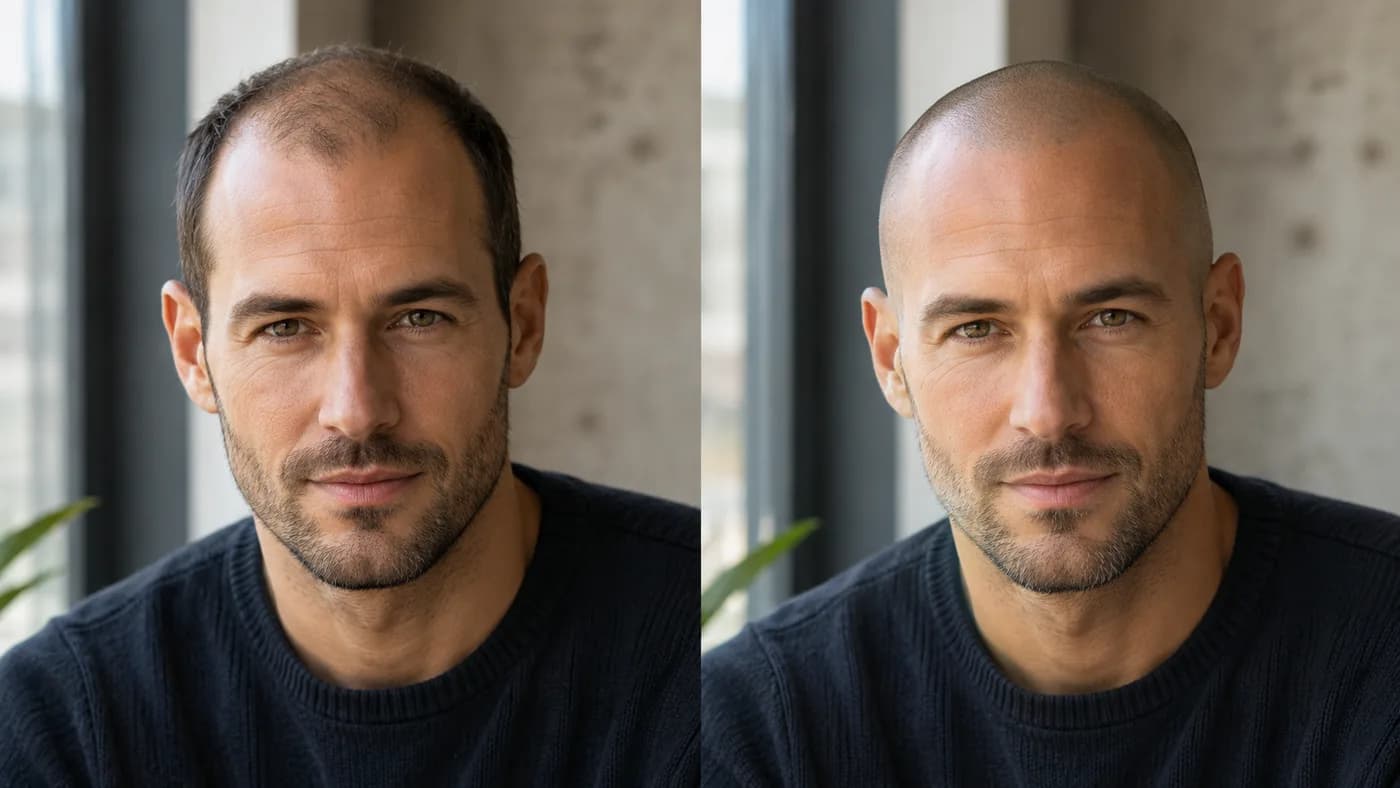
A shaved head before and after can look like a huge transformation, but it rarely changes your face as much as it changes the frame around it. When longer hair is thinning, separating, or retreating at the temples, it can pull attention upward all day. Removing that hair changes the visual problem: your eyes, jawline, beard, glasses, skin, and clothes become more noticeable.
That can be a relief. It can also feel strange for the first week because you are seeing your actual head shape and forehead without the familiar softening effect of hair. Both reactions are normal—and neither tells you whether the shaved look is right for you.
The useful question is not, “Will I become more attractive if I shave?” It is: does a clean, intentional shaved look suit me better than the hair I am managing now?
Quick read
A close shave removes the gap between dense sides, thin top, and a changing hairline. That often makes the whole head look calmer.
Brows, jawline, beard, glasses, expression, and skin care carry more of the visual weight after hair is gone.
Compare short buzz and shaved versions of your own face before deciding whether the change feels like you.
Quick answer: what really changes after you shave your head?
Shaving your head can make thinning or recession look more deliberate because it removes the inconsistent coverage around it. It does not make every concern disappear. Your scalp becomes more visible, your grooming routine changes, and a beard or wardrobe choice may matter more than it did before.
For men with hereditary hair loss, the common visible patterns are a receding hairline, thinning near the temples, or loss at the crown—not one identical “balding” look for everyone. The American Academy of Dermatology and Cleveland Clinic both describe those patterns. That is why one person’s bald before-and-after can look quietly cleaner while another person may prefer a short buzz.
A shaved head is a styling decision, not a diagnosis
If hair loss is sudden, patchy, painful, scaly, or worrying you, talk with a dermatologist rather than assuming it is typical pattern loss. A new haircut can be empowering, but it should not replace getting an unusual change checked.
The five visual changes you will notice first
1. The hairline stops competing with your face
With a receding or uneven hairline, the eye tends to track the temples and front edge. A shave removes that outline altogether. This can make a deeply receded hairline feel less like an unfinished haircut and more like a chosen look.
The tradeoff is that a naturally high forehead is fully visible. In most cases, that is more noticeable to you than to anyone else. Look at a normal-distance photo, not only a bathroom mirror at close range, before deciding it is “too much.” If recession is the main issue, our guide to a shaved head with a receding hairline compares the shaved, buzzed, and cropped options in more detail.
2. The crown becomes simpler to read
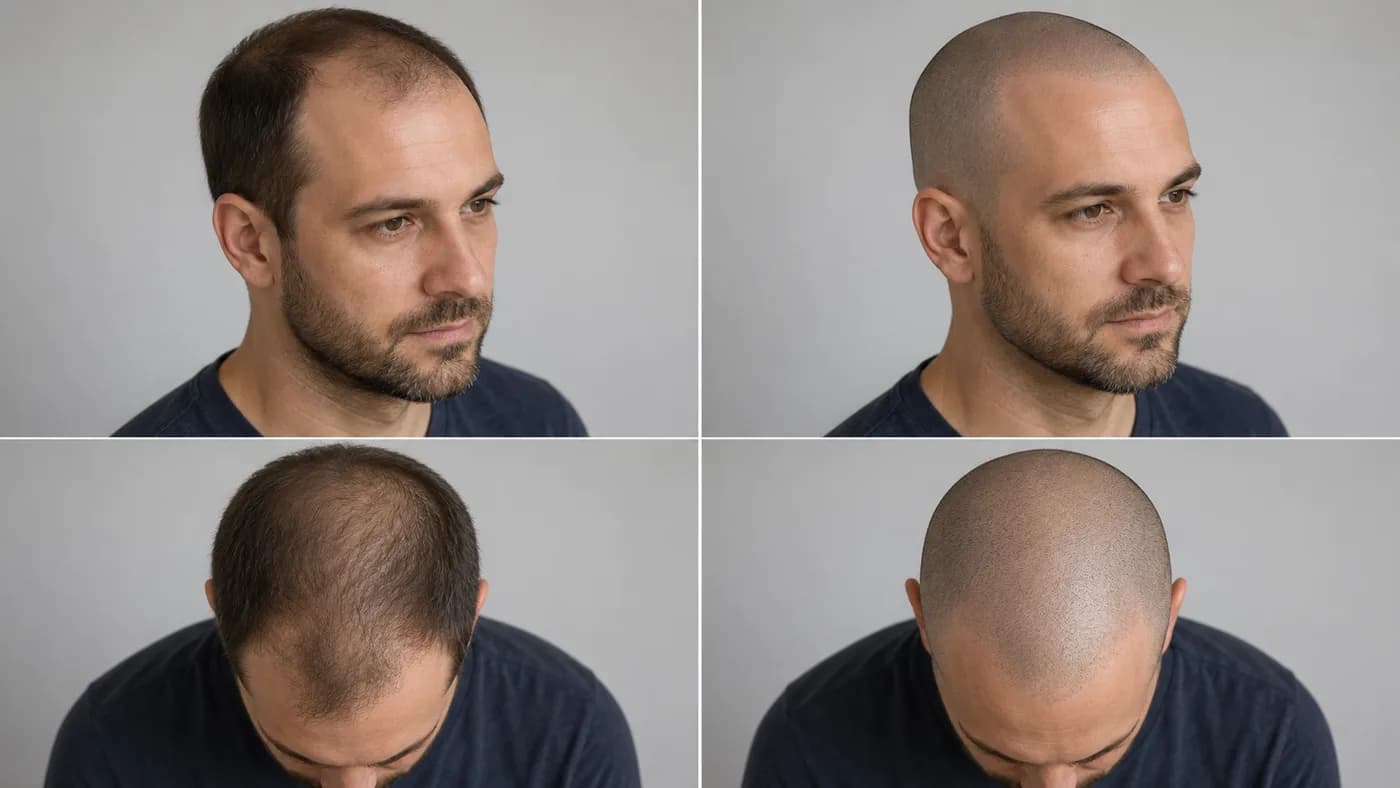
Longer hair can create a ring of density around a thinner crown. A close shave eliminates that ring, so there is less difference between the top and the sides. For many men, this is the cleanest part of the transformation.
It is not a coverage trick: a shaved scalp is still visible. The improvement comes from removing the pattern of “thick here, sparse there.” If you are unsure how far crown thinning has progressed, start with crown balding rather than making the decision from one overhead-light photo.
3. Your lower face matters more
Hair gives the top of the face visual weight. Once it is gone, the jaw, chin, mouth, and neck carry more presence. That is why a little stubble can look surprisingly different after a shave. It creates a gentle top-to-bottom balance without needing a large beard.
But a beard is optional. A clean-shaven face can work just as well if the overall presentation is tidy: moisturized skin, intentional glasses, a good neckline, and clothes that fit through the shoulders. If you want to experiment, compare bald with stubble, bald with a goatee, and bald with no beard as separate looks—not as a rule that you must grow facial hair.
4. Skin and shine become part of the presentation
After shaving, your scalp is visible skin. Dryness, razor irritation, and excessive shine can be more noticeable, especially under harsh overhead light or in photos. A basic routine—gentle cleansing, moisturizer that agrees with your skin, and sun protection when you are outdoors—does more for a polished result than chasing a perfect head shape.
Give irritated skin time before judging the transformation. A red, freshly shaved scalp under bathroom lights is not the final version of the look. For practical upkeep, see our bald head care routine and how often to shave your head.
5. Clothes and glasses show up more clearly
This is the most underestimated before-and-after change. Without hair adding color and texture above the face, neckline, jacket structure, glasses, and beard contrast become more visible. A plain T-shirt can still look great; the point is simply that fit and proportion now do more work.
Start small. Try a crew neck, an overshirt, a collared shirt, or glasses you already like. You do not need a new “bald man uniform.” The goal is for the shaved head to look integrated with the rest of you. How to dress when bald has the practical follow-through.
What improves—and what can feel unfamiliar
| Before shaving | After shaving | The honest tradeoff |
|---|---|---|
| Longer hair may separate, flatten, or expose weak areas unpredictably. | The outline becomes consistent in wind, sweat, and daylight. | You lose the soft texture of hair and see your scalp more clearly. |
| Receding temples or crown contrast can dominate photos. | The face and whole silhouette often look more intentional. | You may need a few days to adjust to a visible forehead or head shape. |
| Styling can take time and mental energy each morning. | Routine often becomes faster and more repeatable. | You replace styling with clipping, shaving, and scalp care. |
| A hairstyle can act as a familiar comfort blanket. | You get a more direct, less managed look. | The emotional adjustment can take longer than the haircut itself. |
The emotional piece is real. Some men feel immediate relief because they stop monitoring wind, product, and angles. Others miss the familiarity of hair even when they prefer the shaved result in photos. Give yourself permission to have both reactions. A good decision is not one that erases insecurity overnight; it is one that is easier to live with every day.
A low-risk way to create your own before-and-after
Other men’s transformations can show possibilities, but they cannot answer how your forehead, beard density, glasses, or face shape will read. Make the comparison personal and consistent instead.
- Take a clear front-facing photo in natural daylight, with no hat and your hairline visible.
- Add a three-quarter angle and a crown photo if thinning there is part of the decision.
- Compare your current look with a short buzz first, then a close-shaved look.
- Judge each version at normal phone size and at arm’s length—not only zoomed in.
- Try one or two grooming variables: clean-shaven, stubble, glasses, or a different neckline.
BaldLooks Free Analysis is a useful first step when you want a practical read from one photo. If the choice feels close, paid BaldLooks plans let you see your shaved-head direction from more angles, with different outfits and in different locations. That makes it easier to decide on the whole look, rather than committing because one filtered selfie happened to look good.

When a shaved head is not the best next move
It is completely reasonable to keep your hair, seek treatment, or choose a buzz cut instead. A shave is not automatically better if your density is still even, your hairline is stable, or you genuinely enjoy styling the hair you have.
It is also worth separating a style decision from a health decision. The AAD notes that different kinds of hair loss have different causes, and early professional advice can matter when you want to explore treatment. If your hair loss is new, rapid, or accompanied by scalp symptoms, book a dermatologist appointment. A shaved head can still be a style you choose, but you deserve good information about what is happening first.
For a middle ground, read buzz cut vs bald. A #2, #1, or #0 can show you whether less length already solves the contrast problem without going straight to a smooth shave.
The bottom line
A shaved head before and after usually looks strongest when it replaces visual conflict with a simpler, more deliberate silhouette. The hairline no longer needs managing, the crown no longer competes with thicker sides, and your face gets more room to lead.
That does not mean everyone should shave. It means the right comparison is your current hair against a shaved version of you—with your face, your beard, your glasses, your skin, and your everyday clothes. Preview it first, let the initial surprise settle, then choose the version that makes you feel most like yourself.