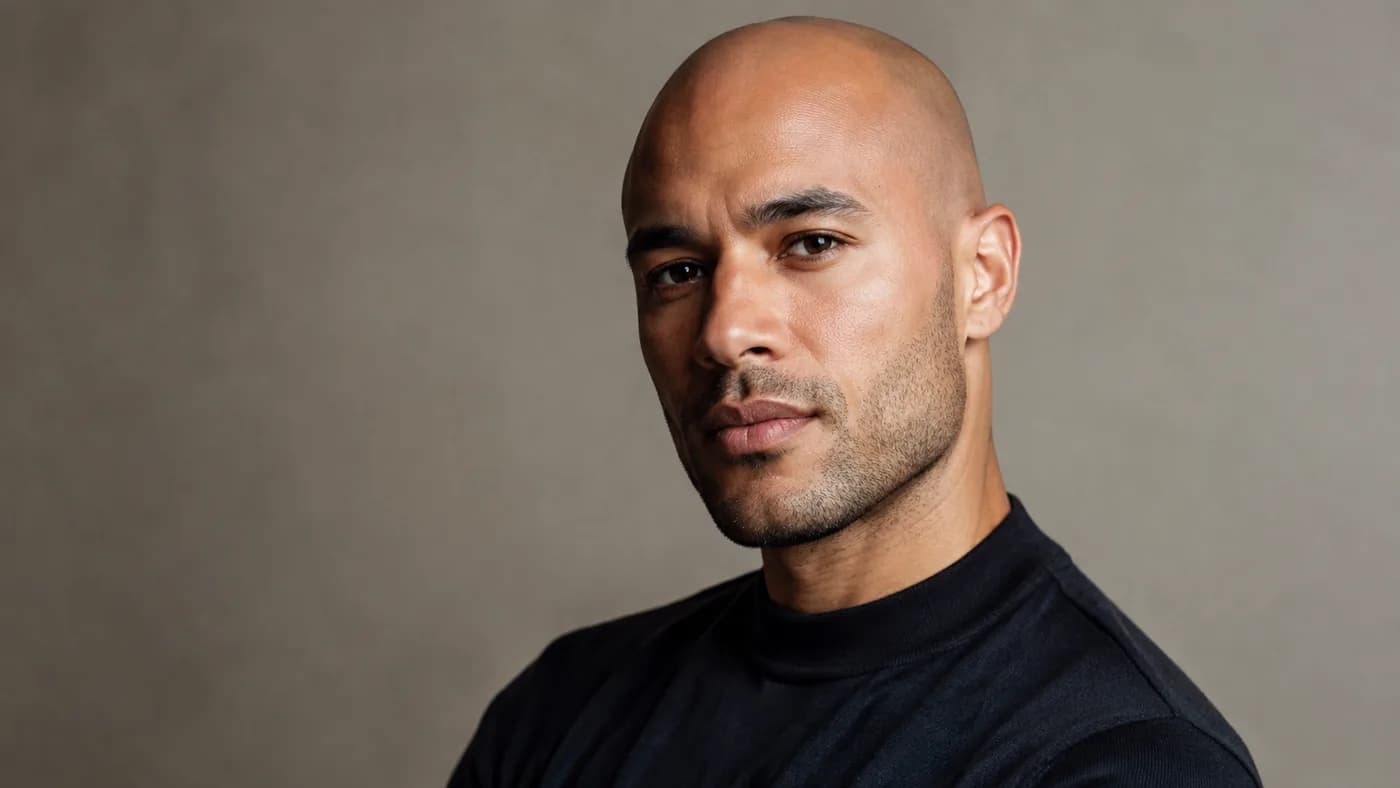
Eyebrow grooming for bald men is mostly about restraint: brush the brows, trim only the hairs that truly overhang, and clean up a few clear strays without changing their natural thickness or shape. Once hair no longer frames the forehead, brows become a more noticeable visual anchor between the scalp, eyes, glasses, and beard. That does not mean they need to look sculpted. It means small details read more clearly.
The useful question is not, “How do I get perfect eyebrows?” It is, “Do my brows look intentional at normal conversation distance?” A healthy brow can be uneven, gray, thick in one spot, or slightly different from the other. The goal is to preserve its character while taking away the distractions: a few hairs reaching far above the top line, a joined center you do not want, or long hairs that point in every direction.
Quick read
Use the brow you have as the template. Grooming should reveal its outline, not replace it with a thin arch or a hard graphic block.
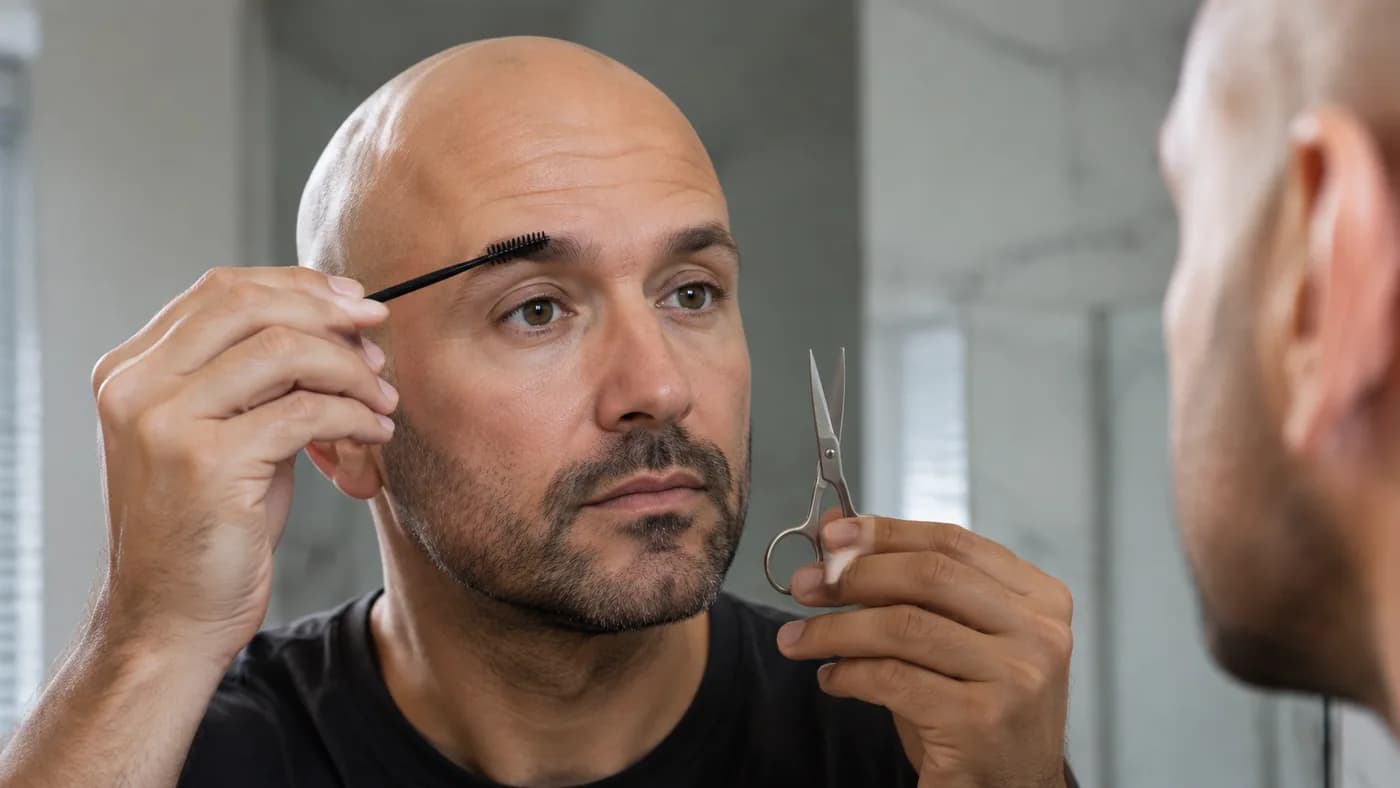
Most brows need a spoolie and tiny, selective snips more than aggressive hair removal. Brush first so you see which hairs are actually too long.
Frame weight, beard density, skin-to-hair contrast, and a shaved scalp all influence how strong a brow should appear.
Why eyebrows matter more with a bald head
With a shaved head, the upper face has a cleaner silhouette. The eye naturally moves from scalp to brow to eyes, then down to the beard, jaw, or collar. Brows help define the expression in that sequence: a soft brow can make heavy glasses feel calmer; a substantial brow can keep a fuller beard from pulling all visual weight downward.
This is not a rule that bald men need bigger or darker eyebrows. It is an argument for proportion. A strong natural brow often looks excellent with a clean shave. A lighter or sparse brow can look equally good when the rest of the frame is quieter: thinner glasses, softer beard edges, and moderate contrast near the face. Read How to Look Good Bald for the wider system of scalp finish, facial hair, and clothing; this article focuses on the small upper-face detail within it.
Natural asymmetry is also normal. One brow may sit slightly higher, grow denser, or have a different arch. Trying to force them into mirror-image shapes tends to create the thing you notice most: overworked brows. Aim for similar overall weight and a tidy outline, not identical individual hairs.
The five-minute eyebrow routine
You need very little: a clean spoolie or brow brush, small blunt-tip grooming scissors, good light, and optional slant-tip tweezers. Do not start with a magnifying mirror. Step back regularly; it is easier to keep a natural result when you see your whole face.
1. Brush brows upward and outward
Brush from the center of each brow toward the tail, first upward and then along its natural direction. This shows what is actually unruly. Many hairs that seem too long settle into place once brushed, so give them a chance before cutting.
2. Trim only the clear overhang
Hold the brush in place and make tiny cuts only on hairs that extend noticeably beyond the top outline. Keep the scissors parallel to the brow rather than cutting a straight horizontal strip. One or two millimeters is enough. You can always trim another hair later; you cannot put length back immediately.
3. Clean up obvious strays, not density
Look for hairs far below the brow, isolated hairs well above it, or center hairs that change the look you want. Remove one at a time with clean tweezers, pulling in the direction the hair grows. Avoid clearing the thick upper edge or repeatedly plucking through the middle to “even it out.” Those are the moves most likely to make a brow narrow and patchy.
The skin around the eye is delicate. Cleveland Clinic dermatologist guidance warns that frequent plucking can traumatize hairs and, over time, may contribute to scarring; it also recommends avoiding obsessive close-up checking (Cleveland Clinic on overplucking). A calm, infrequent cleanup is a safer style strategy than daily correction.
4. Check the face, not each eyebrow in isolation
Move back from the mirror, relax your forehead, and look forward. Then put on the glasses you wear most and inspect your beard or stubble as it normally is. Ask whether the brows look awake and tidy—not whether they trace exactly the same line. A phone photo in window light is a useful final test because it shows the scale people actually see.
5. Leave the result alone for a few days
Freshly plucked skin can look red and make the result feel harsher than it is. If you are grooming before photos or an event, do a conservative cleanup a few days ahead rather than experimenting the night before. The same event-ready principle applies to a beard neckline and scalp shave.
A brow is not a beard line
Crisp beard edges can look great because they define a larger shape below the face. Brows sit directly above the eyes. Keep their edges softer and their thickness more natural; a visible “template” is rarely the most flattering outcome.
Choose the right amount of grooming
The best amount is driven by hair texture, density, and your everyday context—not by a gendered standard of neatness. Use this as a starting point.
| What you notice | Low-risk response | Avoid |
|---|---|---|
| A few long, wiry hairs | Brush up; snip only the tips that project beyond the outline. | Cutting a full straight line across the brow. |
| A handful of hairs between brows | Remove individual center strays if you prefer a little separation. | Creating a wide, bare gap that makes the inner brows look disconnected. |
| Dense, naturally full brows | Tidy outliers and preserve the body. | Thinning the entire brow to make it match a trend. |
| Sparse or graying brows | Brush, condition gently if desired, and trim only obvious length. | Plucking gray hairs until density becomes uneven. |
| Uneven left and right brow | Make the more unruly side a touch tidier, then reassess at distance. | Raising or narrowing both brows in pursuit of exact symmetry. |
Thick brows: tame direction, not volume
Full brows offer useful structure on a bald face. Often the only change they need is direction: brush them up and outward, trim the few hairs that sit well outside the shape, and remove a small number of isolated strays. Avoid hollowing out the middle. Density is what makes a fuller brow look natural.
Sparse brows: preserve what is there
Sparse brows do not need to be “fixed.” Keep trimming minimal, avoid removing hairs near the front, and choose glasses with a frame that supports rather than overwhelms the eye area. If brow thinning is sudden, patchy, itchy, or accompanied by other hair or skin changes, it is worth discussing with a clinician rather than assuming it is only cosmetic. Cleveland Clinic notes that eyebrow hair loss can have several causes and can be treatable depending on the cause (overview of eyebrow hair loss).
Gray hairs: coordinate rather than erase
A few silver hairs can look especially intentional when they repeat a salt-and-pepper beard, gray frames, or cool-toned clothing. Trim a hair that is unusually long or wiry, but do not reflexively pluck every gray one. Color consistency matters less than an even overall silhouette.
Glasses, beard, and brow: the balance check
With a shaved head, eyebrows do not work alone. Use this simple three-part check before changing them significantly.
If you wear glasses
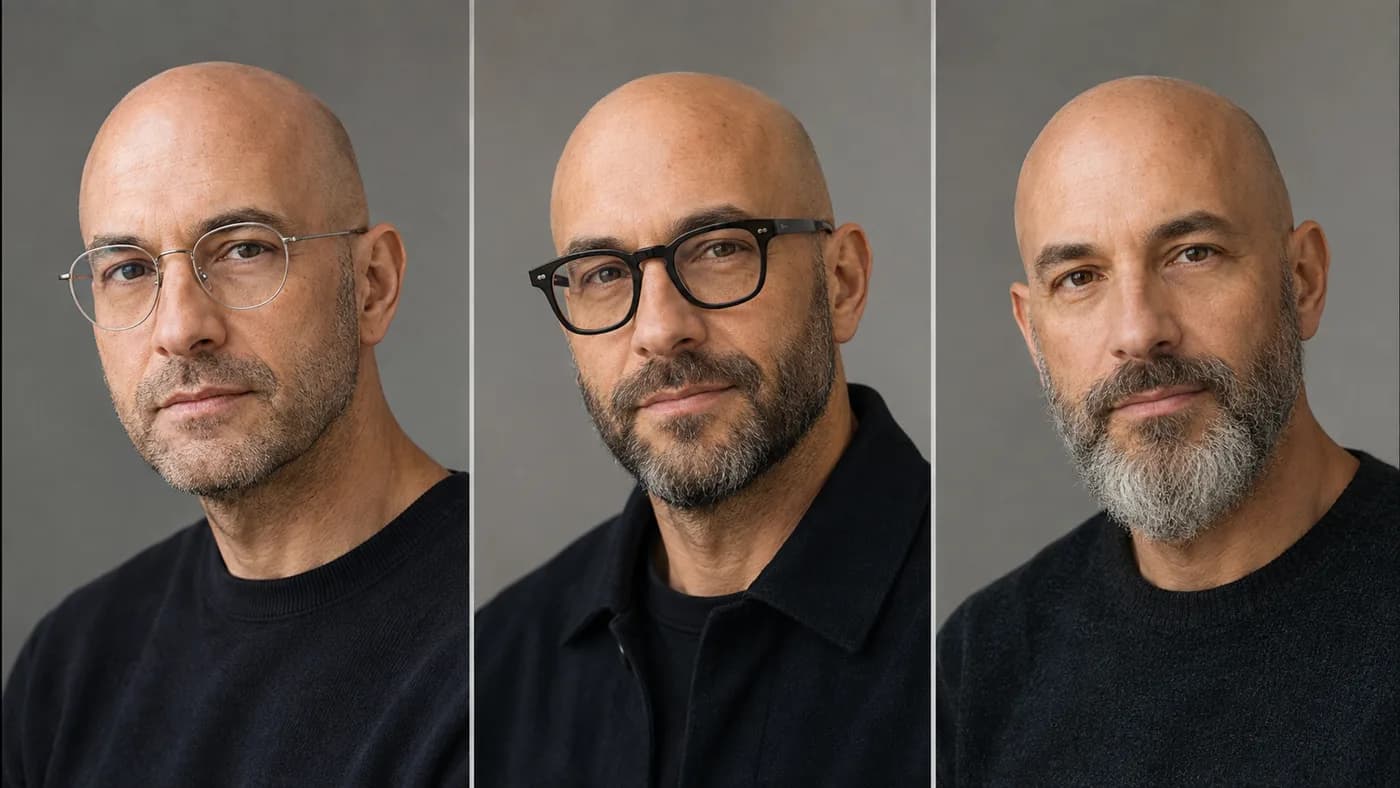
Heavy black or thick acetate frames add a strong horizontal line at the brow. Let your natural brows remain visible behind or above them, but avoid over-sculpting the brow into another dark, hard line. Thin metal or light-colored frames add less weight, so a naturally full brow can provide welcome structure. Our Bald With Glasses guide covers frame shape and fit; here, the key is avoiding three competing brow lines: eyebrow, frame top, and sharply drawn grooming edge.
If you have a beard
A dense full beard pulls visual weight to the lower face. A well-kept, natural brow keeps the eyes present without needing to be darker or thinner. With stubble or a clean-shaven face, a slightly tidier brow can become a useful upper-face anchor. Do not match beard sharpness exactly: a polished beard neckline and softly groomed brows are often a more relaxed pairing than two severe outlines.
If your contrast is high or low
Dark brows against light skin, a dark beard against a lighter scalp, or bold black frames all create high contrast. In that case, do less grooming—the brows already read clearly. If your brows, beard, and skin are closer in value, clean direction and sensible glasses can improve definition without adding artificial color. The goal is harmony, not maximum contrast in every feature.
When a professional shaping appointment helps
A barber, experienced brow groomer, or licensed threading professional can be useful if you have very dense growth, do not know where to stop, or want a clean baseline to maintain yourself. Ask for a natural men’s cleanup, not a thinner shape. Say you want to keep the width and arch, remove only obvious strays, and trim length conservatively.
Threading can be precise for eyebrows, but technique matters. The American Academy of Dermatology notes that threading can be a precise option for brows; inexperienced hands can leave them uneven or lead to ingrown hairs (AAD hair-removal guidance). If you use a service, choose someone whose work looks natural and hygienic, and do not schedule your first appointment immediately before an important photo.
Skip wax, strong depilatory creams, or any unfamiliar procedure around the eye area just to solve a few strays. Precision and skin comfort are more useful than a dramatic short-term result.
A simple photo test before you overthink it
Brows look different under bathroom lights, outdoor shade, and a phone camera. Take three quick photos: a front-facing window-light photo, a three-quarter portrait with your regular glasses, and a normal-distance image in the outfit you wear most. Compare the whole face. Are your eyes visible? Do glasses and beard feel balanced? Do the brows look like you, only a little more awake?
BaldLooks Free Analysis gives you a bald-look report from one photo. If you want to explore the wider combination, paid BaldLooks plans let you compare shaved-head looks across angles, outfits, locations, beard choices, and glasses—so you can decide where facial-detail grooming actually matters instead of changing everything at once.
The practical takeaway
Eyebrow grooming for bald men works best when it is almost invisible. Brush the hairs into place, trim the few that overhang, remove only clear strays, and let your natural thickness, gray hairs, and small asymmetries remain. Then assess the brows alongside your glasses, beard, scalp finish, and usual clothing. A balanced brow will not call attention to itself—it simply helps the whole face look deliberate.