
Bald With a Full Beard: Strong Look or Too Much?
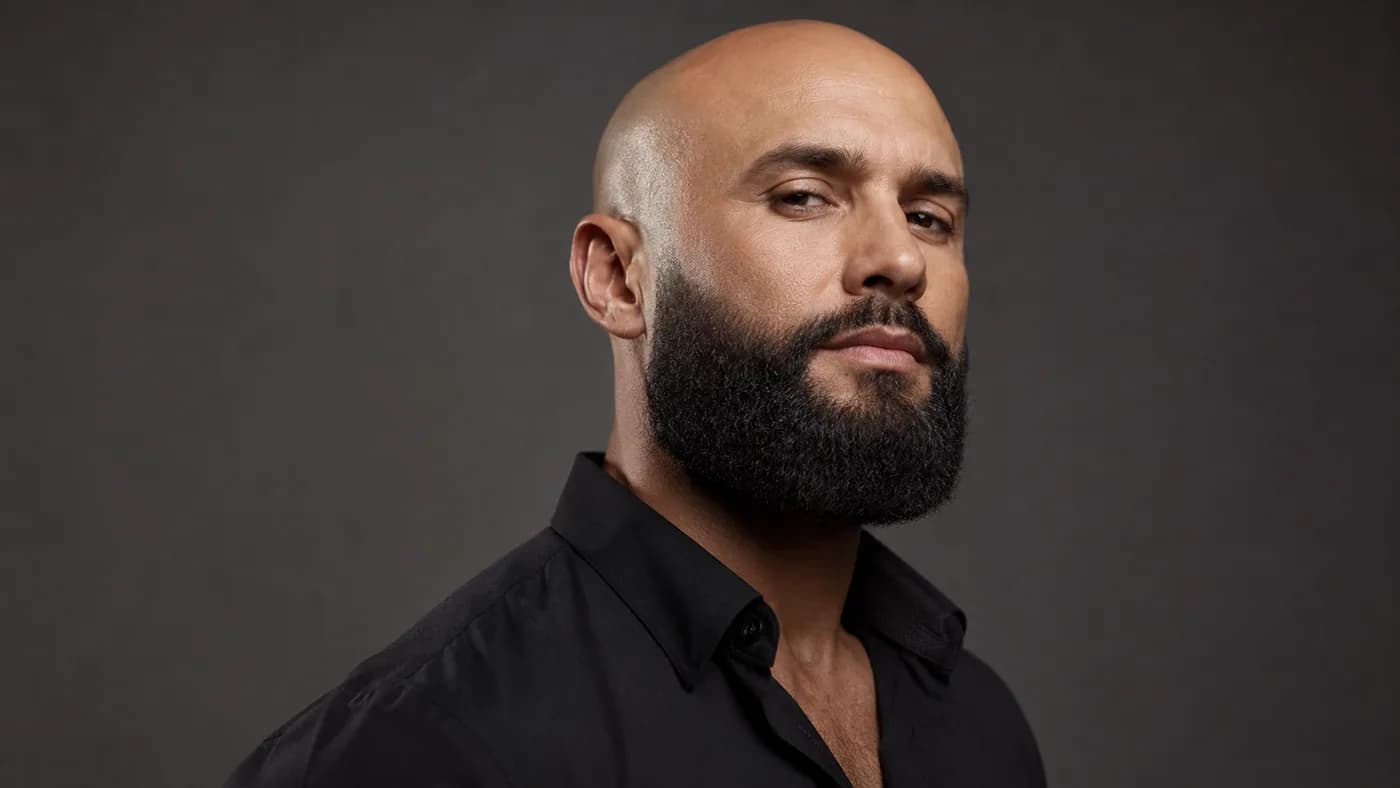
If you are considering bald with a full beard, you want to know whether your beard makes the shaved look more balanced—or simply makes the lower half of your face too heavy. It can add jaw definition and deliberate ruggedness, but it can also make a round face look wider or demand more upkeep than you want.
Quick read
A full beard should read as even and intentional from normal distance. If it only works in a close mirror, a shorter style may be stronger.
The right width, neckline, and chin length can balance a shaved head; unchecked side bulk usually does the opposite.
Stubble, a goatee, and a short boxed beard may give you the same definition with less visual weight and upkeep.
Quick answer: a full beard can make a bald head look excellent
The combination works best with dense cheek, jaw, and chin growth, a deliberate outline, and a beard shape that supports your face.
Full does not mean untrimmed
The strongest full beard is rarely the biggest beard. It has enough density to create a clear silhouette, but enough shape that people notice your face before they notice a block of facial hair.
For a broad overview of all beard directions, start with Bald Men With Beards. This guide is for deciding whether the full-beard version is the one to commit to.
Does your face shape suit a full beard?
Face shape is a starting point, not a verdict. Your beard density, glasses, jaw, and personal style matter too. But the outline you create with a full beard can either move your proportions toward balance or exaggerate what is already strongest.
GQ's beard guide by face shape makes the useful general point: rounder faces often benefit from controlled sides and more length below the chin, while longer faces usually need the opposite. With a bald head, those adjustments are even easier to see.
| Face shape | Full-beard opportunity | Shape to test | Avoid |
|---|---|---|---|
| Round or soft | Adds structure and chin presence | Keep sides neat; add a little length below the chin | Wide, puffy cheek bulk |
| Oval | Most flexible | A tidy, natural full beard with gentle edges | Growing it long only because you can |
| Square | Can look especially strong | Round the lower corners slightly; keep width controlled | A sharp box that makes the jaw overly blocky |
| Long or rectangular | Still workable, but needs restraint | Keep the bottom shorter and allow modest side fullness | A long, narrow beard that stretches the face |
| Triangle or very wide jaw | Use carefully | Keep the cheeks cropped and taper inward | Extra width at the jaw corners |
For a round face, see beard styles for bald men with round faces. Use the wider bald beard styles by face shape guide as a testing map instead of forcing a label.
The density check: can your beard carry the look?
A full beard needs enough connected growth across the cheeks, jaw, mustache, and chin to form one believable shape. Assess it honestly after two to four weeks:
- Look from conversational distance. If the cheeks disappear while the chin remains heavy, the style may need to be shorter or more focused.
- Check both sides in daylight. A large density mismatch is a cue to choose a style that uses your strongest areas.
- Judge the neck separately. Neck growth adds volume, not structure.
Patchiness is not a reason to force a full beard
If your density is uneven, heavy stubble, a compact goatee, or a beardstache can look more deliberate than a longer beard that exposes every weak patch. See Bald With Stubble and Bald With a Goatee before treating fullness as the only goal.
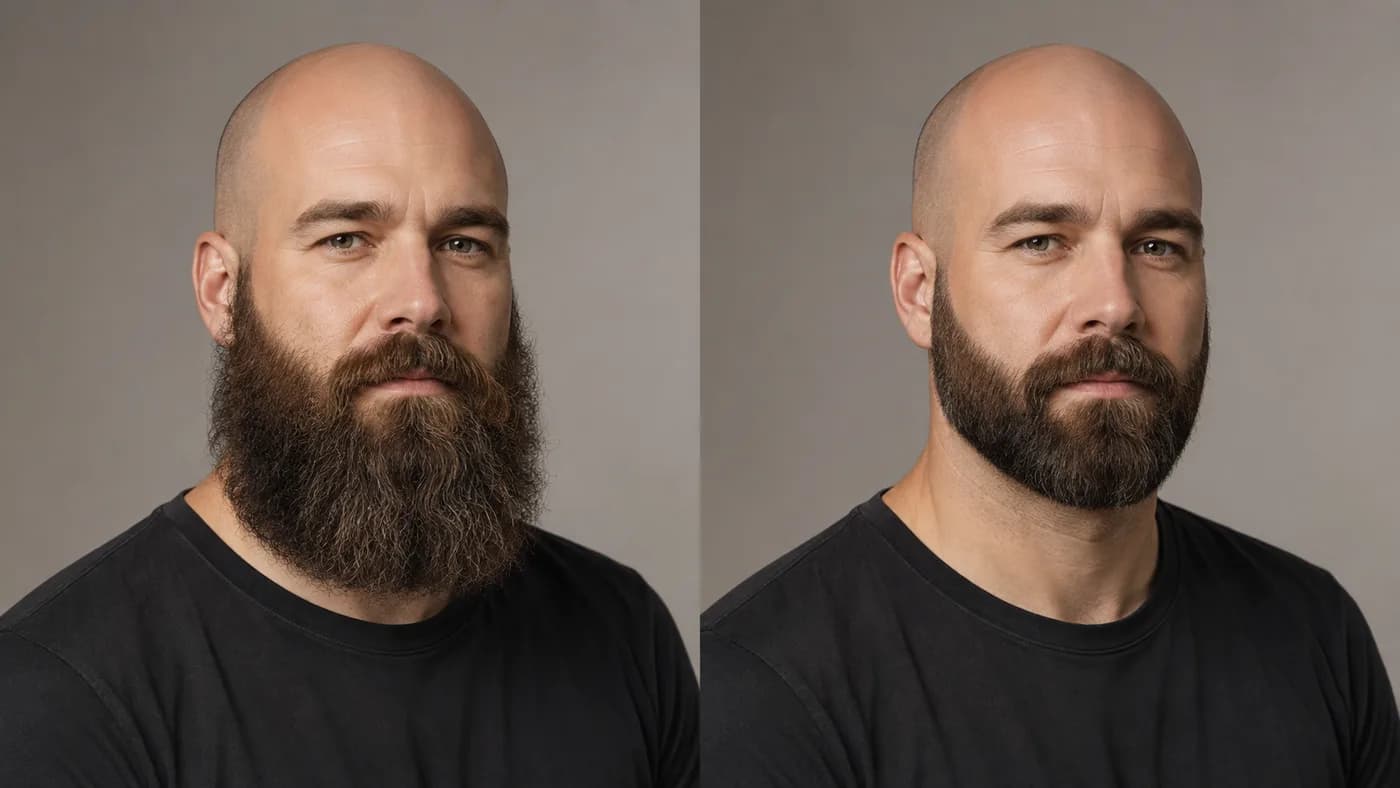
Full beard vs stubble vs goatee: choose the right amount of facial hair
Do not choose a full beard just because bald men are often shown with one. You may get a better result with less facial hair.
Choose the full beard only if it looks even and balanced. Choose stubble for lighter contrast, or a goatee when your cheeks are weaker and you want chin focus.
Grooming a bald full beard so it looks intentional
The full-beard look succeeds or fails on maintenance. You do not need a complicated product shelf, but you do need a routine that protects both the beard's outline and the clean scalp above it.
- Set the neckline first. A beard without a neckline can make the jaw disappear into the neck. Gillette's neckline guide recommends a distinct boundary and regular trimming beneath it. Start conservatively: it is easier to remove more hair than regrow a line set too high.
- Control side width before bottom length. Removing cheek and jaw-corner bulk often improves a too-large beard more than shortening the chin.
- Keep beard and scalp as one look. Wash and soften wiry beard hair, and keep the scalp moisturized and protected. See Bald Head Care Routine for the scalp side.
- Use normal-distance photos. A front and three-quarter view in daylight reveal whether the beard overwhelms your face, collar, or glasses.
A low-risk way to test the full-beard look
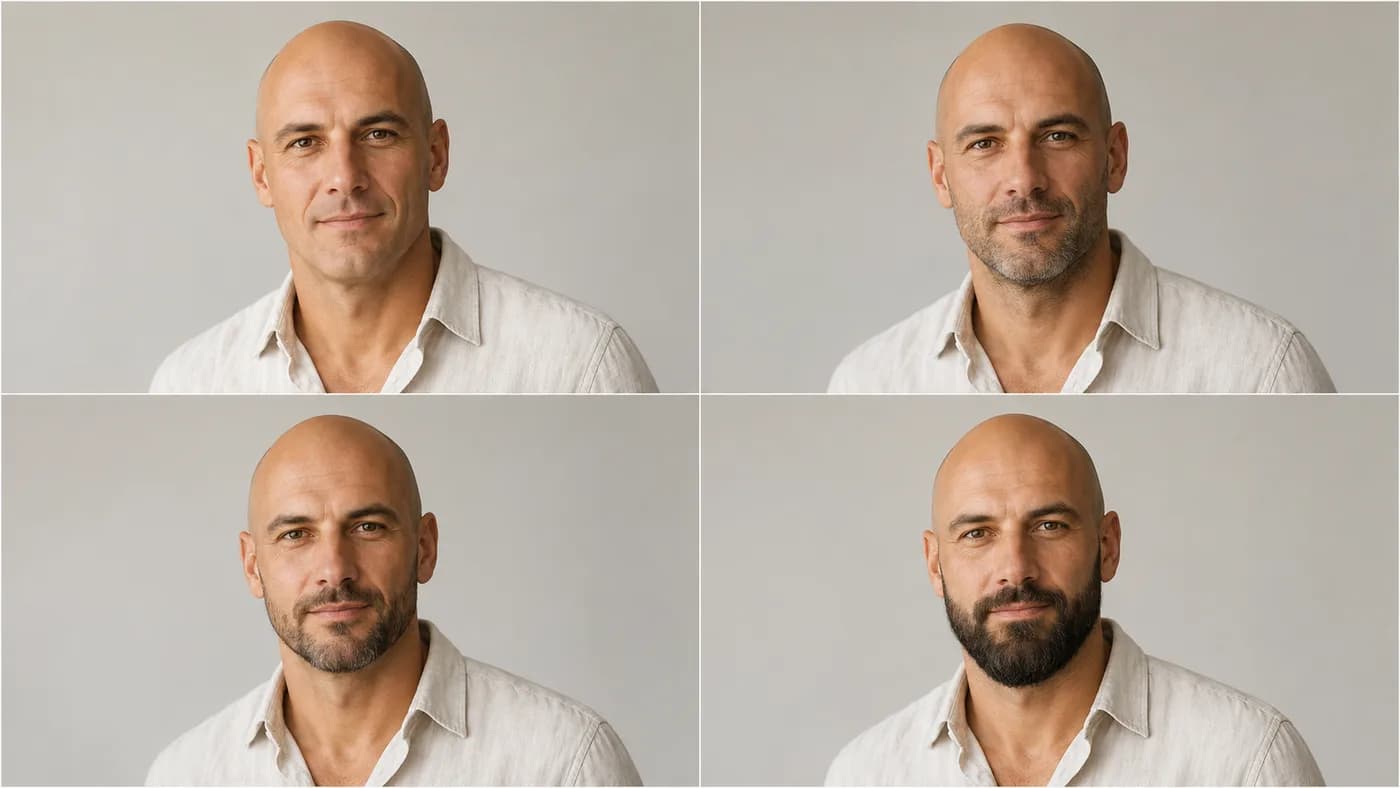
Before you grow for months or reshape your beard, compare clean-shaven, stubble, short-boxed, and full-beard versions from the same clear, front-facing photo. Include your usual glasses, shirt collar, and expression.
BaldLooks Free Analysis can give you a first bald-suitability read from one photo. If you want to judge a full beard with a shaved head more confidently, BaldLooks paid plans let you compare your bald look across different angles, facial-hair variations, outfits, and locations. That is a much better test than imagining a beard from someone else's face.
The bottom line
Bald with a full beard can be a strong, confident look when it gives your face purposeful lower-frame definition rather than sheer bulk. Dense growth, a clean neckline, controlled sides, and a shape that respects your face proportions are the difference between rugged and overdone.
Start smaller than you think. Let the beard prove that it improves your balance before you add more length. If it does, a full beard can become the signature detail of your shaved-head look. If it does not, stubble, a short boxed beard, or a goatee may give you a cleaner—and better—answer.