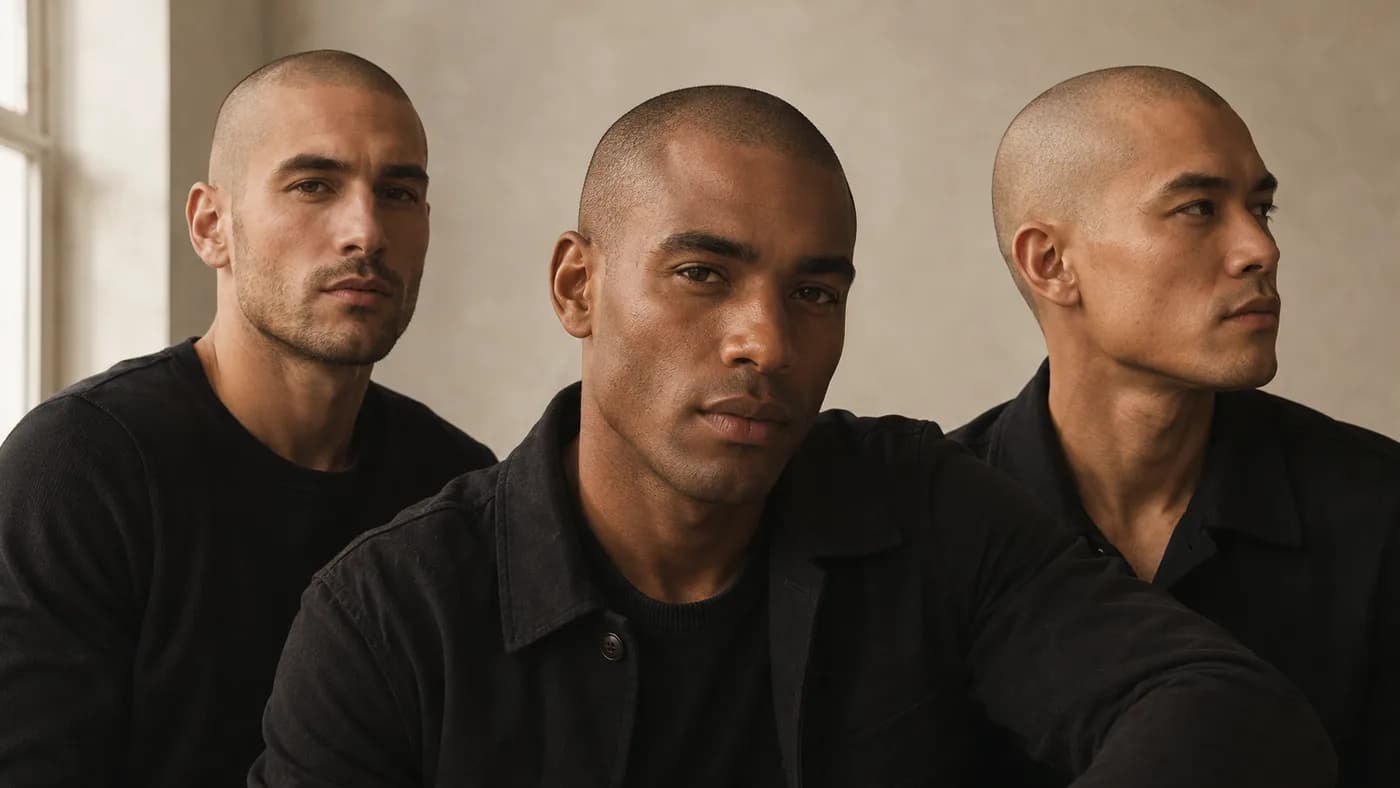
If you are searching for the best head shape for bald, you may be hoping for a simple checklist: round skull, strong jaw, small forehead—approved; everything else—not approved.
That is not how a shaved head works in real life.
There is no single best head shape for a bald head. What people usually respond to is overall balance: how your scalp silhouette, face, beard, eyebrows, glasses, skin, and current hair all work together. A man with a slightly flat back of head can look great bald; a man with a conventionally round head may still prefer a short buzz. The more useful question is not “Is my skull perfect?” It is: does a shaved look make my whole face feel clearer and more intentional than my current hair does?
Quick read
Natural asymmetry, a flatter area, or a visible bump rarely decides the look alone. Your face and styling change what people notice first.
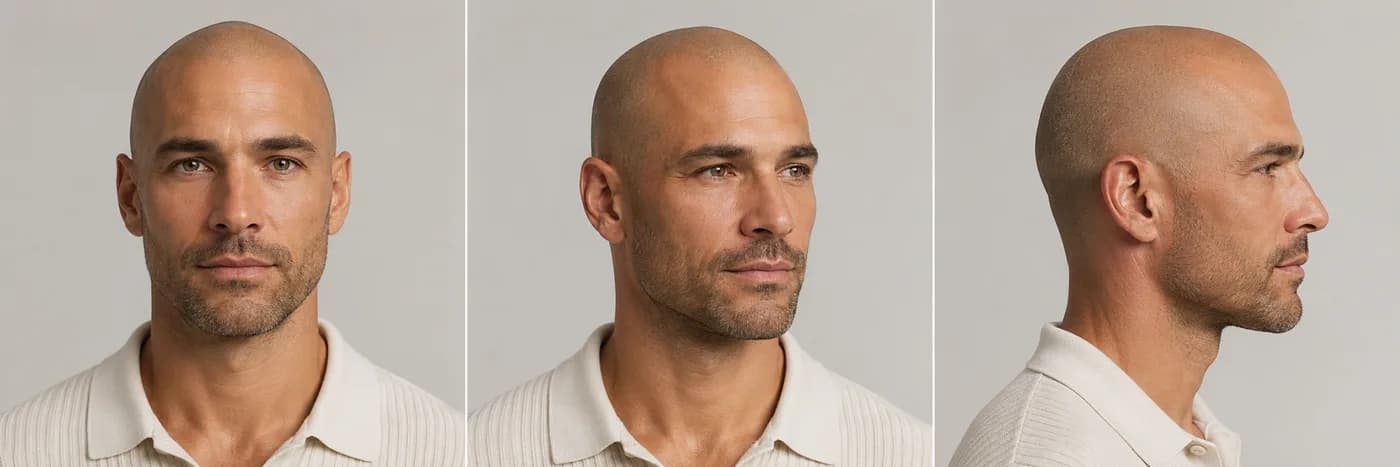
Front, three-quarter, and side angles reveal forehead balance, profile, and the back of the head far more honestly than one bathroom mirror.
A shaved head does not have to beat your teenage hair. It only has to work better than your current hair, styling effort, and hair-loss pattern.
Quick answer: what head shape looks good bald?
The head shapes that tend to look best bald are not a narrow category. A reasonably balanced front-to-back outline helps, but the final impression depends just as much on facial structure and contrast. A defined jaw, noticeable brows, a beard, glasses, or well-kept skin can all make a shaved head feel complete.
It also matters what you are shaving. The American Academy of Dermatology notes that male pattern hair loss commonly develops slowly, often starting with a receding hairline or thinning on top. When hair has become uneven, wispy, or hard to style, removing it can make the entire outline look more even—even if you have concerns about head shape.
So do not compare bald only with a dense-haired model. Compare it with the hair you have now.
The six things that matter more than “perfect” head shape
1. Your overall silhouette from three useful angles
A bald head exposes the outline that hair used to soften. That is why the front view, side profile, and three-quarter view all matter.
- Front view: Look for proportion between the width of your head, forehead, cheekbones, and jaw. It does not need to be symmetrical to the millimeter.
- Three-quarter view: This is often the most realistic social angle. It shows how the forehead, brow, nose, cheek, jaw, and scalp curve work together.
- Side profile: This is where men tend to worry about a high crown, a flatter back, or a bump. A close buzz is useful here because it reveals structure without showing every contour as sharply as a razor shave.
Small uneven areas are normal. Most heads are not perfectly round, and most faces are not perfectly symmetrical. In fact, a PubMed-indexed study found facial symmetry and attractiveness were not strongly linked in its sample, even though symmetry affected perceived health. That is a useful reminder not to turn a tiny asymmetry into a verdict about your appearance.
Do not let one bad selfie diagnose your head shape
A phone held too close can enlarge the center of your face and flatten the sides. Harsh overhead light can make the scalp look bumpier and shinier than it does in person. Use a little distance and even daylight before you decide a contour is a problem.
2. The relationship between your forehead and your face
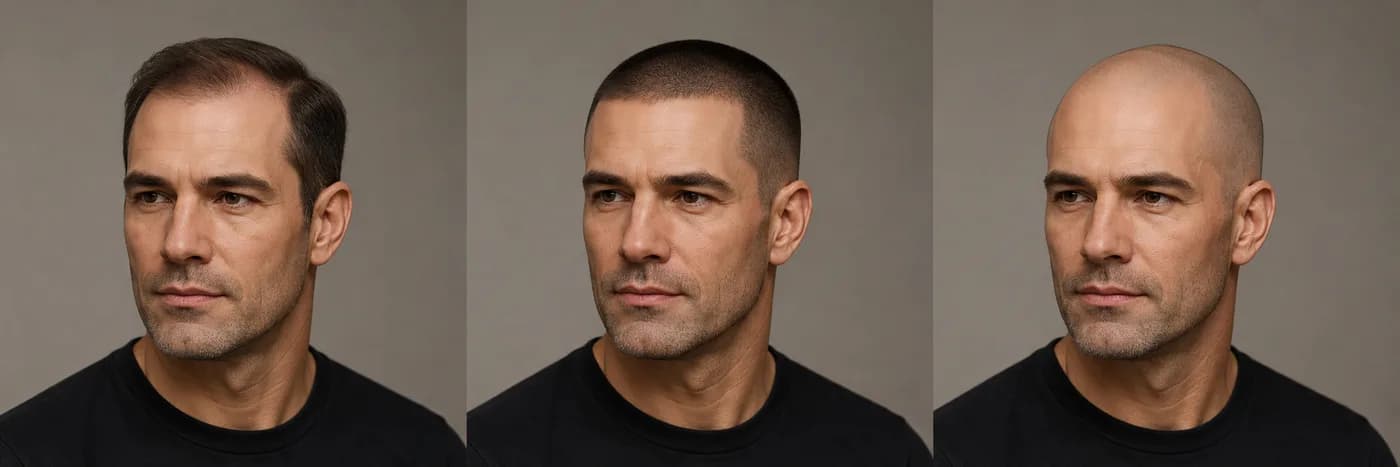
A large forehead is one of the most common fears behind the search for a bald head shape. Hair can feel like a lid that controls the top third of the face, so removing it may initially make the forehead feel bigger.
But “more forehead visible” is not the same as “worse.” If your hairline is receding, thin, or uneven, the sharp contrast between dense hair and exposed skin may already be pulling attention upward. A clean shave removes that broken edge. For some men, that makes the face read as simpler and more balanced.
Judge forehead balance with these questions:
- Does the shaved or buzzed version make your eyes and brows easier to notice?
- Does a receding hairline currently create a stronger distraction than a fully visible forehead would?
- Do your normal glasses, beard, or clothing add enough definition around the face?
- Does the result feel strange because it is new, or genuinely out of proportion after a few different photos?
If your forehead is the main concern, a realistic preview is more reliable than judging yourself against celebrity examples with different facial proportions.
3. Jawline, chin, and lower-face weight
Once hair is gone, the lower half of your face does more visual work. That does not mean you need a movie-star jawline. It means that if your jaw or chin is softer, you may prefer to add structure elsewhere instead of assuming bald is off-limits.
Stubble, a short boxed beard, or a compact goatee can change the balance quickly. The goal is not to hide your face; it is to give the eye a clear frame from scalp to jaw.
GQ’s face-shape guide makes the same broader grooming point: beard shape and glasses can be chosen to add length, width, softness, or definition depending on the face. Use that as a starting hypothesis, not a rulebook. A long beard can make an already long face feel longer; a very wide beard can make a round face feel wider. Your own preview is the tie-breaker.
| If your face feels… | A practical bald-pairing test | Watch for |
|---|---|---|
| Round or soft | Keep beard sides neat and add a little chin length; try angular glasses | A beard that grows too wide at the cheeks |
| Long or narrow | Try even stubble or a short, fuller beard with modest chin length | A long pointed beard that adds more length |
| Square or strongly angular | Test clean-shaven, stubble, then a compact beard | Heavy beard lines that make the face feel too blocky |
| Weak chin or lighter jaw | Compare dense stubble, short beard, and a neat goatee if cheek growth is patchy | Letting an uneven beard grow long without shape |
For a deeper read on the pairing, see Bald With Stubble, Bald With a Goatee, and Bald Men With Beards.
4. The back of your head, bumps, and asymmetry
This is the part most people mean when they ask about the “best head shape for shaved head.” They are not really asking about face shape; they are asking whether the back looks flat, the crown is high, or there is a bump they cannot stop noticing.
Here is the realistic answer: a smooth shave makes contours more visible, but it also removes uneven hair coverage that can exaggerate them. A flatter back is not automatically unflattering. A bump is not automatically obvious. People see your expression, posture, and grooming in motion—not an isolated side-profile screenshot paused at its least flattering moment.
Try a transition instead of an all-or-nothing decision:
- Start with a #2 buzz if you have enough hair for it.
- Move to a #1 if the shorter version looks cleaner and you want a clearer shape read.
- Compare that photo with a clean-shaved preview.
- Decide whether the smooth finish improves the look or whether the small amount of texture from a buzz is your better style.
This is exactly why Buzz Cut vs Bald is often a more useful next read than generic reassurance. Both can look intentional; they just reveal different amounts of scalp texture and contour.
5. Glasses, eyebrows, and contrast
Hair provides automatic contrast at the top of the face. When you shave, the eye naturally goes to the eyebrows, eyes, beard, glasses, and skin.
That is good news because contrast is adjustable. If you wear glasses, try the bald look with the frames you actually use. Medium-weight frames with enough structure can anchor the face, while frames that are extremely oversized or too narrow can make the proportions feel off. Bald With Glasses has a more complete guide to choosing frames by face shape.
You can also improve the result without changing your identity:
- keep brows tidy without over-shaping them,
- maintain a clean beard neckline if you have facial hair,
- use shirts, jackets, or collars with some structure near the face,
- and look after the scalp as carefully as you would your facial skin.
The AAD recommends protecting exposed or thinning scalp from the sun. That includes broad-spectrum sunscreen or a hat outdoors. It is practical health advice, but it helps the look too: sunburn, dryness, and uneven tone make any shaved head harder to judge fairly.
6. Whether bald is better than your current hair
This is the variable that online “head shape” advice misses.
A bald head on someone with dense, healthy hair is a pure style choice. A bald head on someone whose hairline is breaking up, crown is thinning, or top is visibly diffuse is a comparison between two different kinds of honesty. One may look more polished simply because it stops pretending the thinning is not there.
If your hair loss is sudden, patchy, painful, itchy, or otherwise unusual, do not treat a haircut guide as medical advice. The AAD’s symptom overview notes that hair loss can also appear suddenly and dramatically, which is a reason to get professional medical input. But for gradual styling frustration, it is fair to compare the practical options: keep it, cut it short, buzz it, or shave it.
A realistic bald head-shape self-check
Use this before you make the decision emotional. Check each item, then look at the pattern rather than searching for one flaw.
When a buzz cut may be the better first move
Choosing a buzz does not mean you are avoiding the bald look. It can be the most practical diagnostic step when you have a very fair scalp, visible contours you have not seen before, or simply want a slower transition.
A #1 or #2 buzz gives you:
- a cleaner outline than longer thinning hair,
- enough texture to soften scalp shine and minor contours,
- a chance to test beard and glasses balance,
- and an easy path toward shaving later if the shorter direction feels right.
Read Buzz Cut for Balding Men if hair loss is the main driver, or Will I Look Good Bald? if you want the bigger style-and-confidence framework.
The bottom line
The best head shape for bald men is not one perfect skull type. A shaved head works when the overall balance works: scalp outline, forehead, jaw, beard, glasses, brows, skin, and your current hair all contribute to that impression.
Do not disqualify yourself over a flat spot, a bump, a large forehead, or an asymmetry that only shows up in one harsh selfie. Compare the look from several angles, try a buzz if you want a lower-commitment test, and judge the shaved version with the rest of your style in place.
The most personalized next step is BaldLooks Free Analysis: upload one clear photo for a practical bald-suitability read. If you want to make the real decision with more evidence, the paid plans let you compare your shaved-head look across multiple angles, outfits, and locations before you touch the clippers.