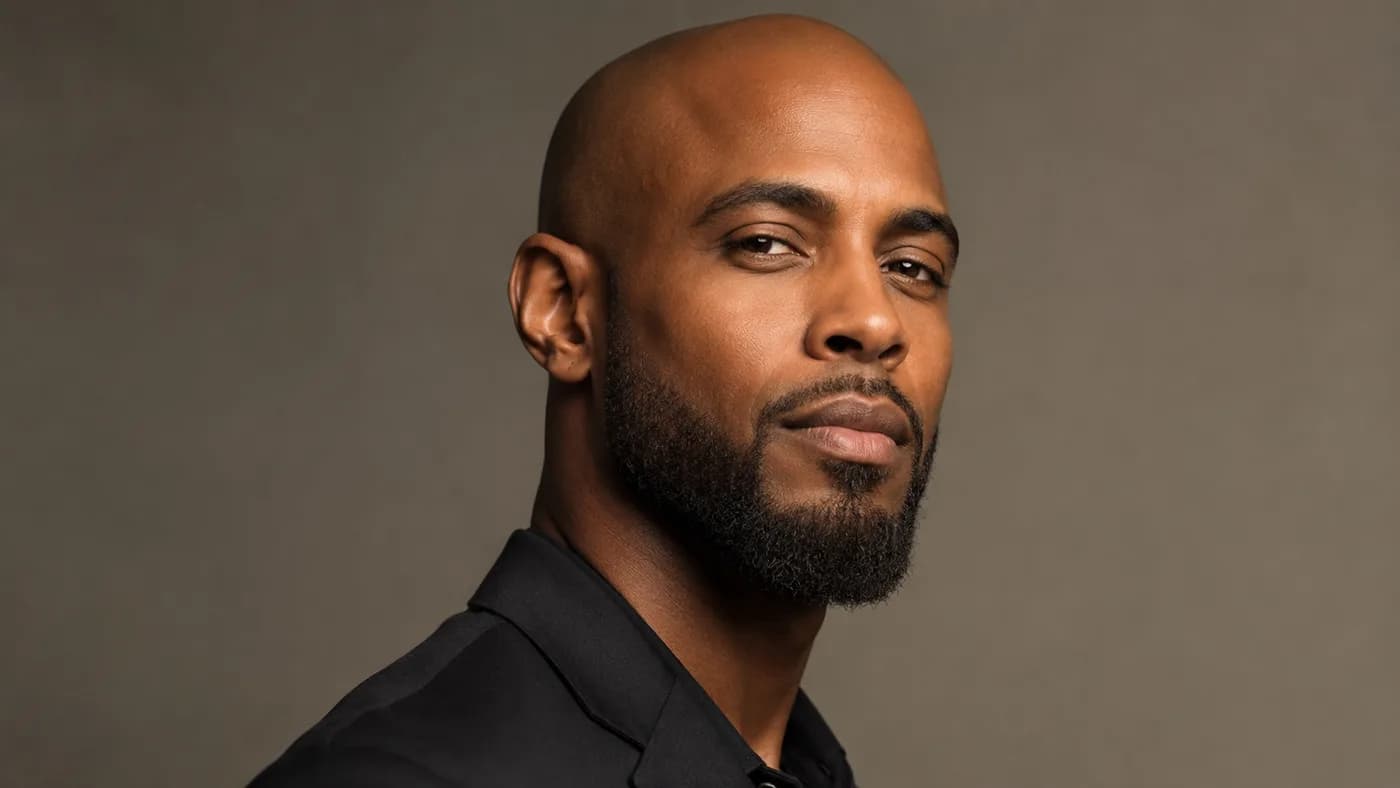
If you are searching for bald with a weak chin, you are probably not looking for someone to tell you that your face is a problem. You want to know whether shaving your head will put too much attention on your chin and jaw—and what you can do with facial hair if it does.
The reassuring answer is that a softer or less prominent chin does not disqualify you from a shaved head. Going bald changes the visual balance of the face because it removes hair from the top, but it also gives you a cleaner base to work with. A beard can add a lower-face anchor; the right shape can make the whole look feel deliberate.
The important word is shape. More beard is not automatically better. A full beard that is too wide can make the jaw look heavier. A pencil-thin goatee can make the chin look smaller. A tidy, chin-aware beard can be a useful style tool—not a disguise.
Quick read
The aim is to give the lower face a clear outline and a little visual weight, not to hide every feature under beard length.
For most softer chins, short cheeks with slightly fuller chin coverage create a stronger result than the same length everywhere.
A beard can look great front-on but add no useful projection from the side. Compare both views before committing.
Quick answer: the best bald beard styles for a weak chin
For most men, the safest starting points are a compact goatee, a short boxed beard with a little extra length at the chin, or a beardstache with controlled chin coverage. Each gives the eye a lower-face focal point without asking you to grow a huge beard.
Use this simple rule:
- Choose a goatee when your chin growth is stronger than your cheeks and you need focused definition.
- Choose a short boxed beard when you want a little more jaw support as well as chin presence.
- Choose a beardstache when your mustache is strong and you want a bolder look without much beard bulk.
- Choose heavy stubble when you want a low-risk first test, not a major reshaping move.
The short boxed beard is popular partly because clean cheek and neck edges make its outline easier to control. That principle matters more than the style name: the outline should add intention around your lower face, not blur into your neck.
A weak chin is a proportion question, not a verdict
Many men use “weak chin” to mean different things: a chin that sits back slightly in profile, a jawline with soft definition, a rounder lower face, or simply a face that feels less structured after shaving. One beard will not solve every version. Test the proportion you actually want to change.
Why a shaved head can make the chin feel more noticeable
Hair normally creates height and visual activity above the face. When it is gone, the eyes move more quickly between the forehead, eyes, nose, mouth, and jaw. That can be a benefit: a clean shaved head often makes the face look clearer and more confident. But it can also reveal that the lower face needs a little more visual support than it did with hair on top.
That is where beard design helps. Facial hair changes contrast and outline. A darker, tidy shape below the mouth can make the chin area read more clearly. Keeping the cheeks tighter while leaving a little more density through the chin draws the eye downward in a controlled way.
This is styling, not bone-structure surgery. It will not change your anatomy, and it does not need to. You are simply deciding where the visual weight of the finished bald look should sit.
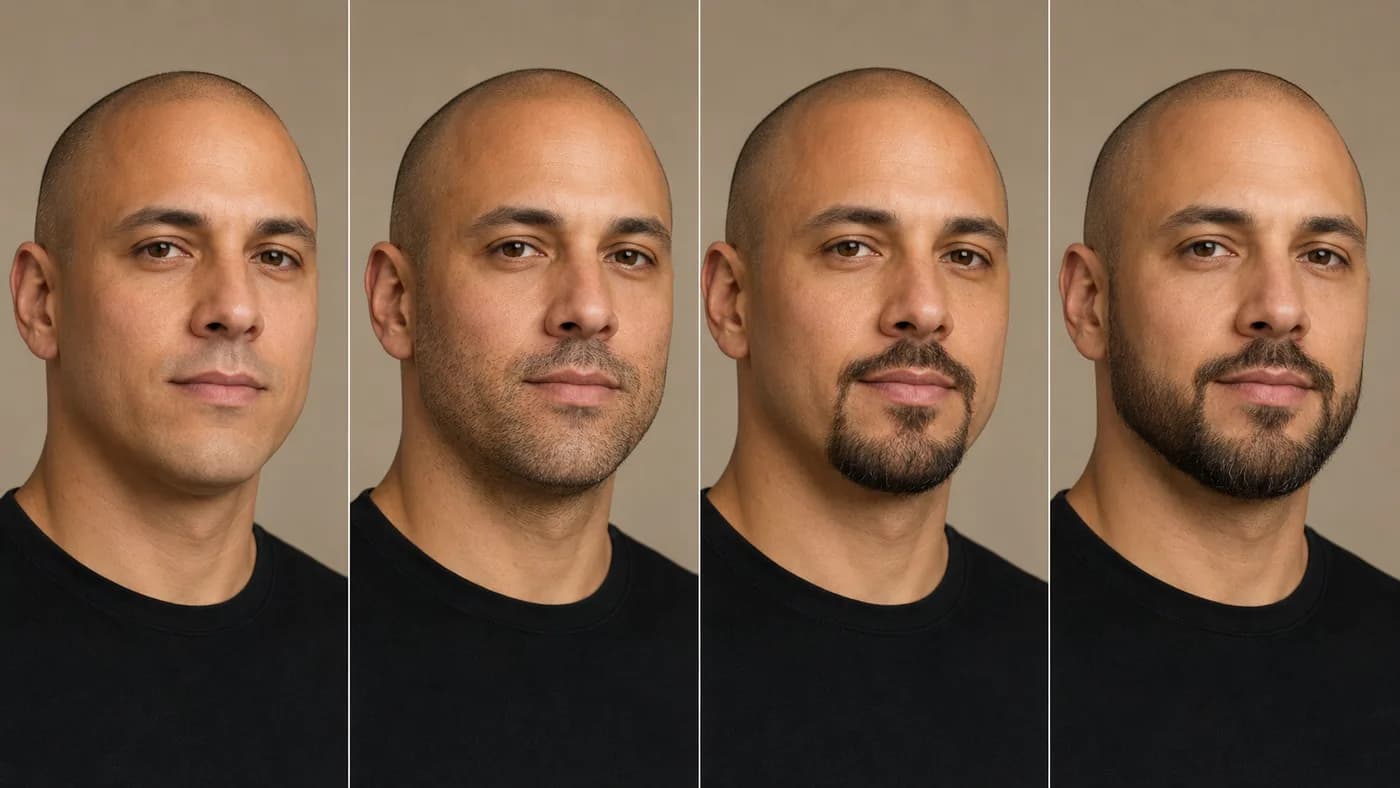
The four best beard directions to test
1. Goatee: best for focused chin definition
A goatee is often the first style people think of for a weak chin, and it can work very well. It puts visual weight exactly at the center of the lower face, especially if your mustache and chin area grow more densely than your cheeks.
The catch is that it is a precision style. Keep the goatee too narrow and it can look fragile. Grow it too long and pointy and it can pull the face downward without creating useful jaw support. A compact circle beard or slightly broader goatee is usually safer than a thin, isolated chin strip.
For the details, see Bald With a Goatee. It is especially useful if your weak point is chin emphasis rather than a lack of width along the jaw.
2. Short boxed beard: best for chin and jaw support
If your chin is not the only concern—perhaps your jawline feels soft too—a short boxed beard is normally the more balanced option. It gives the eye a clean edge along the lower face, but it should not be the same bulky length everywhere.
Ask your barber, or set your trimmer, to keep the sides short and allow only a subtle increase toward the chin. This creates a modest forward-and-downward emphasis without turning the beard into a heavy block. The neckline matters here: a low, fuzzy neckline adds volume under the chin, which is the opposite of the shape you want.
3. Beardstache: best when the mustache is your strength
A beardstache is a fuller mustache paired with shorter beard growth. It is not the obvious weak-chin solution, but it can be excellent if you have strong mustache density and do not want your beard to dominate your face.
The mustache creates a strong horizontal feature; the short beard and modest chin coverage stop the look from feeling top-heavy around the mouth. It is more style-led than a boxed beard, so it works best when the mustache genuinely grows in well. If it does, Bald Beardstache explains how to keep the contrast intentional.
4. Heavy stubble: best for a cautious first experiment
Heavy stubble will not add as much projection as a boxed beard, but it is the easiest way to find out whether lower-face contrast helps your shaved look. Start around a consistent 3–5 mm, clean up the neckline, and take photos in daylight.
If the result already feels more balanced, you may not need a more involved beard style. If it looks better but still a little flat around the chin, that is a useful signal to test a goatee or short boxed beard next. Shaved Head With Stubble has the practical trimming details.
What to avoid when your goal is better balance
The wrong beard does not make you look bad; it just may not solve the style issue you are trying to solve.
| Avoid | Why it can work against you | Try instead |
|---|---|---|
| Very thin chin strip | It can make the chin look more isolated than defined | A compact goatee with enough width to read clearly |
| Same long length across cheeks and neck | It adds bulk rather than a purposeful outline | Shorter sides and a little more chin density |
| Low, fuzzy neckline | It creates visual weight under the jaw instead of along it | A tidy neckline that follows your natural jaw-to-neck transition |
| Overly pointed, long goatee | It can make the face look longer without adding support | A rounded or squared-off compact goatee |
| Forcing a sparse full beard | Patchy cheeks can make the beard look unfinished | Heavy stubble, goatee, or beardstache that uses your strongest growth |
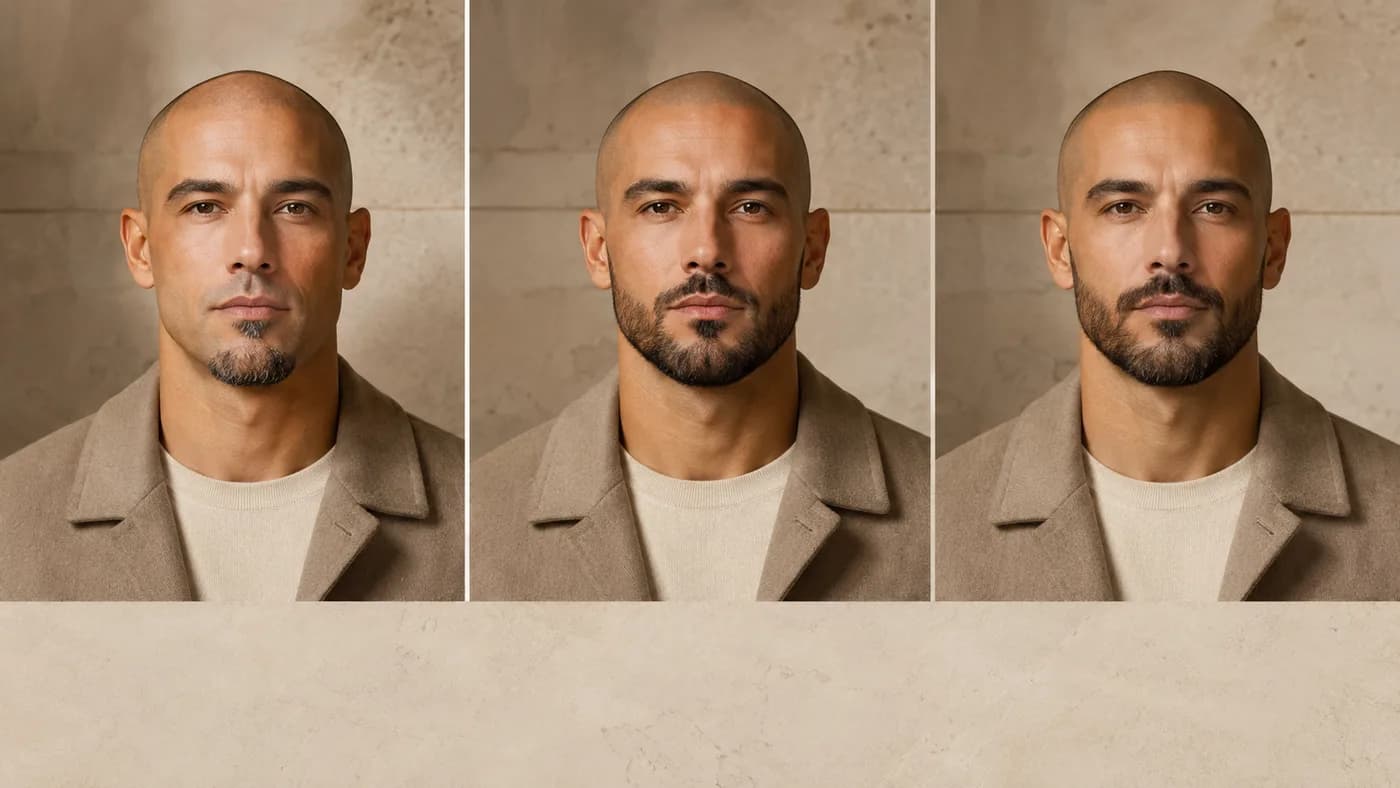
Small styling choices that help the whole bald look
Beard shape does most of the work, but it is not the only lever.
Keep the scalp and beard grooming rhythms aligned. A freshly shaved head beside an untrimmed beard looks accidental. A clean scalp and a controlled beard read as one chosen look.
Use glasses as a frame if you wear them. Medium-weight frames can give the upper face a little structure and create a useful counterweight to lower-face beard definition. The right pair should support the beard, not compete with it. Bald With Glasses can help you think through that combination.
Do not over-correct with clothing. Structured collars, a well-fitting T-shirt, and simple layers can make the whole silhouette feel sharper, but you do not need to dress like a different person to make a shaved head work. The goal is consistency, not costume.
Take normal photos before deciding. Bathroom mirrors and dramatic lighting are unreliable. Look at a front photo, three-quarter photo, and relaxed side profile in daylight. That is the evidence that matters.
A five-minute test before you trim or shave
If you are not ready to experiment in the mirror, use a clear photo first. BaldLooks Free Analysis gives you a quick bald-suitability read from one photo. When you want to compare a shaved head with beard directions, different angles, outfits, and locations, the paid BaldLooks plans give you a more complete visual test before you change anything for real.
Final answer
Being bald with a weak chin is not a style dead end. The best result usually comes from treating facial hair as a balance tool: keep the cheeks and neck controlled, put a little more visual weight where your chin or jaw benefits from it, and avoid growing extra length just because you think more beard must be better.
Start with heavy stubble if you are unsure. Move to a compact goatee if you need chin focus, or a short boxed beard if you want both chin and jaw support. Then judge the result in real photos, from the side as well as the front. Your own face—not a celebrity reference—is the right test.